
Three Ways of Taking Refuge
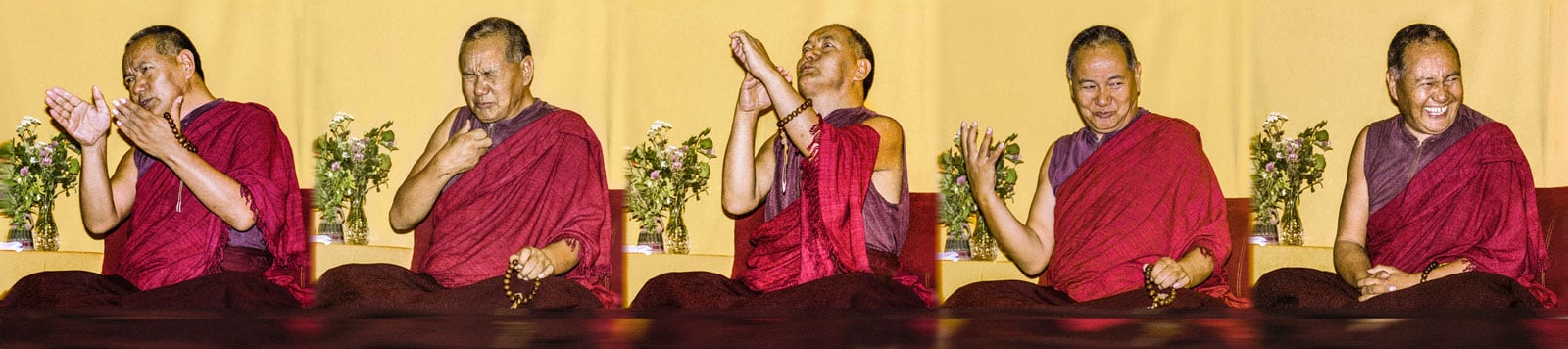
Lama Yeshe explains outer, inner and secret refuge, so that practitioners can choose the method best suited to their level of mental development. This teaching is excerpted from a Heruka Vajrasattva commentary given to students preparing for a retreat at Kopan Monastery, Nepal, in May 1974. Edited by Nicholas Ribush and published in chapter 12 of Big Love: The Life and Teachings of Lama Yeshe.

There are three ways of taking refuge: outer, inner and secret. Most people think that the sutra, or Paramitayana, way of taking refuge is the only one. That is what we call outer refuge and is the method usually explained when teachings on refuge are given. In outer refuge, the Buddha in whom we take refuge is somebody other than ourselves: a person who has attained buddhahood, an enlightened being such as Shakyamuni Buddha. The Dharma refuge in this system is the teachings given by that enlightened being. The outer Sangha includes the ordained and realized followers of the Dharma teachings ... Understanding that the already-existent Buddha, Dharma and Sangha have the power to guide us, and fearing the sufferings of samsara, we take refuge in them.
The other two ways of taking refuge are tantric methods. Inner refuge is taking refuge in the buddha you yourself will become. The wisdom of that, your own future buddha, is the inner Dharma refuge object. When you have attained that state, you yourself become Sangha: that is the inner Sangha refuge object. At that stage, you not only become Sangha, you attain unity with all Three Jewels of Refuge and no longer need to take refuge in something separate from yourself.
When you take inner refuge, your mind becomes transcendental omniscient wisdom; this transforms into the divine aspect of Heruka (or Vajradhara), along with the dakas and dakinis, the peaceful and wrathful bodhisattvas and so forth and you take refuge in that. To do this you need to have at least a deep intellectual understanding of the false conceptions and projections of your ego so that you can somehow purify these at the moment of taking refuge. You can see that this is quite difficult.
Secret refuge is the third way of taking refuge. This way of taking refuge is the most difficult of all. You have to recognize that your nervous system is pervaded by blissful daka-dakini energy instead of the usual ridiculous energy of gravitational attachment to sense pleasures, and you take refuge in that. Here you are utilizing your nervous system’s energy resources to generate simultaneously-born great bliss, which you unify with the wisdom of nonduality, taking it as the blissful path to liberation. This experience is really what liberates you from dissatisfaction and dualistic thinking ....
These three ways of taking refuge are entirely noncontradictory and have been taught so that practitioners can choose the method that best suits their level of mental development. Outer refuge is for the least developed; secret refuge for the fortunate, highly intelligent few.
If you understand the true meaning of taking refuge, you will know what a positive effect it has on your mind and experience its great benefits. You will really enjoy taking refuge, and every time you do, the pure energy of your innermost heart will grow. If you do not know how to take refuge properly, whatever meditation you do will be like snow on the road, which looks very impressive as it falls, but quickly disappears. Like that, your meditation will have no lasting effect. With a deep understanding of taking refuge, you will begin to taste the honey of Lord Buddha’s wisdom.1
Notes
1 This teaching is included in Becoming Vajrasattva (Wisdom Publications), pp. 29–30.