
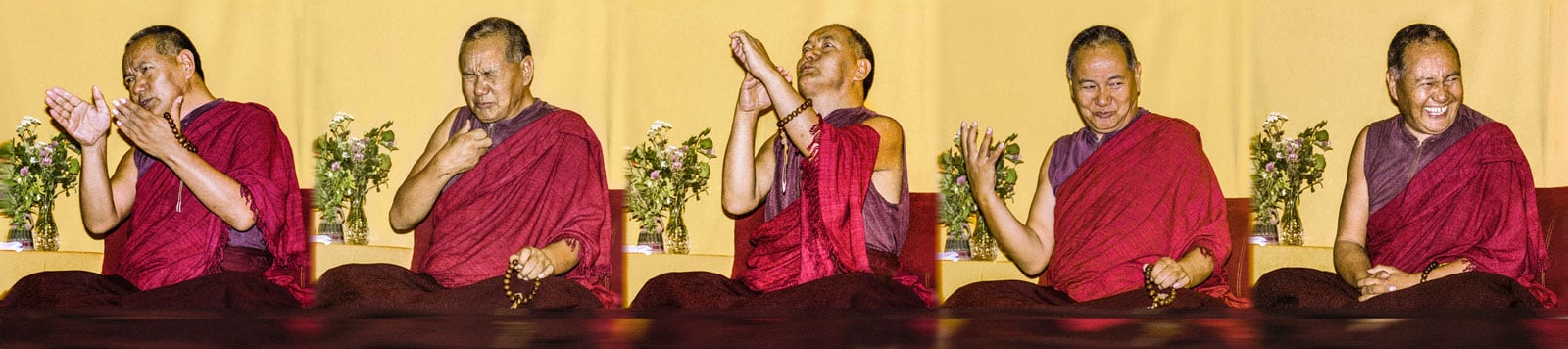
E-letter No. 59: April 2008

Dear Friends,
Thank you for subscribing to and reading our e-letter. Please try to share it far and wide.
What People Are Saying

We’re extremely gratified by the response to our new Lama Yeshe book, Universal Love. One person was reported to have called it the “best Dharma book I have ever read.” That, of course, is a very small sample.
Not so, however, the 650 people who have kindly responded to our online survey. Again, much helpful and positive feedback, for all of which we are very grateful. You can read the free-form comments from survey respondents, and also view the results to the multiple choice questions. If you have not taken the survey, please take the time to do so. Thank you again.
We would also like to thank the many people who responded to our appeal for support of Lama Zopa Rinpoche's new book Heart of the Path. As you can see, this is the ultimate distillation of Rinpoche thirty-five years’ teachings on guru devotion, the root of the path to enlightenment. We are so honored and happy to be publishing this book and delighted to offer everybody a chance to participate with us. Please do!
Prison Dharma
Every week we receive letters from prisoners and usually we pass these on to Liberation Prison Project, who do a wonderful job sending books and other materials to prisoners and communicating with them in various ways. They send thousands of LYWA books into prisons on our behalf every year. So I just wanted to share with you an inspiring letter we received recently. It speaks for itself.
Dear Sirs,
My name is James [last name withheld] and I am currently in prison in Georgia.
I found this book thrown away in the trashcan, in my dorm. I don’t pretend to try and explain why or how it caught my attention, only to say that it did, so I pulled it out and cleaned it off and put it in my locker box.
That’s been 10 months ago.

Recently this book again caught my attention. I don’t know if it was the picture of Lama Yeshe on the cover of the book; to me, that smile said, “I am free of pain.” And that is what I want: to be free of the pain my mind holds over me.
After reading the book Becoming Your Own Therapist, the expanded version with Make Your Mind an Ocean, my mind is asking me to find out more. The little peace that these two books gave me was like a drop of water in the hottest desert.
My mind is so full of pain and hate, loneliness and hopelessness. I could not see that before I read this book that was part of your free publications. Now I find my mind starving for better guidance to help me focus, to get rid of all the anger in there. I want to be able to smile like Lama Yeshe and tell the world without words that I am free on the inside and it shows on the outside.
I don’t know what I want. But I do know I wanted to say thank you for opening my eyes and to thank you for reaching out to us people who have given up hope, because now I can see the sun again, I can feel some love in my heart for other people that I don’t know, like you and Lama Yeshe.
Thank you. [Signed]
For those of you who know individuals who are practicing in prison, you can read or print out Lama Zopa Rinpoche's advice to prisoners in the Online Advice Book.
Recent Travels

In our previous e-letter I mentioned the death of my kind mother. I would sincerely like to thank everybody who sent condolences and other nice messages. Thank you so much. Her funeral was a great celebration of her life, with many people in attendance: family members and friends, former medical colleagues and, of course, all sorts of Dharma buddies from the FPMT, the Buddhist Society of Victoria and beyond. Our family was most touched by everybody’s kindness. Thank you again.
A couple of days after the funeral Wendy and I went to New Delhi for a week for some special teachings on emptiness by His Holiness the Dalai Lama at the Ashok Hotel. These wisdom teachings were organized by our friends at the Dalai Lama Foundation and the Foundation for Universal Responsibility of His Holiness the Dalai Lama and given to a relatively small gathering of about 150 people. His Holiness offered a brief commentary on the Heart Sutra and a more extensive explanation of chapters 26, 18 and 24 of Nagarjuna’s Fundamental Wisdom of the Middle Way. His Holiness also gave a White Manjushri je-nang and on the morning of March 29 led an interfaith prayer service at Raj Ghat for all those killed or otherwise harmed in the recent unrest in Tibet.

It was a wonderful experience to be with His Holiness in such a small gathering for four days. For example, during the break His Holiness remained on his seat and we could just go up and chat with him. One day I took the opportunity of having His Holiness bless my mother’s ashes. At the end we were also able to go up one by one to offer a khatag. An amazing week.
News Out of Tibet
With respect to the unrest in Tibet, after our last e-letter one person wrote to me expressing surprise that I had not mentioned what was going on in Tibet. I think if it had not been receiving the publicity it was I might have brought it to our readers’ attention but—fortunately, I guess—it was all over the media and the Internet and to this day remains on front pages everywhere. Since the situation is changing so fast, there’s not much point in our trying to report what’s going on. If, however, you have just arrived from another planet, you can visit the Office of Tibet, New York website for starters.
You can read the latest advice from Lama Zopa Rinpoche on the situation in Tibet on the FPMT website. I would also like to share with you a short prayer our resident teacher here in Boston, Ven. Geshe Tsulga, wrote a few years ago, which is more relevant today than ever:
Prayer for Peace and Freedom
Due to the great force of negative karma amassed in past lives,
In this life we Tibetans are undergoing great suffering.
May all the causes for this suffering finally be consumed
And may the happy sun of freedom dawn above us all.
The most salient supporting condition for the suffering of Tibetans
Are the Chinese, who are confused about what causes happiness and pain.
May they develop great loving kindness and compassion
Directed toward us Tibetans and all sentient beings.
We must recognize that we Tibetans viewing the Chinese
As our enemies and their viewing us with hatred and disdain
Will cause ceaseless suffering for all concerned. Knowing this,
Let us have love for one another like the love between mother and child.
Through the powerful reality of the Three Jewels and of relativity free from extremes,
And through the powerful truth of the unwavering causality of karma, good or bad,
May these aims that I have prayed for with a good heart
Come to pass right now without any hindrance.[Translated by John Dunne.]
Thank you again so much for your kind interest in and support of the Lama Yeshe Wisdom Archive.
Much love,

Nick Ribush
Director
Understanding attachment

It’s extremely worthwhile to understand the nature of your own self-cherishing and attachment.
Sometimes we think, “I want inner freedom; I want some kind of magic, higher meditation.” When we think like this we’re dreaming, not facing the reality of what we are right now. Because what we’re always dealing with in our life—with other people, with our mind, all the time, from when we were born until now—is attachment. All our problems—mental problems, external problems, internal problems, whatever we consider to be a problem, everything—come from attachment.
Understanding this fact is wisdom and the path to liberation, the vehicle that carries you to everlasting peaceful enlightenment. It’s so worthwhile.
Also, it’s so logical. You don’t have to believe in something that’s difficult to believe in; you don’t have to believe in anything. You can prove logically that attachment is the main problem, the principal cause of all your personal problems and the problems you have with those to whom you relate.
These are not merely dry words; they derive from life experiences. It’s very important to know this. That’s why Lord Buddha always emphasized understanding as the path to liberation.
These days in the West there are many books that talk about the magic and mystery of Tibet, so when people see that a Tibetan lama is coming to give a meditation course, they think, “Oh, maybe I can learn some magic” and attend with that expectation.
But we don’t need to teach you magic—your mind is already magic; the magic of attachment has been within you from the moment you were born. Magic is not the path to liberation; don’t expect me to do something funny. Some people do, you know. They expect lamas to do magic and make them hallucinate. Don’t expect that. Instead, simply understand what your life is, how complications arise, what it is that complicates your life, what makes you happy…these are the things you should understand. Then your being here becomes worthwhile. You’re not dreaming, you’re down to earth, and you’re realistic about the way to develop your mind. And with that attitude, you won’t be disappointed—you know what you’re going to do, what your trip is—meditation, spiritual practice or whatever.
Otherwise there’s a danger of doing things without really knowing what you’re doing. Many people are like that. Intellectually they say, “I want liberation, inner freedom, nirvana, enlightenment,” they know all the big words, but they don’t actually know what to do.
But at least we know that in reality, all false actions, misery, unhappiness and unenjoyable energy comes from the self-cherishing thought of attachment. As long as we know that and prove it through our own experience, that simple understanding is enough for us to really change our actions, to really put a stop to selfish thoughts and that’s what’s most worthwhile. Otherwise what happens is that we learn all about this religion or that philosophy but don’t change our attitude or behavior; we can’t even stop drinking or smoking. Although we might say that drinking and smoking are not good, because we don’t change inside our external actions don’t change either.
From Lama’s point of view, if your actions don’t change, even though you might think or say, “Attachment is the cause of all my problems,” it’s not really true for you; you haven’t realized it. We don’t call that level of understanding realization. It’s worthwhile to understand these things.
If we don’t understand the psychological root of problems we can never cut them off, never rid ourselves of them. In order to overcome an enemy we have to identify and know where to find him. Otherwise we shoot here while the enemy’s over there. So in order to destroy the root of our miserable energy we have to know exactly where it is. Then the antidotes we apply will go to exactly the right spot. Even one atom of antidote will be part of the solution. But that’s not what we normally do. Normally the problems here but we apply the antidote over there. Like when things go wrong we usually blame our family, friends or society. Actually, that’s all misconception.
If you think that the cause of problems is external, there’s no way you’ll ever be able to stop them. In fact, that’s why from the time of their evolution on this earth humans have never been able to put a complete end to problems. Without right understanding, it’s impossible.
So since we now realize that attachment is the cause of all our problems, we must determine for the rest of our life not to allow the actions of our body, speech and mind to follow after attachment. Why? Because acting under its influence attachment causes us to create false actions.
Therefore we have to change our mental attitude, our self-attachment to our ego, I, and transfer that energy to others. That means we should concern ourselves more with others’ pleasure than always thinking only of I, I, I. We should make the determination, “Right now, for the rest of my life, I’m going to dedicate the energy of the actions of my body, speech and mind to others and change my attitude, my self-cherishing thought of attachment, too much concern for my own pleasure, to greater concern for others’ pleasure. Since I was born until now, all my pleasure is due to others’ kindness. Even my very existence is due to the kindness of other sentient beings; without it I would not exist, I would not have reached even the age of five.”
That’s true. For example, since we were born we’ve been drinking milk. It’s not our own milk that we’ve been drinking; it’s that of others. That’s also others’ energy. Think—this is scientific reality.
And we need clothes; without clothes we’d die of cold. So everything that preserves us—food, clothing, everything else—comes from other sentient beings. So think how others preserve our life and how without them we’d die. And most of us eat meat…without depending on animals, how could we eat meat? Animals are so kind; they give us clothes, meat and milk. And all the people who work for us one way or another, they are also kind.
To give you just a simple example, think about Lord Buddha and Jesus Christ, how they gave up their worldly lives and pleasures and totally dedicated their actions to the welfare of other sentient beings, released their own attachment and reached the highest goal of enlightenment. On the other hand, we’re always concerned with nothing but I, I, I and we end up miserable.
Actually, psychologically, we’re suffering because of attachment, I, I, I, I, I…. Always I. So this attitude of attachment itself is the suffocating mind; it suffocates us and makes us uptight. Attachment makes us feel a kind of intensity at our heart, a tightness; no release, no relaxation. All that comes from attachment.
And Lord Buddha and Jesus Christ even gave their bodies for others; many times they gave their hands, legs and kingdoms for others. With our present attitude of self-cherishing attachment we can’t even give somebody a cup of tea with genuine pleasure; we can’t give anything without expectation.
Perhaps you’re now thinking, “Lama must be joking, putting us down by saying we don’t do good things. We do plenty of good things.”
Perhaps you do give things, practice charity, but check with what kind of mind you make charity. I’m sure that when you give others presents you have some kind of expectation. If you do give without any expectation, completely for the benefit of others, with no thought of enhancing your reputation, with no ulterior motive such as “I have to give him a gift because he’s my relative” or “If I don’t give her a present she’ll freak out,” then it’s OK. But we don’t usually give like that and mostly our giving has nothing to do with true charity but is simply an ego trip.
As long as you have expectations such as, “I have to give my husband a birthday present or else he’ll get upset,” that’s not true giving; you’re not really dedicating. You have the expectation, “If I don’t give him a present he won’t give me one for my birthday.”
All such giving is just a joke. Out of the whole universe, we choose one atom—one girlfriend or one boyfriend—we choose one tiny bit of energy and say, “I love you.” With much attachment we put an enormous amount of energy into this one concrete object, so from the beginning we automatically set ourselves up for conflict.
By building up such tremendously powerful attachment we create within ourselves a psychological atomic bomb. Our internal energy is so dependent upon this external object—this girl, this boy, whatever it is—that when it moves we shake. Our mind shakes; our life shakes. But this external object is impermanent; by nature, it’s constantly changing, changing, changing. But the character of attachment is that it doesn’t want things to change; it wants things to stay as they are. So when they do change, great worry and paranoia arise within us.
And when the time comes to separate from our object of attachment through death or any other reason, we feel, “My life is over.” Of course, that’s not true, but you can see how attachment exaggerates, “Now I have no life.” Before, you have life; now suddenly you don’t? Can you believe it? But that shows you what a totally overestimating, exaggerating mind the basic conception of attachment actually is. And you can see how miserable feelings come from your building up certain conceptual philosophies on the basic conception of attachment and that’s how you end up suffering.
There’s no way your pleasure can depend upon another atom; it’s impossible. That’s the materialistic way of thinking. The whole thing’s completely wrong.
Lama Yeshe gave this teaching 21 September 1975 at Royal Holloway College, Surry, England. Edited from the Lama Yeshe Wisdom Archive by Nicholas Ribush