
E-letter No. 23: February 2005

Dear Friends,
Thank you for reading another LYWA e-letter. I’m writing this in Singapore, where I’m on my way to Melbourne to visit my 91-year-old mother. She’s fading, as one does, but I’m happy that she had a chance to meet Lama Yeshe and Lama Zopa Rinpoche back at Kopan at the Fourth Meditation Course in 1973, after which she became their student and a Buddhist. The Lamas used to stay with her the first few times they went to Melbourne in the 70s, and she’s still in the same house, so going home always brings back those fond memories.
OK, well, enough of that!

Everybody seems to like our Lama Yeshe DVDs so we’re in the process of preparing several more programs from the relatively few rare archival videos of Lama that we have. Watch out for two different talks, both entitled “Anxiety in the Nuclear Age” from California, 1983 (and not that irrelevant these days, given the noise coming out of Washington); an introduction to transference of consciousness (po-wa) from London, 1982, the text of which we offer you below; Lama’s 1983 commentary to the Heruka Vajrasattva tsog he wrote (published in the Wisdom book Becoming Vajrasattva); and his last teaching in the West—Geneva, 1983, a weekend course on life, death and after death.
In addition to the Fourth Kopan Course posted in our members' area, we've also posted the complete transcript of the Seventh Kopan Course publically for all our visitors to read. We have also added more audio teachings on our website. The companion audio to our book Virtue and Reality has been completed, and we will soon post the audio from Rinpoche's recent Mahamudra Retreat in Adelaide, Australia.
Thank you so much to all who have responded so far to our appeal for funds to complete the editing of Lama Zopa Rinpoche's Vajrayogini teachings. Still, we could do with more contributions to reach our goal of $6,000, so please help us out if you can. Thank you.
Once more, thank you for your kind interest in and support of the Lama Yeshe Wisdom Archive. Please let us know if we can do anything for you.
Much love,
Nick Ribush
Director
An Introduction to po-wa: Transference of Consciousness

The teachings on transference of consciousness (Tib: po-wa) come from Shakyamuni Buddha. They weren’t made up by Tibetan monks. These teachings passed down from the Buddha through the Indian oral transmission lineage and eventually reached Tibet. That’s how come the Tibetan tradition contains the practice of po-wa.
Who does this practice and what are its benefits?
First of all, from the Buddhist point of view, human life and death are equally important events. There’s no reason to think that life is important and death is bad, unimportant. Both are important.
Now, in the same way that we want to have happy, joyful lives, Himalayan yogis want to have happy, joyful deaths. They certainly don’t want unhappy, confused, disaster deaths.
Of course, those who attain enlightenment in their lifetime don’t need transference of consciousness. It’s a practice for those who don’t reach enlightenment in this life and need another in which to do so.
At the time of death, everybody’s consciousness has to leave the body, but sometimes the conditions at that time are disastrous: overwhelming disease, grasping, attachment, wrong thinking and so forth. Therefore, yogis like to have at their disposal a method that will allow them to die perfectly, before such disadvantageous conditions arise. The practice of po-wa is one such method.
At present, it seems that we’re completely stuck in this body of sense-gravitation attachment, with no way out. Call it karma, life-force or whatever, but yogis who are fully trained in po-wa are able to transfer their consciousness out of their sense-gravitation body and are therefore free from dying a disastrous death. Whenever they feel like it, they’re free to employ the meditation techniques they’ve accomplished and transfer their consciousness out of their body.
I’m not just talking philosophy here. Many Tibetan monks and meditators have really been able to use these methods at the appropriate time.
For example, I heard that in 1959, when China overran Tibet, many ordinary monks employed the techniques of po-wa because they felt that under occupation they would no longer be able to exercise their religious faith. So they were glad to have a method whereby they could happily leave this life.
Why is it helpful to know about this kind of thing in the West? It seems to me that the modern world has become so preoccupied with material things that it has neglected the potential of the human mind. Therefore, I feel it’s a good thing to make known the fact that people have the power to eliminate the fears of life, death and sense-gravitation attachment and disastrous situations. In fact, everybody does have the potential to eliminate such fears because all beings’ minds have buddha-nature. It really exists.
So you should not feel stuck and incapable of doing anything. We have the capacity to free ourselves from all suffering and confusion. However, the important thing to realize is that the actual source of all happiness, misery and confusion is the mind, not the body. Thus, by investigating and coming to know the nature of our own consciousness, we can free ourselves from all fear.
When should we choose to transfer our consciousness? We’re not allowed to do it at just any time. The time has to be chosen carefully; otherwise we’re in danger of simply killing ourselves. We choose the right time by scientifically checking the signs that warn us that the time of death is approaching. These signs can be internal or external…there are detailed explanations.
However, the appearance of these signs doesn’t necessarily mean that death is imminent. There are things we can do to postpone it, such as reactivating the energy in our nervous system. Because this is just an introduction, I’m not going to go into more detail here.
Since death is definite and at that time our consciousness will transfer naturally, why should we practice po-wa? Because usually we die from some kind of disease, and at the end we are totally ravaged by it and unable to do anything. So, before we’re reduced to a situation with which we can’t cope, the methods of transference of consciousness allow us to leave our body with control, before that final devastation. That’s the right time to use it. But, to reiterate, before doing po-wa we need to be able to recognize the signs of death and know clean clear when we’ve reached the right point to transfer our consciousness.
What do we do in the practice of po-wa? Basically, through concentration we put our energy into the right channel and stop it from going the wrong way. Again, the technical details are in the commentaries and I’m not going to describe them here.
For example, at the time of death the consciousness can leave the body from one of its many orifices, such as the nose, mouth, navel and lower orifices, and the one from which it leaves indicates the realm of rebirth. However, the best point from which the consciousness can leave the body is the crown of the head and that’s what we try to ensure by practicing po-wa. If we consciously, mindfully separate our consciousness from our body through the crown we give ourselves the ability to select our next rebirth in the best way and thus put ourselves on the path that leads from happiness to happiness. That’s the main point.
The thing is, in this life you can be a good, kind, loving person but still be unable to cope and get angry at the time of death. If that happens you’ve basically ruined any positive energy you might have generated during your lifetime.
Why do we sometimes call transference of consciousness a super method? Because even incredibly negative people like Hitler—who killed millions of human beings and created unbelievably bad karma—can kiss all their negativity goodbye if they’re able to practice po-wa perfectly at the time of death and die with a clean clear mind. We also say that death is a kind of final destination in the sense that it’s a chance to make a clean break with the past and make the next life perfect.
Before Himalayan practitioners transfer their consciousness they prepare—they practice the special techniques, of course, but they also eliminate every last atom of attachment; they make sure they do not have a single object to grasp at. This is the most important thing.
What interferes with a peaceful death, what causes fear, is the grasping mind. Grasping attachment to any object at the time of death is the source of confusion and a bad rebirth.
I don’t know if you like to hear about rebirth or not; you may not believe in the existence of future lives; still, I think that most people feel something’s going to happen after death. If you feel from your heart or intellectually that something continues, that’s good enough.
The way Tibetans prepare for death is by giving away all their possessions. Seeing old monks die perfectly not owning a single object when I was a young, inexperienced monk was very helpful and gave me a lot of confidence. Of course, anybody can understand this intellectually, but to see it actually happen makes you feel that it’s something you can do yourself. That’s very important.
Usually we talk about transferring our consciousness to the pure land but what is that? From the Buddhist point of view, it’s not like there’s some pure place out there waiting for you. “Pure” means it’s a reflection of your own pure thought, your own pure, clean mind. Actually, we say that any good or bad environment is a manifestation of the mind rather than really existing externally out there.
Normally we like to project good things but without control, bad projections appear. However, it’s important to know how good, positive, happy projections arise.
When I talk about good projections, I don’t mean good in our usual over-estimated, or exaggerated, way. It’s possible for good projections on other people to be realistic.
The thing is that people appear the way you want them to. If you want to see others as negative, once your mind has made that decision, that’s how they’ll appear to you. In other words, your view of good or bad comes more from you than from the object you’re looking at.
So we do have a choice in how things appear to us…in our views and concepts. And we also have the capacity to amplify such views, both positively and negatively. Since we have a choice, we should choose the good.
As I mentioned before, at the time of death energy leaves the body through different orifices. In order to prevent that from happening and to increase the energy of our life force, there are meditation techniques that help us keep this energy inside and thus extend our life, because life depends on the breath.
How many breaths are there in a twenty-four hour period? Buddhism does have a number, as I’m sure the West does, too. Anyway, in terms of signs of impending death, changes in the pattern of respiration are very important and can be detected, if you know what to look for. Sometimes exhalation gets stronger from the right nostril, sometimes from the left—this is the kind of thing we look for. We examine our breath and if we detect any of the signs of approaching death we can avert it through the special meditation techniques given for this purpose.
Also, when we practice transference of consciousness, it’s not only a matter of concentration. In training we also use the physical energy force that moves the breath. In addition, we meditate on the chakras as well, and this brings different experiences and realizations.
In other words, Tibetan Buddhist practice involves not only the mind but also the physical elements of our existence. I’ve heard that medical science has recently described pain and pleasure centers and chemicals in the brain. Buddhist tantra has always done so. Furthermore, tantra teaches us how to concentrate on our pleasure center on order to activate it, releasing peace and bliss. Therefore, when we practice po-wa, we do focus on the chakra energy centers.
What are some of the signs of success in this practice? There are many, but one is the generation of inner heat, which is indicated by improved digestion of food. Also, you get the feeling that you are no longer stuck in the mire of sense-gravitation; you feel that you have somehow gone beyond mundane experience.
We should develop our life; we should enjoy it. But if we feel somehow bound and stuck yet at the same time realize that we have the ability to transcend such feelings, we should definitely utilize the skills we have to do so.
Many people are scared of death. First, they feel that it’s disastrous and that they’re going to experience difficulty and suffering. Second, some of them are also afraid of what comes after; they assume something terrible awaits them.
In order to avert such worries, even if you can’t practice transference of consciousness, you can decrease your self-cherishing mind and attachment to body and possessions and generate loving kindness for others. That’s absolutely good enough to eradicate fear of death and what comes after. The dedicated attitude kind of guarantees a good rebirth and itself makes you peaceful. So, if you can’t do po-wa, cultivating the mind that cherishes others is a good way of ensuring a good death and eliminating fear of a bad rebirth.
Besides learning to transfer your consciousness [to a pure land] you can also send it into another body. Concentration and meditation are really that powerful. You can even move or heat objects with your mind. I’m sure you’ve heard of that.
Through power of mind you can also eliminate your disturbing emotions, your attachment and confusion. That’s actually the main point of practicing Dharma. In other words, you can change your mind from misery to happiness.
The question, however, is whether you really want to or not; are you truly seeking liberation or not? If you are, you should know intuitively that you can really do something. That’s the power of the human consciousness. Don’t place limited judgments on yourself.
All of us do have good thoughts and a positive mind that has the potential for limitless development. That’s the beauty of the human consciousness. For example, we all possess a certain degree of loving kindness—that can be developed limitlessly. The nature of loving kindness is such that it brings peace and happiness; the nature of the self-cherishing thought and attachment is such that it brings misery and confusion.
Therefore, to have an easy-going, happy life, you have to be willing to correct yourself, to change your attitude. By exerting right effort you can definitely do it, so encourage yourself. Allowing your weak mind to take over eliminates your human potential.
The reason we feel trapped is because we’re so attached to our body. We identify with it so strongly: “This is me.” The true fact, however, is that your body is not you. The real essence of the human being is the consciousness, which has neither shape nor color.
The materialistic attitude makes you think, “I’m my body; I’m my body.” That’s the fundamental wrong thinking: “I’m my body.” Then what follows is, “My body is nice, so I’m nice,” “My body is awful, so I’m awful,” “My body is happy, so I’m happy.” It’s totally the wrong attitude. Your body can be cut to pieces while your mind remains tranquilly peaceful and blissful. It’s possible. That’s the point. Your body can be sick but your mind can be completely radiant and blissful. Therefore, you should abandon all concepts of “I am this body.”
My point is that Western people can’t understand the difference between the physical body and the mind. You must understand the distinction otherwise you’ll continue finding it difficult to conceive of life after death. Believing that your body is you, you’ll think that when your body breaks or burns out, where can you be?
The thing is, however, that Buddhism doesn’t hold that you’re permanently existent or that you go to the next life as the you that you are now. When we talk about rebirth we’re talking about the consciousness taking another body, a different shape.
Anyway, you’re always grasping at something, aren’t you? So when your relationship with this body finishes, you’re going to grasp at something else. And at that point your consciousness takes another form, another life. That’s what Buddhism calls rebirth. It’s not that you go into the next life with this body.
It sometimes seems that even in this one life we take many different bodies, different manifestations. Check out the details of your life’s experiences in this body; you’ll see.
Anyway, the basic thing to understand is that after you die your mind continues and carries your life experiences with you. If you understand it in this way your mind will relax. Otherwise you’ll have the underlying thought, “Twentieth century life offers so much. I have to do it all.” This keeps you so busy. I mean, check out how many things on this Earth there are to do. You can’t do them all in one life. However, there’s no need to rush.
If you understand the power of your mind, you’ll find a way to satisfy yourself. I think it’s very important that you find a way to make your life content. Otherwise you’ll just feel that your life is empty and worthless. You should feel that your life is more precious than the entire wealth of the world.
Knowing the characteristic nature of your own mind is the way to bring peace to both yourself and the whole world. Peace is an inner, personal experience, not something external. The beauty of peace is that it’s something to be experienced, and with it comes great satisfaction. First you generate this within yourself and then you share it with others. That’s the way to truly bring peace to others and the world.
The opposite of peace is grasping; the grasping mind is the opposite of peace. You can see this within yourself and in the external world as well. Everything destructive comes from grasping.
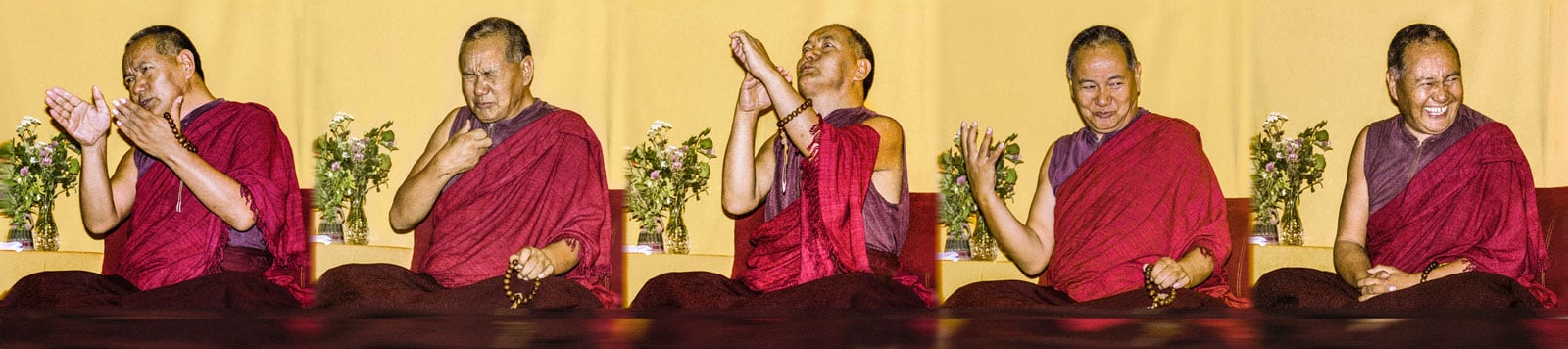
Lama Yeshe gave this teaching at St. John’s Church, London, on 18 September 1982. It was edited from the Lama Yeshe Wisdom Archive by Nicholas Ribush.