
E-letter No. 33: December 2005

Dear Friends,
Welcome to our final e-letter for 2005 and our e-letter’s third anniversary. We hope that you’ve had a good year and that your 2006 will be meaningful as well. We really enjoy what we do here at the Archive and thank all our kind and generous supporters who make it possible for us to archive the incredible teachings of Lama Yeshe and Lama Zopa Rinpoche for eternity and to make them available to everybody in the world by putting them on our website and publishing them in various other ways.

2005 was a good one, as we saw so many of our goals met for the benefit of all…we sent tens of thousands of free books out all over the world, added vast amounts of material—especially audio—to our website, started developing our photo archive, launched our Lama Yeshe DVD project in earnest, published the landmark Teachings from Tibet, finished off a couple of other new books (The Joy of Compassion and The Kindness of Others), which will be printed in January, added just over one hundred members and generally received wonderful support from our major and regular benefactors. On behalf of all sentient beings, thank you so much. It is our privilege to be able to serve our teachers, the Dharma and all living beings.
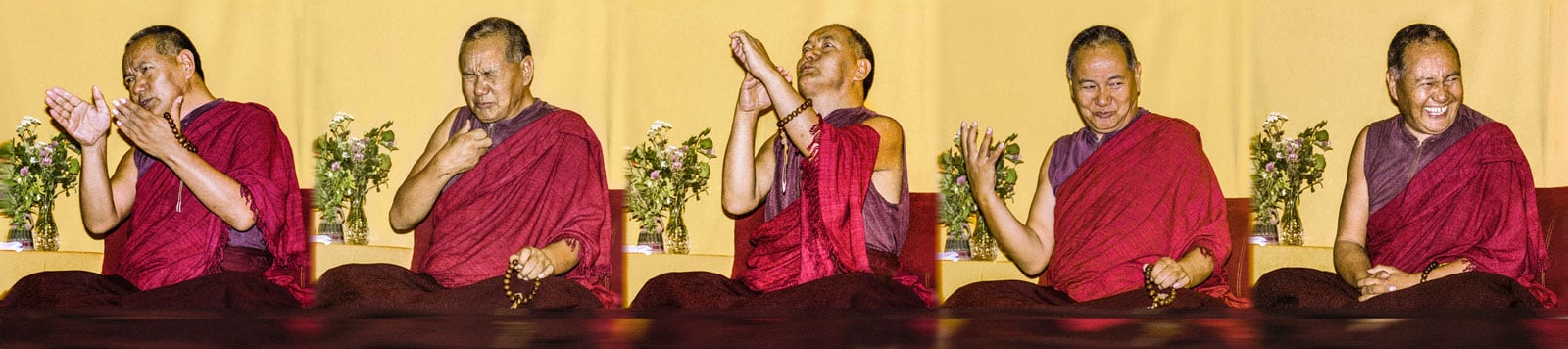
We can see that so many of you have visited our photo archive, to which we've recently added many new pictures, and which is growing all the time. Take a look to see more pictures like the one above, which was taken of Lama Yeshe at Vajrapani Institute in 1983.
Newly posted to our public area is a series of teachings given by His Holiness the Dalai Lama in New York City in 1998 at The Spirit of Manjushri event. We have also added a teaching by His Holiness to our Members' Area which were given prior to the Kalachakra Initiation in Barcelona, December 1994.
We continue to add material to Lama Zopa Rinpoche's Online Advice Book. This month find new advices in the Family and Relationship section under the topics "Parenting" and "Schoolchildren", the Transitions section topics "Helping a Dying Person" and "Prayers for the Deceased", and a reproduction of a paid advertisement Rinpoche wrote for a Sydney newspaper under the topic Euthanasia.
This month's podcast is Lama Yeshe's talk on the transference of consciousness, the transcript of which you've been reading in the last two e-letters, and which is concluded below. We're planning on making a DVD of this talk soon. You can find this one and more on our Online Teachings page. Also, we've just posted the transcript of another series of teachings given by Lama Yeshe on transference of consciousness in March 1981 at Tushita Retreat Centre, in Dharamsala, India.
Enjoy, and thank you again for your kindness, interest and support.
Much love
Nick Ribush
Director
Transference of Consciousness at the Time of Death (conclusion)

Even though it focuses on the mind, Tibetan Buddhism says that the physical body is also a source of pleasure and pain. And just as modern science now talks about pleasure and pain centers in the brain and chemicals associated with pleasure, Tibetan Buddhist tantra also describes a happiness, or bliss, center. If we concentrate on that center we activate its energy, which creates the conditions that energize the mind to experience peace and bliss. Therefore, when we meditate on transference of consciousness we use certain techniques that focus on or activate the various chakras.
Signs of success in this practice include the generation of inner heat, which itself has beneficial effects, such as improved digestion. But there are many good results. For example, we no longer feel stuck in the world of sense gravitation attachment; we somehow feel that we have gone beyond, or transcended, worldly life.
I’m not saying we should not enjoy our life; we should. But if we feel trapped and find we have access to a means of escape, we should definitely utilize whatever skills we have to do so.
Of course, many people are afraid of death because first, they think it’s going to be a disastrous experience with much difficulty and suffering, and second, they think that after death they’re going to find themselves in a miserable situation; they project or presume that something like that is going to happen.
In order to stop that kind of worry, even if we can’t do transference of consciousness, we can at least try to diminish our self-cherishing and attachment to our body and possessions and generate loving kindness for others. That’s good enough, absolutely good enough, to eradicate fear of death and the next life; it guarantees a good rebirth because the dedicated attitude itself is peaceful in nature. So that’s the way those who have not mastered transference of consciousness can eliminate fear of the next life and have a good death.
Once you have gained control over your mind there are many things you can do. Not only can you transfer your consciousness from your body but you can also direct it into another body. Meditation and concentration are extremely powerful—using the mind alone you can move objects, heat them up and so forth.
However, the main point is that through the power of mind you can eradicate negative and emotionally disturbed minds. That’s what practice is for. In other words, you can change your mind—from misery into happiness.
The question is—do you want to or not? Are you truly seeking happiness or not? If you’re a true seeker you’ll know intuitively that somehow you can do something yourself. That’s the power of the human mind. Don’t make limited judgments of yourself. We all have good, positive thoughts. These can be developed limitlessly. That’s the beauty of the human mind; it has limitless potential.
For example, we all have a certain degree of loving kindness. That small loving kindness can be developed infinitely. The nature of loving kindness itself is peace and happiness; the nature of self-cherishing is misery and confusion.
To have an easy, happy life you have to be willing to correct your behavior and attitude and then make the effort to do so. That means you have to have some mental fortitude based on the conviction that you can do it. A weak mind eliminates all potential.
The reason we feel trapped is because we’re so attached to our body. We pretty much identify with our body: “This is me.” The truth is that your body is not you; your bones are not you. The true essence of the human being is consciousness and it possesses neither shape nor color.
Thinking “I’m my body” is totally materialistic. It’s a fundamentally wrong thought. What comes next is, “My body is nice, I’m nice”; “My body is horrible, I’m horrible”; “My body is happy, I’m happy.” Those attitudes are wrong. Your body can be hacked to pieces while your mind remains blissful and tranquilly peaceful. It’s possible. That’s the point. Your body can be sick but your mind can be completely radiant and blissful. It’s possible.
So don’t think, “My body is me.” That’s my point. Western people often can’t tell the difference between the consciousness and the physical body. You should understand it well.
Because of their strong identification with their body many people find it difficult to conceive of life after death. They think that because they are their body, when their body burns out, so do they. “If my body has finished, where could I possibly be?”
The thing is that Buddhism doesn’t say that you’re permanently existent, nor does it say that you go to your next life the way you are now. From the Buddhist point of view, rebirth is the mind’s changing bodies, leaving one and taking another.
This happens because we’re always grasping at something. So when we die and are leaving this body we automatically grasp for another one, which creates the conditions for our mind to leave our present body for that of our next life. Taking a new body is what Buddhism calls rebirth. We don’t go into our next life in this body or as the person we are now.
Sometimes it can even seem that in this life itself we take many different bodies, different manifestations. Even in just this life. Check out in detail your experiences of your body at different stages of your life.
After death, your consciousness continues and carries with it all your past experiences. If you understand that this is what happens you’ll feel much more relaxed and less pressured to squeeze as much as you possibly can into this life, making yourself all busy and exhausted, thinking that this is the only life you get. There’s no need to rush.
If you understand the power of the mind you’ll find a way to satisfy yourself. It’s very important for all of us to find a way to make our lives satisfied and content rather than thinking that they’re empty and worthless. We should feel that our life is more precious than all the wealth in the world.
Knowing the characteristic nature of your own consciousness is the way to bring peace to yourself and the world at large because peace is your own inner experience, not something derived from outside of you. The beauty of peace is something that has to be experienced. With peace comes satisfaction. You have to generate all this within you. Once you have you have had this experience you can share it with others. That’s the way to bring true peace to the world—first get it yourself, then share it with others.
Grasping is the opposite of peace. You can see this in yourself and in the world as well. Everything destructive comes from grasping.
Lama Yeshe gave this teaching at St. John’s Church, London, 18 September 1982. It was excerpted and edited from the Lama Yeshe Wisdom Archive by Nicholas Ribush. Listen to this teaching at recordings.LamaYeshe.com. We are in the process of producing a DVD of this teaching.