
E-letter No. 43: October-November 2006

Dear Friends,
Thank you for your kind interest in our monthly e-letter. Sorry for the delay in sending you October’s but we’ve been making some technical upgrades here so we’ve combined the October and November issues. We have a new Web host, which has made accessing pages, doing searches and using our shopping cart faster than ever. Please check out our Web site and let us know if you find anything not working properly.
You might also notice that we've upgraded our e-letter format; we hope you like it. We welcome your feedback. On anything!
New on our Website
To celebrate our improved site, we offer you a new teaching by His Holiness the Dalai Lama: a commentary on the Avalokiteshvara yoga method given in New York last year. Also, we have added some advices to Lama Zopa Rinpoche's Online Advice Book on recent events, such as a letter to Al Gore about his movie on global warming, and a letter to crocodile-hunter Steve Irwin's family in the Death and Transitions section.
Our podcast this month continues with Lama Zopa Rinpoche's teachings from Barcelona in September 2005. This excerpt includes an oral transmission of the Golden Light Sutra. Listen to this and many other teachings an our Online Recordings page.
Latest Publications

The main excitement around here, however, is the publication of our next free book, Lama Yeshe’s Ego, Attachment and Liberation, which, as ever, you can read on our Web site or receive by mail. We’re in the process of sending it out to our members and benefactors.
We thank our benefactors for their donations of $20 or more in the last year; see our Donations page for more information. And, you can visit our Membership page for more information about that special program. If you are neither a member nor a benefactor but would like our new book, please order online.
We’re also happy to announce the reprinting of Lama’s very popular The Peaceful Stillness of the Silent Mind, which brings to almost 400,000 our number of free books in print. We’d also be happy to send you a copy of that.
More Audio and Video
In addition to our Online Recordings page and monthly podcast mentioned above, we recommend you check out Lamrim Radio, where you can listen to teachings and recitations by Lama Zopa Rinpoche and many other great lamas. They are also broadcasting 24 hours a day.
We’re in the process of preparing our next Lama Yeshe DVD for production: a two-disk set containing Lama’s Vajrasattva Tsog commentary, as found in the Wisdom book Becoming Vajrasattva. I hope that next month we’ll be announcing that it’s available!
In our last e-letter I mentioned I was leading a seminar in Cincinnati. It seemed to go well. A couple of weeks before the seminar, I was interviewed on Cincinnati public radio.
November Holidays
Sunday November 12 was the special Buddhist day of Lha-bab-du-chen, commemorating Guru Shakyamuni Buddha’s descent from the Realm of the Thirty-Three after giving teachings there to his mother. Several of us recited the Golden Light Sutra at Kurukulla Center. (As mentioned above, you can listen to Rinpoche give this oral transmission on our Online Recordings page.) Like the Sanghata Sutra, recitation of the Golden Light Sutra is highly recommended by Lama Zopa Rinpoche.
Well, as millions of turkeys are being sacrificed for that day of madness bizarrely called Thanksgiving, spare a thought for our kind feathered friends, check this out and, if you’re normally a traditional participant, perhaps this year decide to eat something else. Thank you so much.
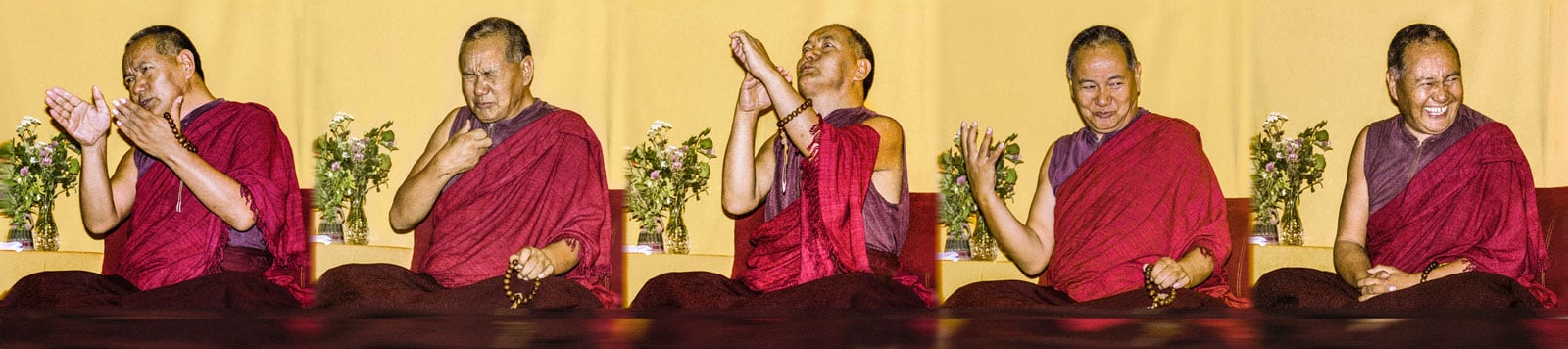
Finally, we’re delighted to bring you another previously-unseen teaching by Lama Yeshe, this one given in Los Angeles in 1975.
Thank you again and please share this e-letter far and wide.
Much love,
Nick Ribush
Director

What is Buddhism?
Although different people have different views of what Buddhism is, I think it’s difficult to say, “Buddhism is this, therefore it should be like that.” It’s difficult to summarize Buddhism in a simplistic way. However, I can say that Buddhism is different from what most Westerners consider to be religion.
First of all, when you study Buddhism you’re studying yourself—the nature of your body, speech and mind—the main emphasis being on the nature of your mind and how it works in everyday life. The main topic is not something else, like what is Buddha? What is the nature of God? Things like that.
Why is it so important to know the nature of our own mind? Since we all want happiness, enjoyment, peace and satisfaction and these things do not come from ice-cream but from wisdom and the mind, we have to understand what our mind is and how it works.
One thing about Buddhism is that it’s very simple and practical in that it explains logically how satisfaction comes from the mind, not from some kind of supernatural being in whom you have to believe.
I understand that this idea can be difficult to accept because, in the West, from the moment you’re born, extreme emphasis is placed on the belief that the source of happiness lies outside of yourself in external objects. Therefore your sense perception and consciousness have an extreme orientation toward the sense world and you come to value external objects above all else, even your life. This extreme view that over-values material things is a misconception, the result of unreasonable, illogical thought.
Therefore, if you want true peace, happiness and joy, you need to realize that happiness and satisfaction come from within you and stop searching so fanatically outside. You can never find real happiness out there. Whoever has?
Ever since people came into existence they have never found true happiness in the external world, even though modern scientific technology seems to think that that’s where the solution to human happiness lies. That’s a totally wrong conception. It’s impossible. Of course, technology is necessary and good, as long as it’s used skillfully. Religion is not against technology; nor is external development contrary to the practice of religion—although in the West there are religious extremists who oppose external development and scientific advancement, and we also find non-believers pitted against religious believers. It’s all misconception.
First let me raise a question. Where in the world can we find somebody who doesn’t believe? Who among us is a true non-believer? In asking this I’m not suggesting some kind of conceptual belief. The person who says “I don’t believe” thinks he’s intellectually superior but all you have to do to puncture his pride is ask two or three of the right questions: “What do you like? What don’t you like?” He’ll come up with a hundred things he likes. “Why do you like them?” Questions like that immediately expose everybody as a believer.
Anyway, in order to live in harmony we need to balance external and internal development; failure to do so leads to mental conflict.
So Buddhism finds no contradiction in advocating both external scientific and inner mental development. Both are correct. But each can be either positive or negative as well. That depends on mental attitude—there’s no such thing as absolute, eternally existent total positivity or absolute, eternally existent, total negativity. Positive and negative depend on the background from which they arise.
Therefore it’s very important to avoid extreme views because extreme emotional attachment to sense objects—“This is good; this makes me happy”—only causes mental illness. What we need to learn instead is how to remain in the middle, between the extremes of exaggeration and underestimation.
But that doesn’t mean giving everything up. I’m not asking you to get rid of all your possessions. It’s extreme emotional attachment to any object—external or internal—that makes you mentally ill. And Western medicine has few answers to that kind of sickness. There’s nothing you can take; it’s very hard to cure. Psychologists, psychiatrists, therapists…I doubt that they can solve the problems of attachment. Most of you probably have experience of that. That’s the actual problem.
The reason that Western health professionals can’t treat attachment effectively is that they don’t investigate the reality of the mind. The function of attachment is to bring frustration and misery. We all know this. It’s not that difficult to grasp; in fact it’s rather simple. But Buddhism has ways of revealing the psychology of attachment and how it functions in everyday life. The method is meditation. The real culprit, however, is a lack of knowledge-wisdom.
Too much concern for your own comfort and pleasure driven by the exaggerations of attachment automatically leads to feelings of hatred for others. Those two incompatible feelings—attachment and hatred—naturally clash in your mind and, from the Buddhist point of view, a mind in this kind of conflict is sick and unbalanced in nature.
Going to church or temple once a week is not enough to deal with this. You have to examine your mind all day long, maintaining constant awareness of the way you speak and act. We usually hurt others unconsciously. In order to observe the actions of our unconscious mind we need to develop powerful wisdom energy, but that’s easier said than done; it takes work to be constantly aware of what’s going on in our mind all the time.
Most religious and non-religious people agree that loving kindness for others is important. How do we acquire loving kindness? It comes from understanding how and why others suffer, what’s the best kind of happiness for them to have, and how they can get it. That’s what we have to check. But our emotions get the better of us. We project our attachments onto others. We think that others like the same things we do; that people’s main problems are hunger and thirst and that food and water will solve them. The human problem is not hunger and thirst; it’s misconception and mental pollution.
Therefore it’s very important that you make your mind clear. When it is, the ups and downs of the external world don’t bother you; whatever happens out there, your mind remains peaceful and joyous. If you get too caught up in watching the up and down world you finish up going up and down yourself: “Oh, that’s so good! Oh, that’s so bad!” If that world is your only source of happiness and its natural fluctuations disturb your peace of mind, you’ll never be happy, no matter how long you live. It’s impossible.
But if you understand that the world is up and down by nature—sometimes up, sometimes down—you expect it to happen and when it does you don’t get upset. Whenever your mind is balanced and peaceful, there’s wisdom and control.
Perhaps you think, “Oh, control! Buddhism is all about control. Who wants control? That’s a Himalayan trip, not a Western one.” But in our experience, control is natural. As long as you have the wisdom that knows how the uncontrolled mind functions and where it comes from, control is natural.
All people have equal potential to control and develop their mind. There’s no distinction according to race, color or nationality. Equally, all can experience mental peace and joy. Our human ability is great—if we use it with wisdom, it’s worthwhile; if we use it with ignorance and emotional attachment, we waste your life. Therefore be careful. Lord Buddha’s teaching greatly emphasizes understanding over the hallucinated fantasies of our ordinary mind. Emotional projections and hallucinations due to unrealistic perceptions are wrong conceptions. As long as our mind is polluted by wrong conceptions it’s impossible to avoid frustration.
The clean clear mind is simultaneously joyful. That’s simple to see. When your mind is under the control of extreme attachment on one side and extreme hatred on the other, you have to examine it to see why you grasp at happiness and why you hate. When you check your objects of attachment and hatred logically, you’ll see that the fundamental reason for these opposite emotions is basically the same thing: emotional attachment projects a hallucinatory object; emotional hatred projects a hallucinatory object. And either way, you believe in the hallucination.
As I said before, it’s not an intellectual, “Oh, yes, I believe.” And by the way, just saying you believe in something doesn’t actually mean you do. However, belief has deep roots in your subconscious, and as long as you’re under the influence of attachment, you’re a believer. Belief doesn’t necessarily have to be in the supernatural, in something beyond logic. There are many ways to believe.
From the standpoint of Buddhist psychology, in order to have love or compassion for all living beings, first you have to develop equilibrium—a feeling that all beings are equal. This is not a radical sort of, “I have a piece of candy; I need to cut it up and share it with everybody else,” but rather something you have to work with in your mind. An unbalanced mind is an unhealthy mind.
So equalizing sentient beings is not something we do externally; that’s impossible. The equality advocated by Buddhists is completely different from that which communists talk about; ours is the inner balance derived from training the mind.
When your mind is even and balanced you can generate loving kindness for all beings in the universe without discrimination. At the same time, emotional attachment automatically decreases. If you have the right method, it’s not difficult; when right method and right wisdom come together, solving problems is easy.
But we humans suffer from a shortage of intensive knowledge-wisdom. We search for happiness where it doesn’t exist; it’s here, but we look over there. It’s actually very simple. True peace, happiness and joy lie within you; therefore, if you meditate correctly and investigate the nature of your mind you can discover the everlasting happiness and joy within. It’s always with you; it’s mental, not external material energy, which always fizzles out. Mental energy coupled with right method and right wisdom is unlimited and always with you. That’s incredible! And explains why human beings are so powerful.
Materialists think that people are powerful because of their amazing external constructions, but all that actually comes from the human mind. Without the skill of the human mind there’s no external supermarket, therefore, instead of placing extreme value on the normal supermarket we should try to discover our own internal supermarket. That’s much more useful and leads to a balanced, even mind.
As I mentioned before, it sounds as if Buddhism is telling you to renounce all your possessions because extreme attachment is bad for you emotionally, but renunciation doesn’t mean physically giving up. You go to the toilet every day but that doesn’t mean you’re tied to it; you’re not too attached to your toilet, are you? We should have the same attitude to all the material things we use—give them a reasonable value according to their usefulness for human existence, not an extreme one.
If a boy runs crazily over dangerous ground to get an apple, trips, falls and breaks his leg, we think he’s foolish, exaggerating the value of the apple and putting his wellbeing at risk for the sake of achieving his goal. But we’re the same. We project extreme attachment onto objects of desire, exaggerating their beauty, which blinds us to our true potential. This is dangerous; it’s the same as the boy risking his life for an apple. Looking at objects with emotional attachment and chasing that hallucinated vision definitely destroys our own nature.
Human potential is great but we have to use our energy skillfully; we have to know how to put our lives in the right direction. This is extremely important.
[This lecture was immediately followed by a Question & Answer session; the entire lecture along with the Q&A session has been posted on our website here.]
Lama Yeshe gave this talk in Los Angeles, CA on 28 June 1975. Edited from the Lama Yeshe Wisdom Archive by Nicholas Ribush.