
E-letter No. 45: January 2007

Dear LYWA Supporters and Friends,
Welcome to another year of monthly e-letters. We greatly appreciate your interest and help. Our purpose is to benefit as many beings as we can by providing the nectar of the Dharma teachings of Lama Yeshe, Lama Zopa Rinpoche and other great lamas, which we do by sending this e-letter out to thousands of you each month, publishing hundreds of thousands of books for free distribution all over the world, offering thousands of pages of teachings on our website and many other means.
Of course, we could not do any of this without the financial support of our many benefactors and again, thank you all so much for your incredible generosity. May our partnership long remain to alleviate all levels of suffering everywhere!
New Lama Yeshe DVD

And now, the news. First, our rather too long awaited new Lama Yeshe DVD has finally arrived in stock: Offering Tsog to Heruka Vajrasattva. This two-disk set contains over seven hours of teachings and other material and at $25 it’s an amazing bargain. The three teachings herein have also been published by Wisdom in Lama’s Becoming Vajrasattva.
In our last e-letter I also mentioned the next Lama Yeshe DVD we’re working on, Anxiety in the Nuclear Age. Since then, the Bulletin of Atomic Scientists at the University of Chicago has moved the minute hand of the Doomsday Clock a couple of minutes closer to midnight, which represents total destruction of the earth through nuclear war. Although Lama’s talks were given in 1983 in another context, his comments are as relevant today as they were when he first gave them, therefore look out for this DVD in February.
New On Our Website
This month's podcast is Lama Yeshe's talk from March 1975 titled Make Your Mind an Ocean, featured in the book with the same name. You can listen to this talk on our Online Recordings page. You will also find links to the book and the unedited transcript, so you can follow along more easily. And, for all our Romanian friends out there, we have just posted a Romanian translation of Becoming Your Own Therapist.

We've just posted Lama Zopa Rinpoche's teaching on How to Make Offerings in Front of Holy Objects. Rinpoche gave this explanation as he walked through his house in Aptos which is filled with Buddha statues and images.
The latest round of updates to Rinpoche's Online Advice Book are in the Health section and include a new topic Healing, along with updates to the topics Handling Sickness, Transforming Pain and Prayers for Good Health.
Now, another request for your help
One of our supporters is selling a large estate and plans to use the proceeds to benefit the Lama Yeshe Wisdom Archive and many other Dharma projects. It has been on the market for a couple of years and Lama Zopa Rinpoche has recommended we do a couple of things to remove hindrances to the sale. One is recitation of five Akashagarbha mantras a day until the property is sold. The mantra is: OM SVASTI KAMALAKSI VIPULA SAMBHAVA / DHARMADHATU GOCARA SVAHA. Please let me know if you are willing to commit to this.
The other thing Rinpoche recommends is writing out the Sanghata Sutra once in ink containing real gold or five times in gold ink. If anybody would like to do this, please let me know. The FPMT has produced a traceable version (which can be found on the Sanghata Sutra page on the FPMT website) and if you would like to take this on, I’ll send you a copy and also some of the gold ink pens you’ll need.
Even if you can’t do either of these activities, please make prayers that the property sells quickly for the benefit of all sentient beings. Thank you so much.
The Passing of Lamas
As I mentioned in the last e-letter, the great teacher Kirti Tsenshab Rinpoche passed away December 15. His student wrote A Prayer for the Quick Return of Kirti Tsenshab Rinpoche, which was translated by Lama Zopa Rinpoche.
Unfortunately we have lost another of our teachers, His Holiness Chobgye Trichen Rinpoche, who passed away on January 22nd.
Final Notes...
Having trouble with our new e-letter format? Do you receive the e-letter without any color or pictures? Does your version contain misplaced characters and long links written out? Then you are subscribed to the "Text Only" version of the e-letter. You're encouraged to change to the html version, which would greatly improve your e-letter experience. Click on the Update Profile/Email Address link at the very bottom of your e-letter and uncheck the box that says "I would like to receive text only email campaigns."
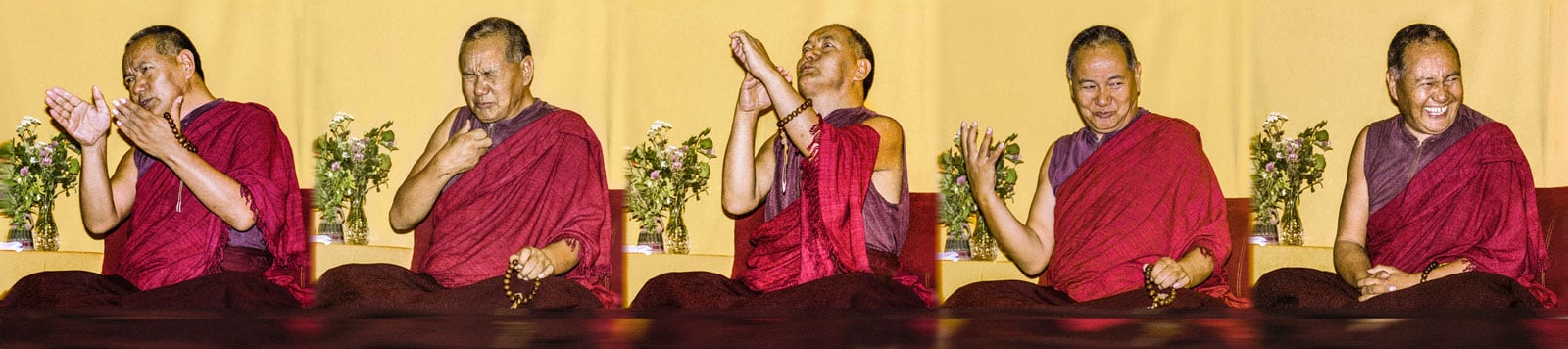
As usual, I leave you with another previously unpublished teaching, this one an excerpt of a talk on meditation by Lama Yeshe. Please forward this e-letter far and wide!
Thank you once more for your kindness and support.
Much love
Nick Ribush
Director
The Purpose of Meditation

We meditate to experience how our mind works, not to change our ideas and philosophy or to try out some Eastern trip. We meditate to investigate the basic energy we already have, the energy of our body, speech and mind: what is it, where does it come from, why does it do what it does?
This is not an external search; it’s a search of our own mind. It is so worthwhile. Investigating our own inner nature, the reality of our own mind and life, is not just a religious undertaking. We can’t deny that we possess body, speech and mind—we experience them all the time; we live within their energy field. So investigating our own energy to understand its true nature really is most worthwhile.
Furthermore, seeking the nature of the mind is not something that’s necessary for young people but not the old; old people can’t deny the existence of their own body, speech and mind. Since the undisciplined, uncontrolled mind is common to both young and old, both need to investigate it. In fact, anybody whose mind is uncontrolled and produces agitation, conflict and frustration needs to look very carefully at what’s going on. Such research is incredibly useful for young and old alike.
Investigating the mind doesn’t demand an extreme change in habits, in the way we work, eat or sleep. However, the uncontrolled mind is intimately associated with the activities of our everyday life and causes the conflicts we experience all the time. Therefore it’s essential that we understand the reality of our mind and the nature of our mental attitudes; this is most necessary.
The mind is like the central generator that provides electricity to all of Los Angeles or wherever; it’s mental energy that determines whether the actions of our body, speech and mind are positive or negative. All the energy of our body, speech and mind comes from our mind; that’s why Buddhism always emphasizes knowing its essential nature and how it produces both controlled and uncontrolled behavior.
How does Buddhism recommend we investigate the mind? The method we use is meditation. We receive teachings on the nature of the mind and on that basis experiment on our own mind, investigating its nature through our own experience.
To our surprise, perhaps, we discover that meditation allows us to control small things that we could not control before, which encourages us to go further. We realize that far from being weak, we have fantastic abilities and potential. We stop thinking, “I’m hopeless, I can’t do anything,” relying on others to do everything for us. From the Buddhist point of view, that’s a weak mind.
So what Buddhism is really trying to get us to do through philosophy, psychology and meditation is to become our own psychologist so that when problems arise we can diagnose and solve them for ourselves. This really is the essence of what the Buddha taught. Everything he taught was aimed at getting us to gain the knowledge-wisdom we need to understand our everyday life through knowing how our own mind functions.
Western psychologists also try to solve their patients’ problems, but not by making them their own psychologist. Patients who have mental problems need to realize the nature of their illness; then they can apply the right solution. If their problems remain hidden there’s no way they can solve them. We have to realize the nature of our own problems.
Also, meditation doesn’t mean sitting alone in some corner doing nothing; you can meditate while physically active—your body is moving but simultaneously you’re totally conscious and aware, observing how your mind communicates with the sense world, how it interprets the objects it perceives. That, too, is meditation.
Often when we’re walking in the street or communicating with others our unconscious behavior leaves imprints on our mind. These imprints later ripen into problems. We call that karma. Most of the time we’re unaware of what we’re doing; that’s the main problem. For example, we talk, eat and do most other things quite unconsciously, but meditation can wake us up and prevent us from sleeping our way through life. We think that when we’re working, interacting with others and so forth we’re awake, but at a certain level, we’re still asleep. If you look below the surface, you’ll see.
Therefore you can see that understanding the way your uncontrolled mind functions and disciplining yourself with right wisdom is so worthwhile and is exactly what we need…even if we’re old. With understanding, control is natural and easy.
Lama Yeshe gave this teaching in Los Angeles, 29 June, 1975. Edited from the Lama Yeshe Wisdom Archive by Nicholas Ribush.