
Commentary on the Eight Verses of Thought Transformation
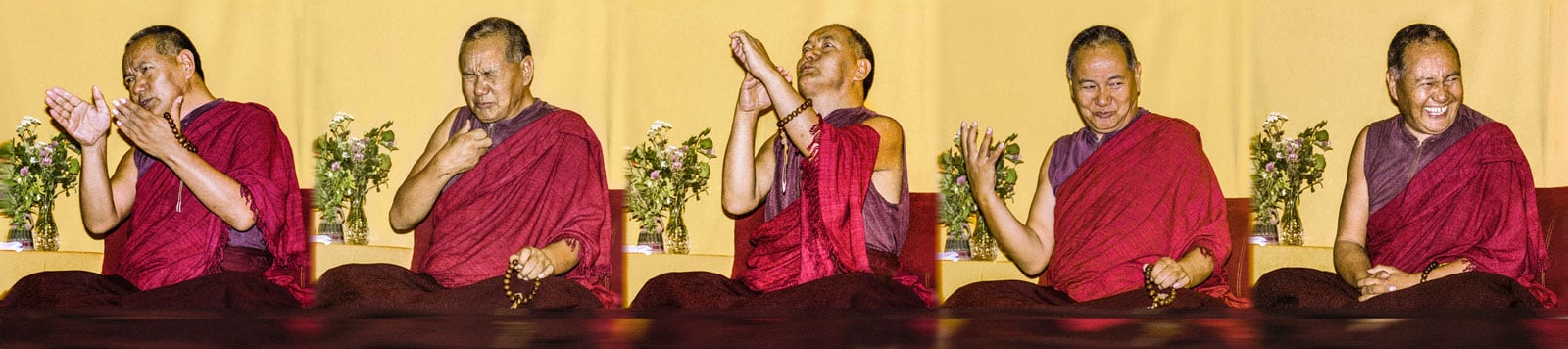
His Holiness the Dalai Lama gave this teaching in Dharamsala, 7 October 1981. It was translated by Alexander Berzin, clarified by Lama Zopa Rinpoche, edited by Nicholas Ribush and first published in the souvenir booklet for Tushita Mahayana Meditation Centre's Second Dharma Celebration, November 5-8 1982, New Delhi, India. This teaching was published in 2005 in the LYWA publication Teachings From Tibet.
See also the Eight Verses of Thought Transformation root text and The Everflowing Nectar of Bodhicitta, a text composed by Lama Zopa Rinpoche that combines Chenrezig practice with the Eight Verses. Also refer to the Commentary on The Everflowing Nectar of Bodhicitta, teachings by Lama Zopa Rinpoche at the Eighth Kopan Course in 1975.

The Eight Verses of Thought Transformation, a text by the Kadampa geshe Langri Tangpa, explains the Paramitayana practice of method and wisdom: the first seven verses deal with method—loving kindness, bodhicitta—and the eighth deals with wisdom.1
1. Determined to obtain the greatest possible benefit from all sentient beings, who are more precious than a wish-fulfilling jewel, I shall hold them most dear at all times.
We ourselves and all other beings want to be happy and completely free from suffering. In this we are all exactly equal. However, each of us is only one, while other beings are infinite in number.
Now, there are two attitudes to consider: that of selfishly cherishing ourselves and that of cherishing others. The self-cherishing attitude makes us very uptight; we think we are extremely important and our basic desire is for ourselves to be happy and for things to go well for us. Yet we don’t know how to bring this about. In fact, acting out of self-cherishing can never make us happy.
Those who have the attitude of cherishing others regard all other beings as much more important than themselves and value helping others above all else. And, acting in this way, incidentally they themselves become very happy. For example, politicians who are genuinely concerned with helping or serving other people are recorded in history with respect, while those who are constantly exploiting and doing bad things to others go down as examples of bad people.
Leaving aside, for the moment, religion, the next life and nirvana, even within this life selfish people bring negative repercussions down upon themselves by their self-centered actions. On the other hand, people like Mother Teresa, who sincerely devote their entire life and energy to selflessly serving the poor, needy and helpless, are always remembered for their noble work with respect; others don’t have anything negative to say about them. This, then, is the result of cherishing others: whether you want it or not, even those who are not your relatives always like you, feel happy with you and have a warm feeling towards you. If you are the sort of person who always speaks nicely in front of others but badmouths them behind their back, of course, nobody will like you.
Thus, even in this life, if we try to help others as much as we can and have as few selfish thoughts as possible, we shall experience much happiness. Our life is not very long; one hundred years at most. If throughout its duration we try to be kind, warm-hearted, concerned for the welfare of others and less selfish and angry, that will be wonderful, excellent; that really is the cause of happiness. If we are selfish, always putting ourselves first and others second, the actual result will be that we ourselves will finish up last. Mentally putting ourselves last and others first is the way to come out ahead.
So don’t worry about the next life or nirvana; these things will come gradually. If within this life you remain a good, warm-hearted, unselfish person, you will be a good citizen of the world. Whether you are a Buddhist, a Christian or a communist is irrelevant; the important thing is that as long as you are a human being you should be a good human being. That is the teaching of Buddhism; that is the message carried by all the world’s religions.
However, the teachings of Buddhism contain every technique for eradicating selfishness and actualizing the attitude of cherishing others. Shantideva’s marvelous text, the Bodhicaryavatara [A Guide to the Bodhisattva Way of Life], for example, is very helpful for this. I myself practice according to that book; it is extremely useful. Our mind is very cunning, very difficult to control, but if we make constant effort, work tirelessly with logical reasoning and careful analysis, we shall be able to control it and change it for the better.
Some Western psychologists say that we should not repress our anger but express it—that we should practice anger! However, we must make an important distinction here between mental problems that should be expressed and those that should not. Sometimes you may be truly wronged and it is right for you to express your grievance instead of letting it fester inside you. But you should not express it with anger. If you foster disturbing negative minds such as anger they will become a part of your personality; each time you express anger it becomes easier to express it again. You do it more and more until you are simply a furious person completely out of control. Thus, in terms of mental problems, there are certainly some that are properly expressed but others that are not.
At first when you try to control disturbing negative minds it is difficult. The first day, the first week, the first month you cannot control them well. But with constant effort your negativities will gradually decrease. Progress in mental development does not come about through taking medicines or other chemical substances; it depends on controlling the mind.
Thus we can see that if we want to fulfill our wishes, be they temporal or ultimate, we should rely on other sentient beings much more than on wish-granting gems and always cherish them above all else.
Q. Is the whole purpose of this practice to improve our minds or actually to do something to help others? What is more important?
His Holiness. Both are important. First, if we do not have pure motivation, whatever we do may not be satisfactory. Therefore, the first thing we should do is cultivate pure motivation. But we do not have to wait until that motivation is fully developed before actually doing something to help others. Of course, to help others in the most effective way possible we have to be fully enlightened buddhas. Even to help others in vast and extensive ways we need to have attained one of the levels of a bodhisattva, that is, to have had the experience of a direct, non-conceptual perception of the reality of emptiness and to have achieved the powers of extra-sensory perception. Nonetheless, there are many levels of help we can offer others. Even before we have achieved these qualities we can try to act like bodhisattvas, but naturally our actions will be less effective than theirs. Therefore, without waiting until we are fully qualified, we can generate a good motivation and with that try to help others as best we can. This is a more balanced approach and better than simply staying somewhere in isolation doing some meditation and recitations. Of course, this depends very much on the individual. If we are confident that by staying in a remote place we can gain definite realizations within a certain period, that is different. Perhaps it is best to spend half our time in active work and the other half in the practice of meditation.
Q. Tibet was a Buddhist country. If these values you are describing are Buddhist ones, why was there so much imbalance in Tibetan society.
His Holiness. Human weakness. Although Tibet was certainly a Buddhist country, it had its share of bad, corrupt people. Even some of the religious institutions, the monasteries, became corrupt and turned into centers of exploitation. But all the same, compared with many other societies, Tibet was much more peaceful and harmonious and had fewer problems than they.
2. When in the company of others, I shall always consider myself the lowest of all, and from the depths of my heart hold others dear and supreme.
No matter who we are with, we often think things like, “I am stronger than him,” “I am more beautiful than her,” “I am more intelligent,” “I am wealthier,” “I am much better qualified” and so forth—we generate much pride. This is not good. Instead, we should always remain humble. Even when we are helping others and are engaged in charity work we should not regard ourselves in a haughty way as great protectors benefiting the weak. This, too, is pride. Rather, we should engage in such activities very humbly and think that we are offering our services up to the people.
When we compare ourselves with animals, for instance, we might think, “I have a human body” or “I’m an ordained person” and feel much higher than them. From one point of view we can say that we have human bodies and are practicing the Buddha’s teachings and are thus much better than insects. But from another, we can say that insects are very innocent and free from guile, whereas we often lie and misrepresent ourselves in devious ways in order to achieve our ends or better ourselves. From this point of view we have to say that we are much worse than insects, which just go about their business without pretending to be anything. This is one method of training in humility.
3. Vigilant, the moment a delusion appears in my mind, endangering myself and others, I shall confront and avert it without delay.
If we investigate our minds at times when we are very selfish and preoccupied with ourselves to the exclusion of others, we shall find that the disturbing negative minds are the root of this behavior. Since they greatly disturb our minds, the moment we notice that we are coming under their influence, we should apply some antidote to them. The general opponent to all the disturbing negative minds is meditation on emptiness, but there are also antidotes to specific ones that we, as beginners, can apply. Thus, for attachment, we meditate on ugliness; for anger, on love; for closed-minded ignorance, on dependent arising; for many disturbing thoughts, on the breath and energy winds.
Q. Which dependent arising?
His Holiness. The twelve links of dependent arising, or interdependent origination. They start from ignorance and go through to aging and death.2 On a more subtle level you can use dependent arising as a cause for establishing that things are empty of true existence.
Q. Why should we meditate on ugliness to overcome attachment?
His Holiness. We develop attachment to things because we see them as very attractive. Trying to view them as unattractive, or ugly, counteracts that. For example, we might develop attachment to another person’s body, seeing his or her figure as something very attractive. When you start to analyze this attachment you find that it is based on viewing merely the skin. However, the nature of this body that appears to us as beautiful is that of the flesh, blood, bones, skin and so forth, of which it is composed. Now let’s analyze human skin: take your own, for example. If a piece of it comes off and you put it on your shelf for a few days it becomes really repulsive. This is the nature of skin. All parts of the body are the same. There is no beauty in a piece of human flesh; when you see blood you might feel afraid, not attached. Even a beautiful face: if it gets scratched there is nothing nice about it; wash off the paint—there is nothing left! Ugliness is the nature of the physical body. Human bones, the skeleton, are also repulsive; a skull-and-crossed-bones has a very negative connotation.
So that is the way to analyze something towards which you feel attachment, or love—using this word in the negative sense of desirous attachment. Think more of the object’s ugly side; analyze the nature of the person or thing from that point of view. Even if this does not control your attachment completely, at least it will help subdue it a little. This is the purpose of meditating on or building up the habit of looking at the ugly aspect of things.
The other kind of love, or kindness, is not based on the reasoning that “such and such a person is beautiful, therefore, I shall show respect and kindness.” The basis for pure love is, “This is a living being that wants happiness, does not want suffering and has the right to be happy. Therefore, I should feel love and compassion.” This kind of love is entirely different from the first, which is based on ignorance and therefore totally unsound. The reasons for loving kindness are sound. With the love that is simply attachment, the slightest change in the object, such as a tiny change of attitude, immediately causes you to change. This is because your emotion is based on something very superficial. Take, for example, a new marriage. Often after a few weeks, months or years the couple become enemies and finish up getting divorced. They married deeply in love—nobody chooses to marry with hatred—but after a short time everything changed. Why? Because of the superficial basis of the relationship; a small change in one person causes a complete change of attitude in the other.
We should think, “The other person is a human being like me. Certainly I want happiness; therefore, she must want happiness, too. As a sentient being I have the right to happiness; for the same reason she, too, has the right to happiness.” This kind of sound reasoning gives rise to pure love and compassion. Then no matter how our view of that person changes—from good to bad to ugly—she is basically the same sentient being. Thus, since the main reason for showing loving kindness is always there, our feelings towards the other are perfectly stable.
The antidote to anger is meditation on love, because anger is a very rough, coarse mind that needs to be softened with love.
When we enjoy the objects to which we are attached, we do experience a certain pleasure but, as Nagarjuna has said, it is like having an itch and scratching it; it gives us some pleasure but we would be far better off if we did not have the itch in the first place.3 Similarly, when we get the things with which we are obsessed we feel happy, but we’d be far better off if we were free from the attachment that causes us to become obsessed with things.
4. Whenever I see beings that are wicked in nature4 and overwhelmed by violent negative actions and suffering, I shall hold such rare ones dear, as if I had found a precious treasure.
If we run into somebody who is by nature very cruel, rough, nasty and unpleasant, our usual reaction is to avoid him. In such situations our loving concern for others is liable to decrease. Instead of allowing our love for others to weaken by thinking what an evil person he is, we should see him as a special object of love and compassion and cherish that person as though we had come across a precious treasure, difficult to find.
5. When, out of envy, others mistreat me with abuse, insults or the like, I shall accept defeat and offer the victory to others.
If somebody insults, abuses or criticizes us, saying that we are incompetent and don’t know how to do anything and so forth, we are likely to get very angry and contradict what the person has said. We should not react in this way; instead, with humility and tolerance, we should accept what has been said.
Where it says that we should accept defeat and offer the victory to others, we have to differentiate two kinds of situation. If, on the one hand, we are obsessed with our own welfare and very selfishly motivated, we should accept defeat and offer victory to the other, even if our life is at stake. But if, on the other hand, the situation is such that the welfare of others is at stake, we have to work very hard and fight for the rights of others, and not accept the loss at all.
One of the forty-six secondary vows of a bodhisattva refers to a situation in which somebody is doing something very harmful and you have to use forceful methods or whatever else is necessary to stop that person’s actions immediately—if you don’t, you have transgressed that commitment.5 It might appear that this bodhisattva vow and the fifth stanza, which says that one must accept defeat and give the victory to the other, are contradictory but they are not. The bodhisattva precept deals with a situation in which one’s prime concern is the welfare of others: if somebody is doing something extremely harmful and dangerous it is wrong not to take strong measures to stop it if necessary.
Nowadays, in very competitive societies, strong defensive or similar actions are often required. The motivation for these should not be selfish concern but extensive feelings of kindness and compassion towards others. If we act out of such feelings to save others from creating negative karma this is entirely correct.
Q. It may sometimes be necessary to take strong action when we see something wrong, but whose judgment do we trust for such decisions? Can we rely on our own perception of the world?
His Holiness. That’s complicated. When you consider taking the loss upon yourself you have to see whether giving the victory to the others is going to benefit them ultimately or only temporarily. You also have to consider the effect that taking the loss upon yourself will have on your power or ability to help others in the future. It is also possible that by doing something that is harmful to others now you create a great deal of merit that will enable you to do things vastly beneficial for others in the long run; this is another factor you have to take into account.
As it says in the Bodhicaryavatara, you have to examine, both superficially and deeply, whether the benefits of doing a prohibited action outweigh the shortcomings. At times when it is difficult to tell, you should check your motivation. In the Shiksa-Samuccaya, Shantideva says that the benefits of an action done with bodhicitta outweigh the negativities of doing it without such motivation. Although it is extremely important, it can sometimes be very difficult to see the dividing line between what to do and what not to do, therefore you should study the texts that explain about such things. In lower texts it will say that certain actions are prohibited while higher ones tell you that those same actions are allowed. The more you know about all of this the easier it will be to decide what to do in any situation.6
6. When somebody whom I have benefited and in whom I have great hopes gives me terrible harm, I shall regard that person as my holy guru.
Usually we expect people whom we have helped a great deal to be very grateful and if they react to us with ingratitude we are likely to get angry. In such situations we should not get upset but practice patience instead. Moreover, we should see such people as teachers testing our patience and therefore treat them with respect. This verse contains all the Bodhicaryavatara teachings on patience.7
7. In short, both directly and indirectly, I offer every happiness and benefit to all my mothers. I shall secretly take upon myself all their harmful actions and suffering.
This refers to the practice of taking upon ourselves all the sufferings of others and giving away to them all our happiness, motivated by strong compassion and love. We ourselves want happiness and do not want suffering and can see that all other beings feel the same. We can see, too, that other beings are overwhelmed by suffering but do not know how to get rid of it. Thus, we should generate the intention of taking on all their suffering and negative karma and pray for it to ripen upon ourselves immediately. Likewise it is obvious that other beings are devoid of the happiness they seek and do not know how to find it. Thus, without a trace of miserliness, we should offer them all our happiness—our body, wealth and merits—and pray for it to ripen on them immediately.
Of course, it is most unlikely that we shall actually be able to take on the sufferings of others and give them our happiness. When such transference between beings does occur, it is the result of some very strong unbroken karmic connection from the past. However, this meditation is a very powerful means of building up courage in our minds and is, therefore, a highly beneficial practice.
In the Seven Point Thought Transformation it says that we should alternate the practices of taking and giving and mount them on the breath.8 And here, Langri Tangpa says these should be done secretly. As it is explained in the Bodhicaryavatara, this practice does not suit the minds of beginner bodhisattvas—it is something for a select few practitioners. Therefore, it is called secret.
Q. In the Bodhicaryavatara, Shantideva says: “…if for the sake of others I cause harm to myself, I shall acquire all that is magnificent.”9 On the other hand, Nagarjuna says that one should not mortify the body. So, in what way does Shantideva mean one should harm oneself?
His Holiness. This does not mean that you have to hit yourself on the head or something like that. Shantideva is saying that at times when strong, self-cherishing thoughts arise you have to argue very strongly with yourself and use forceful means to subdue them; in other words, you have to harm your self-cherishing mind. You have to distinguish clearly between the I that is completely obsessed with its own welfare and the I that is going to become enlightened: there is a big difference. And you have to see this verse of the Bodhicaryavatara in the context of the verses that precede and follow it. There are many different ways the I is discussed: the grasping at a true identity for the I, the self-cherishing I, the I that we join with in looking at things from the viewpoint of others and so forth. You have to see the discussion of the self in these different contexts.
If it really benefits others, if it benefits even one sentient being, it is appropriate for us to take upon ourselves the suffering of the three realms of existence or to go to one of the hells, and we should have the courage to do this. In order to reach enlightenment for the sake of sentient beings we should be happy and willing to spend countless eons in the lowest hell, Avici. This is what is meant by taking the harms that afflict others upon ourselves.
Q. What would we have to do to get to the lowest hell?
His Holiness. The point is to develop the courage to be willing to go to one of the hells; it doesn’t mean you actually have to go there. When the Kadampa geshe Chekawa was dying, he suddenly called in his disciples and asked them to make special offerings, ceremonies and prayers for him because his practice had been unsuccessful. The disciples were very upset because they thought something terrible was about to happen. However, the geshe explained that although all his life he had been praying to be born in the hells for the benefit of others, he was now receiving a pure vision of what was to follow—he was going to be reborn in a pure land instead of the hells—and that’s why he was upset. In the same way, if we develop a strong, sincere wish to be reborn in the lower realms for the benefit of others, we accumulate a vast amount of merit that brings about the opposite result.
That’s why I always say, if we are going to be selfish we should be wisely selfish. Real, or narrow, selfishness causes us to go down; wise selfishness brings us buddhahood. That’s really wise! Unfortunately, what we usually do first is get attached to buddhahood. From the scriptures we understand that to attain buddhahood we need bodhicitta and that without it we can’t become enlightened; thus we think, “I want buddhahood, therefore I have to practice bodhicitta.” We are not so much concerned about bodhicitta as about buddhahood. This is absolutely wrong. We should do the opposite; forget the selfish motivation and think how really to help others.
If we go to hell we can help neither others nor ourselves. How can we help? Not just by giving them something or performing miracles, but by teaching Dharma. However, first we must be qualified to teach. At present we cannot explain the whole path—all the practices and experiences that one person has to go through from the first stage up to the last, enlightenment. Perhaps we can explain some of the early stages through our own experience, but not much more than that. To be able to help others in the most extensive way by leading them along the entire path to enlightenment we must first enlighten ourselves. For this reason we should practice bodhicitta. This is entirely different from our usual way of thinking, where we are compelled to think of others and dedicate our heart to them because of selfish concern for our own enlightenment. This way of going about things is completely false, a sort of lie.
Q. I read in a book that just by practicing Dharma we prevent nine generations of our relatives from rebirth in hell. Is this true?
His Holiness. This is a little bit of advertising! In fact it is possible that something like this could happen, but in general it’s not so simple. Take, for example, our reciting the mantra OM MANI PADME HUM and dedicating the merit of that to our rapidly attaining enlightenment for the benefit of all sentient beings. We can’t say that just by reciting mantras we shall quickly attain enlightenment, but we can say that such practices act as contributory causes for enlightenment. Likewise, while our practicing Dharma will not itself protect our relatives from lower rebirths, it may act as a contributory cause for this.
If this were not the case, if our practice could act as the principal cause of a result experienced by others, it would contradict the law of karma, the relationship between cause and effect. Then we could simply sit back and relax and let all the buddhas and bodhisattvas do everything for us; we would not have to take any responsibility for our own welfare. However, the fully enlightened one said that all he can do is teach us the Dharma, the path to liberation from suffering, and then it’s up to us to put it into practice—he washed his hands of that responsibility! As Buddhism teaches that there is no creator and that we create everything for ourselves, we are therefore our own masters—within the limits of the law of cause and effect. And this law of karma teaches that if we do good things we shall experience good results and if we do bad things we shall experience unhappiness.
Q. How do we cultivate patience?
His Holiness. There are many methods.10 Knowledge of and faith in the law of karma themselves engender patience. You realize, “This suffering I’m experiencing is entirely my own fault, the result of actions I myself created in the past. Since I can’t escape it I have to put up with it. However, if I want to avoid suffering in the future I can do so by cultivating virtues such as patience. Getting irritated or angry with this suffering will only create negative karma, the cause for future misfortune.” This is one way of practicing patience.
Another thing you can do is meditate on the suffering nature of the body: “This body and mind are the basis for all kinds of suffering; it is natural and by no means unexpected that suffering should arise from them.” This sort of realization is very helpful for the development of patience.
You can also recall what it says in the Bodhicaryavatara:
Why be unhappy about something
If it can be remedied?
And what is the use of being unhappy about something
If it cannot be remedied?11
If there is a method of overcoming your suffering or an opportunity to do so, you have no need to worry. If there is absolutely nothing you can do about it, worrying cannot help you at all. This is both very simple and very clear.
Something else you can do is to contemplate the disadvantages of getting angry and the advantages of practicing patience. We are human beings—one of our better qualities is our ability to think and judge. If we lose patience and get angry, we lose our ability to make proper judgments and thereby lose one of the most powerful instruments we have for tackling problems: our human wisdom. This is something that animals do not have. If we lose patience and get irritated we are damaging this precious instrument. We should remember this; it is far better to have courage and determination and face suffering with patience.
Q. How can we be humble yet at the same time realistic about the good qualities that we possess?
His Holiness. You have to differentiate between confidence in your abilities and pride. You should have confidence in whatever good qualities and skills you have and use them courageously, but you shouldn’t feel arrogantly proud of them. Being humble doesn’t mean feeling totally incompetent and helpless. Humility is cultivated as the opponent of pride, but we should use whatever good qualities we have to the full.
Ideally, you should have a great deal of courage and strength but not boast about or make a big show of it. Then, in times of need, you should rise to the occasion and fight bravely for what is right. This is perfect. If you have none of these good qualities but go around boasting how great you are and in times of need completely shrink back, you’re just the opposite. The first person is very courageous but has no pride; the other is very proud but has no courage.
8. Undefiled by the stains of the superstitions of the eight worldly concerns, may I, by perceiving all phenomena as illusory, be released from the bondage of attachment.
This verse deals with wisdom. All the preceding practices should not be defiled by the stains of the superstitions of the eight worldly dharmas. These eight can be referred to as white, black or mixed.12 I think it should be all right if I explain this verse from the point of view of the practices being done without their being stained by the wrong conception of clinging to true existence—the superstition of the eight dharmas.13
How does one avoid staining one’s practice in this way? By recognizing all existence as illusory and not clinging to true existence. In this way, one is liberated from the bondage of this type of clinging.
To explain the meaning of “illusory” here: true existence appears in the aspect of various objects, wherever they are manifest, but in fact there is no true existence there. True existence appears, but there is none—it is an illusion. Even though everything that exists appears as truly existent, it is devoid of true existence. To see that objects are empty of true existence—that even though true existence appears there is none, it is illusory—one should have definite understanding of the meaning of emptiness: the emptiness of the manifest appearance.
First one should be certain that all phenomena are empty of true existence. Then later, when that which has absolute nature14 appears to be truly existent, one refutes the true existence by recalling one’s previous ascertainment of the total absence of true existence. When one puts together these two—the appearance of true existence and its emptiness as previously experienced—one discovers the illusoriness of phenomena.
At this time there is no need for an explanation of the way things appear as illusory separate from that just given. This text explains up to the meditation on mere emptiness. In tantric teachings such as the Guhyasamaja tantra, that which is called illusory is completely separate; in this verse, that which is called illusory does not have to be shown separately. Thus, the true existence of that which has absolute nature is the object of refutation and should be refuted. When it has been, the illusory mode of appearance of things arises indirectly: they seem to be truly existent but they are not.15
Q. How can something that is unfindable and exists merely by imputation function?
His Holiness. That’s very difficult. If you can realize that subject and action exist by reason of their being dependent arisings, emptiness will appear in dependent arising. This is the most difficult thing to understand.16
If you have realized non-inherent existence well, the experience of existent objects speaks for itself. That they exist by nature is refuted by logic, and you can be convinced by logic that things do not—there is no way that they can—inherently exist. Yet they definitely do exist because we experience them. So how do they exist? They exist merely by the power of name. This is not saying that they don’t exist; it is never said that things do not exist. What is said is that they exist by the power of name. This is a difficult point; something that you can understand slowly, slowly through experience.
First you have to analyze whether things exist truly or not, actually findably or not: you can’t find them. But if we say that they don’t exist at all, this is a mistake, because we do experience them. We can’t prove through logic that things exist findably, but we do know through our experience that they exist. Thus we can make a definite conclusion that things do exist. Now, if things exist there are only two ways in which they can do so: either from their own base or by being under the control of other factors, that is, either completely independently or dependently. Since logic disproves that things exist independently, the only way they can exist is dependently.
Upon what do things depend for their existence? They depend upon the base that is labeled and the thought that labels. If they could be found when searched for, they should exist by their own nature, and thus the Madhyamaka scriptures, which say that things do not exist by their own nature, would be wrong. However, you can’t find things when you search for them. What you do find is something that exists under the control of other factors, which is therefore said to exist merely in name. The word “merely” here indicates that something is being cut off: but what is being cut off is not the name, nor is it that which has a meaning and is the object of a valid mind. We are not saying that there is no meaning to things other than their names, or that the meaning that is not the name is not the object of a valid mind. What it cuts off is that it exists by something other than the power of name. Things exist merely by the power of name, but they have meaning, and that meaning is the object of a valid mind. But the nature of things is that they exist simply by the power of name.
There is no other alternative, only the force of name. That does not mean that besides the name there is nothing. There is the thing, there is a meaning and there is a name. What is the meaning? The meaning also exists merely in name.
Q. Is the mind something that really exists or is it also an illusion?
His Holiness. It’s the same thing. According to the Prasangika Madhyamaka, the highest, most precise view, it is the same thing whether it is an external object or the internal consciousness that apprehends it: both exist by the power of name; neither is truly existent. Thought itself exists merely in name; so do emptiness, buddha, good, bad and indifferent. Everything exists solely by the power of name.
When we say “name only” there is no way to understand what it means other than that it cuts off meanings that are not name only. If you take a real person and a phantom person, for example, both are the same in that they exist merely by name, but there is a difference between them. Whatever exists or does not exist is merely labeled, but in name, some things exist and others do not.17
According to the Mind Only school, external phenomena appear to inherently exist but are, in fact, empty of external, inherent existence, whereas the mind is truly existent. I think this is enough about Buddhist tenets for now.18
Q. Are “mind” and “consciousness” equivalent terms?
His Holiness. There are distinctions made in Tibetan, but it’s difficult to say whether the English words carry the same connotations. Where “mind” refers to primary consciousness it would probably be the same as “consciousness.” In Tibetan, “awareness” is the most general term and is divided into primary consciousness and (secondary) mental factors, both of which have many further subdivisions. Also, when we speak of awareness there are mental and sensory awareness, and the former has many subdivisions into various degrees of roughness and subtlety. Whether or not the English words correspond to the Tibetan in terms of precision and so forth is difficult to say.
Notes
1. See Lama Zopa Rinpoche, The Everflowing Nectar of Bodhicitta, for a complete meditation practice on the Eight Verses. [Return to text]
2. See Geshe Rabten’s teaching on the twelve links. [Return to text]
3. From Nagarjuna’s Precious Garland, verse 169 :
There is pleasure when a sore is scratched,
But to be without sores is more pleasurable still;
Just so, there are pleasures in worldly desires,
But to be without desires is more pleasurable still.
See Buddhist Advice for Living and Liberation: Nagarjuna's Precious Garland. [Return to text]
4. This does not mean that these beings’ fundamental nature is unchangeably evil but refers more to their character or behavior. [Return to text]
5. This is the 16th secondary vow: “The auxiliary vow to abandon not dispelling another’s negative actions with wrathful methods that you know will be effective” (Lama Yeshe & Lama Zopa Rinpoche. The Bodhisattva’s Precepts: Golden Ornament of the Fortunate Ones, Pleasing All Sentient Beings. Kopan Monastery, 1974). [Return to text]
6. See A Guide to the Bodhisattva Way of Life, Chapter 5, and Shantideva, Shiksa-Samuccaya: A Compendium of Buddhist Doctrine, translated by Cecil Bendall & WHD Rouse; Delhi: Motilal Banarsidass, 1971. [Return to text]
7. See A Guide to the Bodhisattva Way of Life, Chapter 6, and note 10, below. [Return to text]
8. See Advice from a Spiritual Friend, pp. 92–93. [Return to text]
9. See A Guide to the Bodhisattva Way of Life, Chapter 8, verse 126. [Return to text]
10. See His Holiness the Dalai Lama's book Healing Anger: The Power of Patience from a Buddhist Perspective, a commentary on the sixth chapter of Shantideva’s Guide. [Return to text]
11. See A Guide to the Bodhisattva Way of Life, Chapter 6, verse 10. [Return to text]
12. The eight worldly dharmas are attachment to (1) everything going well, (2) fame, (3) receiving material goods and (4) praise, and aversion to their opposites. According to Pabongka Dechen Nyingpo, such actions are black when done with attachment to the happiness of this life, mixed when done without attachment but with self-cherishing and white when done without self-cherishing but with clinging to the I as truly existent. Another explanation has it that black are actions that both look non-virtuous and are done with non-virtuous motivation, mixed are actions that look virtuous but are done with non-virtuous motivation, and white are those such as this example: a monk who is not a particularly good one acts very properly, as if he is always like that, when he is in public so that people will not criticize the Sangha. (Notes 12 through 17 are from clarifications made by Lama Thubten Zopa Rinpoche.) [Return to text]
13. His Holiness chooses to explain “without their being stained” here from the point of view of the practices being done free from the wrong conception of holding things as truly existent as well as free from attachment to this life. The other way they can be stained is by self-cherishing. [Return to text]
14. “That which has absolute nature” is the interpretive translation of the term chhos.chan used by His Holiness, where chhos means absolute nature. [Return to text]
15. A mirage appears to be water but it is not. When we understand the reality that what we are seeing is an optical illusion caused by atmospheric conditions, we still see the water but it appears illusory. [Return to text]
16. Take, for example, “I am going to Kathmandu.” How are the subject I, and the action, going, dependent arisings? Why do you say “I am going”? Your aggregates are going to Kathmandu and you merely label them “I”—the subject is dependent upon the aggregates, as are the subject’s actions. When you consider how the I exists dependent upon being imputed by thought to its basis, the aggregates, and how actions too depend upon thought and the basis of imputation, you can see the subject and the action as dependent arisings. While you reflect on this—that subject and action exist dependent upon the aggregates (the basis of imputation), the label and the thought—you lose the truly existent I on the aggregates and the truly existent I going to Kathmandu. By realizing that the aggregates are empty of the truly existent I and its action of going, automatically you realize that the I and its actions exist dependent upon the aggregates and their actions, and by the power of name. [Return to text]
17. The real person and the phantom person are both merely labeled, but the real person actually exists because his basis of imputation, the aggregates that are labeled “person,” exists. The phantom person does not exist because there are no aggregates, no consciousness for him to depend on; he does not exist in name. In a dream, the appearance of a person serves as a basis of imputation but it is not a proper base as there are no aggregates. [Return to text]
18. For more on tenets, see Geshe Lhundup Sopa & Jeffrey Hopkins. Cutting Through Appearances. 1989. Daniel Cozort & Craig Preston. Buddhist Philosophy: Losang Gönchok’s Short Commentary to Jamyang Shayba’s “Root Text on Tenets.” 2003. Both Ithaca: Snow Lion Publications. [Return to text]