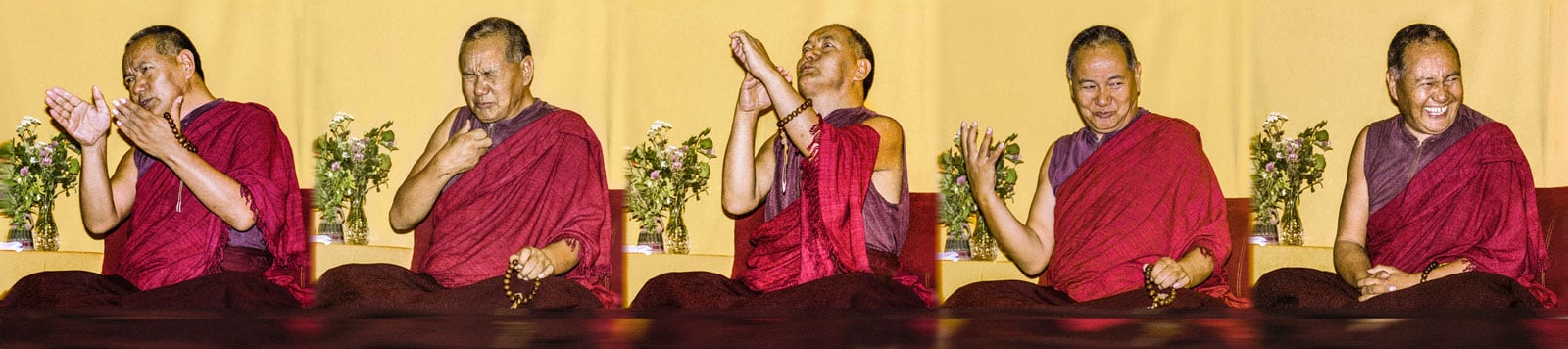
A Chat about Yamantaka
Lama Zopa Rinpoche
|
|
Materials for Initiates Only
An initiation is a part of the practice of tantra,
which Lama Yeshe describes in the free book Essence
of Tibetan Buddhism. In an initiation,
a qualified Vajrayana teacher empowers a student to undertake
certain
practices. In order to read books describing such practices,
one needs to have received initiation into the particular
tantric deity concerned. In the case of Lama Zopa Rinpoche's
"Chats" about Heruka and Yamantaka, Rinpoche
has requested that they be provided to initiates into
those specific practices only. For
more detailed information, see Lama Yeshe's book
Introduction to Tantra, Wisdom Publications, 1987.
Thank you so much for your interest in this profound
path.
The following chapters are available
for general consumption, however if you would like
the complete
books, please complete the...
We will reply with instructions on how
to place your order.
|
Chapter Eight: Emptiness
Bring your attention to the nature of your life, particularly
the nature of samsaric life. Our life under the influence
of delusions and karma is impermanent; it is suffering in
nature. All people, possessions, and sense objects around
us, all these causative phenomena, change within every second;
they are constantly decaying. Under the control of causes
and conditions, they do not last. These causative phenomena—including
this life—can cease at any time. When death arrives, you have
to leave everything. There is no choice but to separate from
everything, including your cherished body.
Mindfulness of impermanence and death brings peace of mind.
Realization of impermanence leads you towards liberation and
enlightenment because it helps curtail obstacles—the disturbing
emotions. Without mindfulness, meditation, and realization
of impermanence and death, your attitude towards life is filled
with disturbing emotions, particularly attachment. As a result,
you are born repeatedly in samsara, especially in the lower
realms of suffering. When you are mindful of impermanence
and death, you want to practice Dharma and actualize the path
to enlightenment.
In reality, everything—all actions, agents, and phenomena—is
merely labeled by mind. How all phenomena exist is by being
merely labeled by the mind in dependence upon a valid base.
Even the base is that which is merely labeled by mind in dependence
upon another base. It goes on and on like that. Starting from
the I and going down to the sub-atomic particles of your body,
everything is merely labeled in dependence upon a base. Nothing
else exists except that which is merely labeled by the mind.
What phenomena are is that which is merely labeled by mind.
Everything exists in mere name. All phenomena are only nominally
existent.
Therefore, the I, action, and all phenomena are totally empty.
They are totally non-existent right there from their own side.
As much as possible, try to practice mindfulness of emptiness
and dependent arising—that everything exists in mere name
in dependence upon its base, which also exists in mere name
in dependence upon its base.
Living your life with the mindfulness that things do not
exist from their own side is the ultimate solution to death.
Common people find it unpleasant even to hear or think about
death. The realization of emptiness is the ultimate means
of overcoming death, of liberating yourself from the suffering
of birth, aging, sickness, and death, and all the other sufferings
that occur between birth and death as well. The realization
of emptiness frees you from the oceans of suffering of each
realm. In addition, it ceases even the subtle obscurations,
making it possible for this mind-stream to become enlightened.
In reality, phenomena exist merely nominally, by being merely
labeled by mind. But your past ignorance projects upon them
the appearance of inherent existence. There is not just the
appearance of action, object, I, form, sound, smell, and so
forth, but something extra—inherent existence; something real
appearing from there. Due to past ignorance, this projection
occurs, and then your present ignorance apprehends it as true.
This is happening in your own life, right now. Then your present
ignorance, which apprehends all this as true, leaves the negative
imprint on your mind-stream for phenomena to appear to you
as inherently existent in the future. And again, you experience
the appearance of an inherently existent I, inherently existent
action, inherently existent form, sound, smell, taste, tangible
object, inherently existent enlightenment, inherently existent
hell, inherently existent liberation, inherently existent
virtue and non-virtue, inherently existent happiness and suffering,
inherently existent depression, inherently existent peace
of mind, and so forth.
This has been happening in your life continuously, from beginningless
samsaric rebirths. You have been completely trapped in hallucination.
Besides being caught in the present hallucination, by following
ignorance and not meditating on emptiness, sentient beings
continuously create the cause for more hallucination in the
future. It is like a fly inside a house. The windows and the
doors may be open, but the fly does not go out. It does not
go to where there’s an opening but flies around where there
is no exit. Hitting its body against a closed window again
and again, it ignores the freedom offered by all the open
windows. It never even looks in their direction. Nobody is
keeping the fly trapped in the house; the fly itself stays
there. It never pays attention to the big space that is open
all the time. It only looks where there is no space and goes
around and around. Even though seeing the open space and flying
there is so easy—there is no suffering or hardship involved—it
does not do that. But the door is always open.
Your life is just like this example. The opportunity to attain
liberation from samsara is always there. All phenomena, including
I, action, and object, have been empty from beginningless
time. It is not that phenomena have been empty at certain
times and inherently existent at others. They have never been
inherently existent. Therefore, the opportunity to realize
emptiness has always existed and always will. By generating
that realization, you will be able to eliminate the root of
samsara, ignorance, the innate conception of inherent existence.
By eliminating ignorance, you will cease everything that stems
from it—all the other disturbing attitudes and emotions, all
karma, the whole of samsara. You will attain complete cessation
of suffering and its cause. Even though the opportunity to
liberate yourself has always been there, so far you have not
taken it.
Like the fly, you have not paid attention to or turned towards
the door to liberation, the very nature of phenomena, the
object of wisdom, emptiness. Continuously following ignorance,
you have kept going towards suffering by believing the view
of ignorance and thinking that the object of ignorance, which
is false, is actually true. This has been your fundamental
mistake.
In the view of your mind, every phenomenon, including the
I, is one hundred percent existent from its own side, one
hundred per-cent truly existent, one hundred percent not merely
labeled by mind. Phenomena are one hundred percent real, one
hundred percent there on the base, one hundred percent solid.
When you look at the mountains, you think they are something
real appearing from there. When you look at the road, it is
a real road appearing from there. Your body is a real body
appearing from there. Your emotions are real ones appearing
from there. This is the view of ignorance.
Ignorance is the view of one part of your mind, but it is
not the view of your entire mind. When your wisdom realizes
emptiness, in the view of that wisdom mind, everything is
empty. In the view of your wisdom seeing the ultimate nature
of the person and phenomena, all these phenomena that ignorance
apprehends as one hundred percent true are seen as false.
In the view of the other part of your mind, wisdom, all the
objects apprehended by ignorance—all these inherently existent
things that appear real from there—are totally non-existent.
This does not mean that all phenomena are non-existent. In
the view of wisdom, all phenomena do exist, but they are totally
empty of existing from their own side. In the case of the
objects of ignorance, inherently existent phenomena, we can
say they are completely non-existent. However, when speaking
of nominally, or conventionally, existent phenomena, which
do exist, we must include the qualifying term “from their
own side” and say that they are totally empty of existing
from their own side.
Rather than thinking that emptiness comes from outside, recognize
that perceiving it depends on which mind you follow—you have
different views. Your present view, the view of ignorance,
is that everything you see—the lights, the carpet, your friends—is
real from there, real from the side of their base. But this
is not the view of all of your mind; it is just the view of
one part of your mind. If you follow the wisdom mind, you
will have a different view of life, phenomena, and yourself.
The former view sees everything as inherently existent, the
latter as empty. They are completely opposite perceptions.
How you see the world, your life, and yourself is completely
different in the two views. It becomes very interesting.
I, action, and object
I, action, object, and all other phenomena are simply that
which has been merely labeled by the mind. Therefore, they
are empty and do not exist from their own side. The I does
not exist from its own side; neither do the action or the
object acted upon. Similarly, all other phenomena do not exist
from their own side, or under their own power, and are therefore
totally empty.
The best meditation on emptiness is when there is no meditator,
no action of meditating, and no object of meditation. The
Guhyasamaja Root Tantra as well as sutra teachings say that
if you can gradually approach this experience, you are meditating
on emptiness correctly.
The body is not I. The mind is not I. The association of
body and mind together is not I. The I exists nowhere on these
aggregates. To express it another way, the aggregate of form
is not I. The aggregate of feeling is not I. The aggregate
of discrimination is not I. The aggregate of compositional
factors is not I. The aggregate of consciousness is not I.
Even the collection of all five aggregates is not I. No I
exists anywhere on these aggregates. Be very clear about this.
Firmly understand this.
It is very good if you can meditate on this and hold the
experience steady for even an hour. The more you meditate
on emptiness in session, the more you will be able to feel
it during the breaks. Doing intensive meditation on emptiness
and having intensive mindfulness of it enables the continuation
of this understanding to remain even when you are working
or engaged in other activities after your meditation session.
What is the I? It is that which is merely labeled by mind.
Although that is sufficient, to make it clearer and be more
precise, you may want to say that the I is that which is merely
labeled by the mind in dependence upon the aggregates. Saying
“in dependence upon the aggregates” counteracts the wrong
idea that your mind’s labeling something is sufficient for
it to exist. Your mind can label many things—such as a rabbit’s
horn or a hairy turtle—that do not in fact exist. For something
to exist, it needs a valid base in addition to the mind and
label. The I, for example, exists by being merely labeled
by the mind in dependence upon the aggregates, which are its
base. The I cannot be labeled on just any base; it has to
be valid. The aggregates are a valid base for the label I.
The I is that which is merely imputed or designated by the
mind in dependence upon a valid base. After the mind merely
imputes the I, it believes that an I is really there. The
I is just an idea or label that the mind makes up and believes.
Even the mind—the thing that makes up the label, that creates
the idea—is not independent. It, too, does not exist at all
from its own side, under its own power. What is the mind?
Nothing other than that which is merely labeled by thought.
Therefore, even the mind is empty. That which creates all
these ideas is itself empty, not something concrete; it does
not exist from its own side. This thing called “mind,” which
exists and creates all these ideas and labels, is that which
is merely labeled by thought. It exists by being merely labeled
by thought in dependence upon a valid base.
After this analysis, it is clear that the I, which is merely
imputed by the mind, and the mind itself, which is also merely
imputed by thought, are totally empty from their own side.
But they are not non-existent. They are like non-existent;
it’s as if they do not exist. After this analysis, what you
see and feel is not that they’re totally non-existent. They
exist, but it is almost as if they don’t. What the I is, what
the mind is, is unbelievably subtle. Even the mind that labels
exists in an extremely subtle way.
In the same way, all phenomena exist so subtly that it is
almost as if they were non-existent. If you analyze the base
of the I—the aggregates—you have the same experience. From
gross body down to its atoms, and from the mind down to the
smallest moments of mind, everything exists by being merely
labeled. You can mentally divide the continuity of consciousness
into smaller and smaller time periods—year, month, week, day,
hour, minute, second, split second, and so on. These mini-mind
moments are the base in dependence upon which the mind is
labeled. To ignorance, your hallucinating mind, all these
appear inherently existent. They seem to exist from their
own side, to be something concrete, something real from there,
but in reality, in the view of wisdom, from the I down to
the sub-atomic particles and from the mind down to the tiniest
moments of consciousness, everything exists by being merely
labeled. Having made this analysis, how do you feel your I
and mind? It is not that they are non-existent, but it is
like they are non-existent. What they are is extremely fine,
extremely subtle.
From the I and the mind that labels I down to the sub-atomic
particles and mini-moments in the continuity of mind, everything
is totally empty of existing from its own side. They are totally
non-existent from their own side. When you reach this conclusion,
this experience, concentrate one-pointedly on emptiness.
Some lines in the Seven Points of Thought Transformation
describe succinctly how to meditate on emptiness:
Having gained stability, receive the secret (teaching).
Consider all phenomena as a dream.
Examine the nature of unborn awareness.
The remedy itself is released in its own place.
Place (your meditation) on the nature of the foundation
of all—
the essence (of the path). In the meditation break, be a
creator of illusion.
Although few in words, these lines are very powerful to meditate
on. Remembering just a few words helps you to not get caught
in the words of emptiness but to reflect on its meaning. For
example, “Be a creator of illusion” reminds you that you are
the creator. With this awareness, practice mindfulness of
things being like an illusion. By memorizing these lines,
you can easily recall them when meditating. I do not know
exactly what they mean, but I find them very effective, very
powerful.
Similarly, The Thirty-seven Practices of a Bodhisattva
contains some verses that give invaluable advice on how to
use mindfulness of emptiness when you encounter problems.
Whatever appears is your own mind.
Your mind from the start was free from fabricated extremes.
Understanding this, do not take to mind
[Inherent] signs of subject and object—
This is the practice of bodhisattvas.
When you encounter attractive objects,
Though they seem beautiful,
Like a rainbow in summer, do not regard them as real
And give up attachment—
This is the practice of bodhisattvas.
All forms of suffering are like a child’s death in a dream.
Holding illusory appearances to be true makes you weary.
Therefore, when you meet with disagreeable circumstances,
See them as illusory—
This is the practice of bodhisattvas.
The last stanza speaks first of the mistake of looking at
hallucinations as true. Doing so makes you suffer; it tortures
your life; it is exhausting. Then Togme Zangpo gives the solution.
When you meet unfavorable conditions, see them as hallucinations.
That is, when things happen that you do not like, that you
think are objectionable, practice as bodhisattvas do by seeing
them as hallucinations. To see as a hallucination what is
in fact a hallucination is a powerful technique. There are
no truly existent problems.
In addition to seeing that no truly existent problems exist
out there, you can transform the problem by transforming your
concept of it. Change the concept that labels it as a problem
and views it as a problem into a thought that gives a positive
label to that situation and thus looks at the situation positively.
For example, instead of labeling it as a problem, label it
as an opportunity to practice patience.
What is an illusion?
Rinpoche: In English, does the word “illusion” only
refer to a magician’s creation?
Student: Illusion can refer to a range of things, not
only what is created by a magician. A hallucination is an
illusion, a mirage is an illusion. So is a reflection in a
mirror. A mistaken idea is also an illusion.
Rinpoche: What is a mirage?
Student: It’s an appearance of water where there is
no water.
Rinpoche: So the appearance of the water is an illusion?
Student: Yes.
Rinpoche: Then the appearance of the water does not
exist.
Student: The appearance of the water does exist. The
illusion exists, but the water does not exist.
Rinpoche: That’s correct. The appearance of water exists,
but the water does not exist. So the appearance of the water
isn’t a hallucination.
Student: Correct.
Rinpoche: Tsa! You contradicted yourself! So the appearance
of water isn’t a hallucination.
Student: The appearance of the water isn’t a hallucination
because the appearance is there. The water isn’t there. It’s
like when you look up and see a face in the clouds. That’s
a hallucination and an illusion. You know it’s only clouds
in the shape of a face. There’s no real face there.
Rinpoche: Are the pictures of our gurus and statues
of the Buddha that we see hallucinations?
Student: There is a particular tribe in Africa that
cannot recognize objects in photographs. If you show them
a picture of another member of the tribe, they will not recognize
him because the photo is flat and still, while their friend
is three dimensional and moves. We see a person in the photo
because we read meaning into the shapes we see there. In a
sense, that’s an illusion because we make it up in our mind.
There’s really just a flat surface there. It only has meaning
to us because as a convention, we give it that meaning. We
reconstruct meaning in our mind.
Rinpoche: Which one is a hallucination—what we see
or what they see?
Student: Going back to the mirage, there’s an illusion
there, but there’s no water there.
Rinpoche: Yes. So you’re saying the appearance of water
isn’t an illusion, right?
Student: There’s a sense object that is correct. The
mirage exists and it’s not an illusion.
Rinpoche: So a mirage isn’t a hallucination? Isn’t
the appearance of an inherently existent I an illusion?
Student: Yes.
Rinpoche: In that case, all sentient beings are already
enlightened because the appearance of inherent existence does
not exist because it’s a hallucination.
Student: It exists. If it’s a hallucination it does
not follow that it does not exist. It exists as an hallucination.
Rinpoche: It exists as a hallucination, but it’s not
a hallucination?
Student: There’s a basis out there that does not exist.
The inherently existent I does not exist. But the perception
of the inherently existent I does exist.
Rinpoche: So the appearance of the inherently existent
I isn’t a hallucination?
Student: It is a hallucination. It exists as a hallucination.
Rinpoche: Are you saying that the appearance of inherent
existence is like an illusion? So it’s not an illusion?
Student: It is illusion, that’s why it exists.
Rinpoche: It’s an illusion?
Student: There’s no basis for the perception. It’s
an illusion.
Rinpoche: If the inherently existent I is an illusion,
is the appearance of an inherently existent I also an illusion?
Are those two the same? Think about it.
Spaced out meditating on empty space
Sometimes it seems difficult to see the I as empty. You do
the meditation taking death as the path to dharmakaya, and
at the clear light, you have an appearance of space, like
a very clear autumn sky at dawn. It is devoid of the three—the
white, red, and dark appearances. It is like the sky before
it’s completely light but after the dark has gone. Space is
often given as an analogy for emptiness because space is already
empty of form. So initially, thinking of space helps some
people have an idea of emptiness. Space is ordinary emptiness—the
emptiness of form and substantial phenomena—but it is not
emptiness of inherent existence. You have to go beyond seeing
space.
The emptiness of inherent existence is also non-objectifying;
it is empty. That intense emptiness is non-dual with you,
with no differentiation between subject and object. It is
very strong emptiness, totally empty from its own side.
However, many people think they are meditating on emptiness
but actually, they are meditating on space. They have not
yet touched actual emptiness, shunyata, the pure nature. Instead,
their experience is like gazing into space. They meditate
on space and label it “emptiness.”
I have not seen what follows in the texts; it is just my
idea how to meditate on emptiness during the dharmakaya meditation.
Rather than spacing out meditating on empty space, it is more
useful to identify the refuted object, the real I appearing
from there, the I that appears not to be merely labeled by
mind. You have this false view grasping onto the refuted object
all the time. You have this hallucination every moment. You
are born with it from beginningless rebirth. You have continuously
lived your life with this false view, this hallucination.
Up until now everything that appears to your senses has been
the refuted object. So far, why you have not been liberated
from samsara is because you have not realized emptiness, not
realized that the refuted object is totally non-existent,
totally empty. The reason you have not realized emptiness
is because you have not identified the refuted object.
To realize emptiness you first have to recognize the refuted
object. Since emptiness is a lack of something—inherent existence—to
realize emptiness you first have to be able to identify what
it is a lack of. You have to recognize the false I, the I
that does not exist. In the four-point analysis to realize
emptiness, the first point is to identify the refuted object.
Without first recognizing the refuted object, the inherently
existent I, the inherent existence projected onto the merely
labeled I, how can you prove it does not exist? The I that
exists is the merely labeled one, but something extra on top
of it appears to you. That is inherent existence, the refuted
object.
At present you apprehend the inherently existent I that is
projected onto the merely labeled I as true. It’s like there’s
I on the I. In the view of your hallucinating mind, ignorance,
it looks like there’s I on the I, an inherently existent I
appearing on the merely labeled I. Apprehending inherent existence
and believing it to be true obstructs your mind from seeing
the reality, or the truth, of the I, the emptiness of the
I. Because you are unable to see the emptiness of the I, the
real nature of the I, you cannot see the I, how the I exists.
You cannot see that the I exists as a dependent arising, as
merely labeled by mind. Because you are unable to realize
the real nature of the I, you are unable to realize the conventional
nature of the I, the dependently arising I itself.
Therefore, the whole problem is not realizing as false that
which is false; not realizing that the way the inherently
existent I and inherently existent phenomena appear is false,
that the I and all other phenomena do not exist in the way
they appear. You have to see that which is false as false.
Liberation from samsara starts from here. When you practice
mindfulness recognizing the refuted object on the I as false,
there is no foundation for any of the delusions to arise,
because your wisdom knows the appearance of a real I is false.
Ignorance, on the other hand, apprehends things in the exact
opposite way. It apprehends them as true; that this is reality;
that inherent existence is the nature of all phenomena. The
ignorance apprehending, or grasping, inherent existence creates
all delusions, all karma, and all the oceans of suffering
in each realm of samsara. That wrong concept is responsible
for the entire problem. The opposite of ignorance is the wisdom
that looks at the false object as false, that recognizes the
refuted object as the refuted object, that sees as a hallucination
what is in fact a hallucination.
In this way, you are able to overcome the delusions. The
correct view does not give the delusions freedom to arise,
to take over your mind and your life, to harm yourself and
others. When you can recognize that this is false, it will
not be long before you will realize emptiness. It takes just
a second to realize that inherently existent persons and phenomena
are totally non-existent. Then you have the wisdom realizing
emptiness. When you have that, you will have definite, unshakeable
faith that you can attain liberation. The wisdom realizing
emptiness directly ceases all defilements, karma, and delusions,
so you do not have to experience them at all. It ceases the
result, true suffering in samsara. By ceasing the subtle obscurations,
it enables you to attain enlightenment.
Apprehending the I that appears not merely labeled by mind
as true, as reality, creates samsara. Looking at it as false,
recognizing it as the refuted object, seeing it as a hallucination—whichever
name works better for you—cuts all suffering and its cause
at its root, bringing liberation or enlightenment. A huge
difference exists between these two thoughts, these two opposite
ways of looking at the object. Which one you follow makes
a huge difference to your life right this minute. It also
makes a huge difference for the future; it is the difference
between being in samsara and experiencing nirvana.
Even if you do not realize emptiness, it is very useful to
practice mindfulness that the way all phenomena appear to
you and the way your mind apprehends them is not true. What
appears to you, what you apprehend, is false. It is the refuted
object; it is a hallucination. Look at everything—the I, the
six sense objects, the apprehending mind, and the apprehended
objects—as false. Just looking at things in this way, which
is opposite to the way ignorance apprehends objects, is very
powerful, even if you do not actually realize emptiness. This
is an unmistaken way to practice and will lead you to understand
that phenomena are empty.
It is better to practice this mindfulness than to think you
are meditating on emptiness when you are actually meditating
on space. Even if you spend a long time concentrating on space,
it does not affect samsara because it is not real meditation
on emptiness. But using the correct words as taught by the
Buddha and Lama Tsong Khapa benefits your mind, even though
at present your understanding of them may be superficial.
Just repeating the words, “All phenomena are not inherently
existent. They do not existent by their own nature. They do
not exist from their own side, nor are they truly existent,”
puts good imprints in your mind-stream. You benefit from repeating
and reflecting on these correct terms, even though you have
no image of what emptiness is at present. Although you are
not really meditating on emptiness, you are planting the seeds
of realization in your mind by repeating the correct words
and concepts of Lama Tsong Khapa’s unmistaken, pure teachings.
If you just concentrate on space that is empty of form, you
are not meditating on emptiness. In fact, you are focusing
on the opposite because you are still apprehending inherently
existent space and thinking that it is true. You still have
the ignorance holding it to be true. In addition, you do not
even have the correct words describing emptiness from Lama
Tsong Khapa’s teachings, so you cannot leave positive imprints
on your mind. Pabongka Dechen Nyingpo explained this in his
teachings.
Put effort into looking at things as hallucinations; not
merely labeled; false; refuted objects; empty; like a dream;
like reflections; like illusions. There are many analogies
to choose from, and you can select the one that works best
for you. When you reflect in this way, the understanding that
they are empty, non-existent from their own side, comes into
your heart. This is correct understanding and correct meditation.
Even if you cannot experience strong, intensive emptiness,
just seeing things as totally empty from their own side, meditating
on their being false, hallucinations, refuted objects is very
powerful. It becomes correct meditation on emptiness, free
of the dangers of incorrect meditation. Whether you use hundreds
of logical reasonings from the philosophical texts or not,
this is the essential point.
If space that is empty of form appears to your mind while
you are meditating on the dharmakaya, examine, “How does that
space appear to me? Does space or clear light appear to me
as merely labeled by mind or not merely labeled by mind?”
If it appears not merely labeled by mind, that is exactly
the refuted object; that is the hallucination; that is what
does not exist at all. Continuously focus on it being the
refuted object or a hallucination. Concentrate on that. At
the same time, reflect on the meaning of hallucination—that
it is non-existent. Then there is no choice but that the object
of ignorance becomes non-existent for your mind.
In summary, you can meditate on emptiness in different ways.
Sometimes meditate by focusing on the I, as I described before,
and try to get an idea of the emptiness of the I. You may
have the experience of everything dissolving. There is nothing
there—no color or form—but it is still just ordinary emptiness.
In the middle of this space, you may have the feeling of me;
that there is an I in space meditating on dharmakaya. That
I who is meditating in space is what has to be negated or
destroyed. That is the target to hit with the atomic bomb
of dependent arising. Identify that as the refuted object,
false, hallucination, totally non-existent.
Sometimes you can meditate on emptiness by applying the same
analysis to the eight visions as the elements absorb. There
is no other way for the visions to appear except the false
way, as existing from their own side. For example, the black
near-attainment vision appears as inherently existent, that
is, as something real from there, as existing there on the
base. Then you meditate, “A real black near-attainment vision
appearing from there does not exist there.”
If you are familiar with the refuted object and can recognize
it easily, you do not need many words. Simply saying, “This
is the refuted object” will facilitate your understanding
that it is empty. If you can do this, you get into emptiness
quickly. If you are not as familiar or cannot identify the
refuted object properly, using logical reasoning is helpful.
Whether you use many words and many logical reasons is up
to you. It is your choice and depends on your familiarity
with meditation on emptiness. See which way is most effective
for you and do that.
After meditating on emptiness for a while, think that the
wisdom seeing this emptiness experiences the greatest bliss
non-dual with emptiness, and meditate on that experience a
little bit. Then think, “This is my future, resultant holy
mind, dharmakaya, the transcendental wisdom of non-dual bliss
and emptiness of Yamantaka.” Make the determination, "This
is me."
Mindfulness
The most important meditation is practicing mindfulness of
emptiness as described before. You can spend a weekend, a
week, or even a month just practicing mindfulness in sitting
meditation and in break times. It is extremely powerful. Break
time does not mean a break from meditation but a break from
sitting. You should continue your mindfulness in the break.
In the morning, practice guru yoga and at the beginning of
each meditation session do strong preliminary practices. Then
focus on the different methods of analysis in your sessions.
You can recite the Heart Sutra each session or even
do retreat on the Heart Sutra or on the Perfection
of Wisdom. If you really try to do this, your view of yourself
and the world will change. Due to that, your attitude towards
life will be totally different. You will see the interesting
movie of your own mind.
The vipassana people do very strict, intensive retreats and
always practice mindfulness. It would be good if you could
practice with this intensity and strong focus, but your object
of mindfulness should be different. Theirs is just walking,
breathing, and sensations in the body. I have not heard of
common vipassana meditation related to emptiness, where you
are aware of the false appearance and the false view. If you
could meditate as intensively as they do but use the methods
described here, you would definitely cut the root of samsara.
In our courses, we tend to have many teachings and less meditation,
and people lack the time to digest or experience the Dharma.
You need to continue to meditate after the course. On the
other hand, if we had less information and more meditation,
people would not get a broad view of Buddhadharma. They might
have some experience, but their general knowledge would be
limited. When time is short, people cannot get much of an
idea about the path to enlightenment. Learning the Four Noble
Truths is good, but it is also limited, and so the purpose
of your life becomes limited. Hearing teachings on bodhicitta
and the Mahayana path makes the goal of your life profound
and vast, like the sky. This is the idea behind the Kopan
courses. People get a broad view of the path, depending on
how much of the lam-rim is covered. In addition, they get
some philosophical teachings and do some meditation. Many
different types of people come to the courses. Some need more
information, some need more meditation.
Chapter Ten: Dedication
Dedication prayers are extremely important. Each time we
pray and generate a wish, it builds power because everything—hell,
enlightenment, and everything in between—comes from the mind.
For ex-ample, let’s say each day you pray to have the same
qualities as Lama Tsong Khapa and to offer benefit to sentient
beings and to the Buddha’s teaching just as he did. This makes
preparation so that in all future lifetimes you will be able
to practice correctly and offer extensive benefit like Lama
Tsong Khapa did by having his same qualities within you. If
you want to make your life most beneficial, pray like this.
Prayers bring results because everything depends on the tip
of the intention; everything depends on your mind, your attitude.
Begin each of the following dedications with “due to the
past, present, and future merits created by myself, the Buddhas,
bodhisattvas, and sentient beings...” so that you make the
dedications as extensive and meaningful as possible.
“May the precious bodhi mind not yet born arises and grow.
May that born have no decline but increase forever more. May
we actualize bodhicitta, the loving-compassion thought renouncing
self-happiness and cherishing the happiness of others, as
quickly as possible.
“In the snowy mountain paradise, you are the source of good
and happiness. Powerful Tenzin Gyatso Chenrezig, may you stay
until samsara ends.
“May the glorious spiritual masters live long and may all
beings throughout limitless space have happiness. By purifying
our defilements and accumulating positive potential, may I
and all others be inspired to attain Buddhahood quickly.
“May all our virtuous friends and other holy beings, whose
only thought is to benefit sentient beings and the Buddha’s
teachings, have stable lives and may their wishes be fulfilled
immediately. May the glorious spiritual masters live long
and may all beings throughout limitless space have happiness.
By purifying our defilements and accumulating positive potential,
may I and all others be inspired to attain Buddhahood quickly.
“May all the father and mother sentient beings have happiness.
May the lower realms be empty forever. May all the bodhisattvas’
prayers succeed immediately. May I be able to cause all this
by myself alone.
“May anyone who merely sees, hears, remembers, touches, talks
to me, talks about me, or harms or helps me never be reborn
in the lower realms. May they immediately be liberated from
all disease, negative karma, and obscurations. May they generate
the entire path, especially bodhicitta, in their mind-streams
and attain enlightenment as quickly as possible.
“May no one experience war, famine, drought, earthquake,
or any other natural or manmade disasters. By generating love,
compassion, and bodhicitta, may everybody live their lives
without harming one another. May they help each other as much
as possible, and may everyone have inner development, the
realizations of the path.
“May we actualize within our minds the complete teachings
of Lama Tsong Khapa, the unified path of sutra and tantra,
without even a second’s delay. In all future lives, may we
be able to offer extensive benefit, limitless like the sky,
just as Lama Tsong Khapa did by having the same qualities
as he did. May we spread Lama Tsong Khapa’s teachings in the
minds of all sentient beings and lead them to enlightenment
as quickly as possible.
“May whatever action I do with body, speech, or mind benefit
sentient beings. May whatever I experience in life—health
or illness, wealth or poverty, comfort or problems, financial
gain or loss, gain or loss in my spiritual life, life or death,
rebirth in the hell realm or rebirth in the human or god realms—be
the most beneficial for all sentient beings. May I cause them
to attain enlightenment as quickly as possible by myself becoming
enlightened.
“Like the Compassionate White Lotus, Chenrezig, may my presence
make the suffering of the sentient beings in the area or realm
where I live naturally and instantly come to an end. May they
and all other sentient beings receive perfect happiness. May
those who are having difficulties finding a job find a job.
May those who are ill—especially those with illnesses that
are difficult to cure, such as cancer, AIDS, leprosy, arthritis,
spirit possession, and so forth—immediately be healed. May
the blind be able to see and the deaf be able to hear. May
those who long to hear the Dharma, receive the Dharma. May
those who need a guru meet a guru. May those who need a friend
find friends. May those who wish to have children have children.
“Due to the past, present, and future merits created by myself,
Buddhas, bodhisattvas and sentient beings, who are like a
dream or an illusion, may I, who is like a dream, attain Yamantaka’s
enlightenment, which is like a dream, and lead all sentient
beings, who are like a dream, to that enlightenment, which
is like a dream, by myself alone, who is like a dream.
"May all Dharma projects and activities of the centers
be successful at once. May the centers become like wish-fulfilling
gems for all sentient beings by immediately pacifying their
physical and mental suffering and spreading the teachings
of Lama Tsong Khapa in the minds of all sentient beings. May
the centers and practitioners receive all the necessary conditions
to do this successfully.
“May all the Dharma projects to benefit others, including
the Maitreya Buddha statue, be immediately successful and
of greatest benefit to all sentient beings. May these projects
cause faith in the Three Jewels and in the functioning of
karma to arise in the minds of all sentient beings. May they
cause loving-kindness and compassion to arise in the minds
of all sentient beings. May people who hear about the Maitreya
statue or see a brochure about it, who talk about it or dream
about it, or who contribute their time, energy, finances and
so forth to it, never be born in the lower realms. May they
be able to receive perfect human rebirths in life after life
and attain enlightenment soon. If that does not happen during
the present era of Guru Shakyamuni Buddha, may they be a direct
disciple of Maitreya Buddha and receive a prediction of their
enlightenment.”
Dedicating for the dying and the deceased
When people have requested you to make prayers for others
who are dying or have died, please do so. At the moment, their
life is finishing, but sooner or later yours will as well.
Other people will use your name, “So-and-so is dying.” They
will call, write, or meet each other and share the news that
you have died. This will definitely happen.
The Stainless Beam mantra can liberate a person in the lower
realms if it is recited seventy times. It immediately liberates
someone who has died and been born in the lower realms from
that misfortune. Unfortunately, I have not memorized that
mantra yet. I am just advertising its benefits!
In general, you can recite any mantra when someone dies,
such as om mani padme hum, Vajrasattva, or Medicine Buddha
mantra. Reciting the Medicine Buddha’s mantra and praying
to him is worthwhile, because in the past he promised to actualize
whatever prayers were done in this degenerate time. The Namgyalma
mantra is another extremely powerful one to recite for dead
people. Kyabje Trijang Rinpoche was doing this one time when
Lama and I went to have an interview with him in Mundgod.
People from all over the world would send offerings and request
him to pray for the deceased, but he told us, “People think
this mantra is only for long life, but it’s not. It is extremely
powerful for purification.” The short Namgyalma mantra is
om dhrum soha om amrita ayur dade soha, although normally
I recite the long one. You can do one mala of the short mantra
or a small number of the long one.
When people die, dedicating as follows is especially good:
“Due to all the past, present and future merits created by
myself, the Buddhas, bodhisattvas, and sentient beings, may
all sentient beings be free from pain and torture from sickness
or karma at the time of death. May they have a clear mind,
generate strong faith by seeing the deity as inseparable from
the guru, go to a pure land, and become enlightened there.
“Alternatively, may they receive a perfect human body and
meet a perfectly qualified Mahayana guru when they are young.
May they generate renunciation, live in pure ordination vows,
and do only actions pleasing the holy mind of the virtuous
friend. Being guided by their guru, may they train their mind
well in the three principals of the path and actualize the
two stages of the tantric path—the generation stage, which
ripens the mind, and the completion stage, which liberates
the mind. By actualizing these two, may they attain the unified
state of Vajradhara, the holy body and mind, the precious
state of enlightenment with seven features, as quickly as
possible. When they die, may all beings who have made a Dharma
connection with me experience this.”
Dedicating to meet qualified spiritual masters
“May our family members, all the students and benefactors,
especially all those who have dedicated their lives to benefiting
others through this organization, and all other sentient beings,
be healthy and have long lives. May all of us in all lifetimes
meet only perfectly qualified Mahayana virtuous friends, and
from our side may we see them only as enlightened beings.”
I would like to comment on this dedication. I am not saying
that I am an enlightened being. However, if we practice looking
at our teachers as enlightened beings, we disciples profit
greatly. Whether from his or her side the teacher is an enlightened
being, a bodhisattva, or an ordinary being, still, from the
side of us disciples, we receive great benefit by having devotion.
Our faith causes us to receive the blessings of the virtuous
friend, the guru. Simultaneously, we receive the blessings
of all the Buddhas and bodhisattvas, and this becomes a cause
to realize the path to enlightenment. That is why we pray
to see our gurus only as enlightened beings, to do only actions
that please them, and to fulfill their wishes immediately.
May it happen like this in all lifetimes from now on.
Praying to do only actions that please the minds of your
virtuous friends is the most powerful purification. It counteracts
heavy negative karma accumulated in this and past lives, especially
that created with your virtuous friends. Fulfilling their
holy wishes is the most potent method of quickly completing
the collection of extensive merit, and thus the quickest path
to developing realizations and creating the cause for all
success, be it temporary or spiritual happiness. Praying in
this way also helps you avoid mistakes in your relationship
with your virtuous friends again in future lives; it allows
you to devote yourself to them properly and makes your practice
more effective in this and future lives. If you would like
to be able to practice better in future lives, this is one
way to bring it about. It is very important to pray like this
all the time.
One way to have fewer obstacles and to practice better in
this and the next life is to purify negative karma, especially
that created in relationship with your gurus. This also stops
the karmic result of having the tendency to create negative
karma with the virtuous friend again in the future. Another
way is to practice correctly, as the Buddha and Lama Tsong
Khapa explained in lam-rim. Dedicating your merit for this
to happen is also important. By generating the wish, the mind
has the power to bring success. It is the nature of the mind
that by generating many wishes like this, they will be actualized.
For example, if you have a strong wish to be born in a pure
land and generate that wish frequently, when you die, the
power of that imprint on your mind will make rebirth in the
pure land easier. Any virtuous wishes you generate again and
again become increasingly more powerful, and after some time,
they are actualized.
|