
Practicing the Good Heart
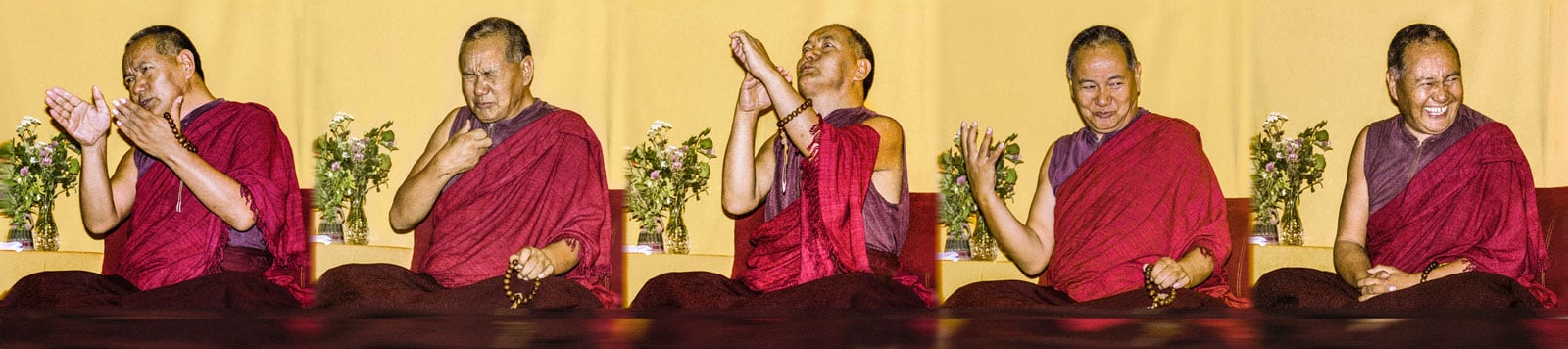
Compassion for all living beings is the heart of Mahayana Buddhist practice. In these three short talks, Lama Thubten Zopa Rinpoche shows us many different facets of practicing the compassionate good heart—its place in daily life, in meditation, and in tantric practice. Lama Zopa Rinpoche's own special compassionate presence permeates each teaching, imbuing every word with the essence of a loving, compassionate attitude that is directly transmitted to the listener, and to you, the reader.
The first talk, Practicing the Good Heart, is the transcript of a public talk given by Rinpoche in Sydney, Australia on 2 October 1987. It was originally transcribed and edited by Ven. Ailsa Cameron, and checked by Ingeborg Sandberg. A more edited version of these three talks was published as a Wisdom Basic Transcript in 1996 by Wisdom Publications.

Practicing the Good Heart
First I would like to thank very much everybody who has come here. I am very happy to meet again those whom I have met before, and those whom I have not met before in this life. I hope that there will be some benefit to you even from my mumbling. I thought to speak a little about Buddhist conduct and view. Buddhist conduct means not harming other living beings; Buddhist view means dependent arising.
The value of a good heart
Buddhist conduct involves great compassion for all living beings. If we have compassion in our heart and our actions come from that compassion, it is impossible for us to harm other living beings. Since we have compassion for others, our actions benefit rather than harm them.
First of all, remember that there is not one living being who wants to receive harm—not even one. Because of this, Guru Shakyamuni Buddha, the founder of Buddhism, trained his mind in compassion for all living beings and completed this training. This was the main practice accomplished by Buddha. With himself as an example, out of his great compassion, Buddha then advised us to have compassion for all other living beings, and not to harm them.
Even if we cannot benefit others, at least we should not harm them. On the basis of not harming others, we then develop the capacity to benefit them. This is Buddha's essential advice to us, which he himself accomplished. From the 84,000 teachings of sutra and tantra, this is the essential practice. If we do not do this practice of abandoning harm to others, there is no spiritual practice in our life.
No matter how much people claim to be meditating or doing profound, secret practices, if they cannot abandon giving harm to others, they are not doing the fundamental practice of Buddhism. I think the fundamental practice of all religions, not only Buddhism, is to abandon harming others and practice compassion. This is the essence of all the various religions. Whether we are Moslem, Christian, Hindu or Buddhist, the essential point is not to harm others and to generate compassion for them.
If we act in this way, our religious practice will bring happiness to others. We will give happiness to others, and we will also certainly obtain happiness for ourselves. Even if we cannot bring happiness to others, our religious practice at least will become beneficial in terms of our own happiness and will not harm us. This is a very important point to analyze and understand. Our practice of religion should at least benefit us with happiness now, and in the future.
It is very important to have a generous, compassionate mind. Without a generous mind, a compassionate heart, no matter how wealthy we are, there is no mental peace in our daily life. Our problems become even greater than before we became wealthy. Our mind becomes more dissatisfied, with more worry and fear. We have more enemies and tend to harm others.
If our heart is empty of compassion, no matter how educated we are—even if we know everything taught in all the universities, have every single degree!—again we have the same problem: we have no peace of mind. We have more pride than when we were uneducated and so many more problems. Our life passes full of problems and finishes while we are experiencing big problems, such as disharmony, worry, and fear.
Even if we are a Buddhist and know by heart all the sutra and tantra teachings of Buddha, and all the commentaries written by the pandits, even if we can explain them all well, if our heart is empty of compassion, if we do not have a generous mind towards other living beings in our daily life, there is still no peace of mind. Even extensive, intellectual understanding of Buddhism does not guarantee mind-peace. This can apply to any religion.
Even if we own diamonds or dollars equal to the number of atoms of the earth, if our heart is empty of compassion for others, our life is empty. Even with that much wealth, our life is empty; there is no happiness. However, even if we do not own one atom of diamond or one dollar, if we have compassion for all beings, there is great peace and happiness in our everyday life.
We can see that none of these alone—wealth, education, or religious knowledge—offers peace of mind. What provides peace of mind and happiness is having a good heart, a generous mind.
Nothing in life is more important than this good heart. Mountains of gold or diamonds cannot compare with the value of this good heart. Without compassion there is no peace or happiness in day-to-day life, so that wealth becomes worthless. Compared to the value of one generous mind, it is nothing. Compassion is incredibly precious and important. It is of the utmost need in each hour, each minute, each second, for the happiness of oneself, and especially for the happiness of all other living beings.
This good heart should be our prime concern in life. Among all our activities, our enjoyment of food, clothing and places, this good heart is the first thing we have to consider. We have to take care to generate compassion within our heart. Among all our everyday activities, we can see that this is the most important to practice from morning until night.
If we have a good heart, we experience much happiness and relaxation. We have no reason to feel angry or jealous and we have a very happy mind. When we speak, sweet words come out. Even our face is happy and smiling. At night we go to bed with a happy mind and have a very comfortable sleep, without any worries.
Otherwise, if we live our life with a very selfish, ungenerous mind, we think about nothing else except me, me, me: "When will I be happy? When will I be free from these problems?" If our attitude is like this, jealousy and anger arise easily, strongly and repeatedly, so we experience much unhappiness in our life, many ups-and-downs. During the day we have a cold heart and at night we even go to bed with a cold heart and unhappy mind.
No matter how hard one tries, a person with a very selfish attitude finds it difficult to make friends. Even when one does manage to make friends, the friendships don't last. Sooner or later, after a few days, after a few hours, his friend becomes his enemy. Anyone with a very strongly selfish attitude has few friends and many enemies. Wherever they go, they always have problems. People always complain about them and warn others, "Don't let him stay at your house!" Even though this person wants only a good reputation, does not want the slightest bad reputation, his or her selfish mind naturally brings about a bad reputation. When they visit other people, people are not happy to see them.
However, people who have a good heart, who care more about others than themselves, always have a good reputation. Wherever they go, they have many friends and they find that other people are happy to help them. When this someone with a good heart goes to visit other people, they are happy to see him and have him stay in their house. People are always very happy to meet and help such a person—crowds of people want to help him.
The other selfish, impatient person, even if he has a very miserable time, has difficulty finding people to help him. Nobody wants to help him. Other people are even glad to hear that he is sick; they may even wish him to die.
It is the complete opposite for the person with a good heart. There is much happiness in his life. Even if he has nothing but water to drink, he is very happy and can enjoy it. If our attitude is very selfish, very impatient, very cruel, even if we eat food costing many thousands of dollars or drink very expensive drinks, we find no enjoyment. We cannot even taste the food because our mind is filled with problems and worries. We cannot even enjoy eating expensive food in a luxurious place.
Even though physically we may be able to go to the moon or other planets, if from birth until death we do not have a good heart towards those with whom we live, there is no happiness. Our life becomes empty—an empty human life. A good heart is priceless, more precious than anything else in the world.
The happiness of others
Starting from our family, the happiness of all beings is dependent upon us. Eliminating their problems, giving them happiness, is our responsibility. This is very important to understand, and to feel, in our everyday life.
I often use the example of a couple in which the wife practices good heart while the husband is selfish. Because the wife has more thought of cherishing her husband than herself, when he causes her some problem, she does not retaliate. By not retaliating, she not only has happiness in her life, but gives him fewer problems, which means more peace. If she retaliates when he gives her a hard time, his problems become greater. Because she does not retaliate, he does not have that additional problem, so there is more happiness for him.
If we have a toothache, but today the toothache is less painful than yesterday, we say, "I am better today." It does not mean there is no pain at all; it just means we are happier today. Why? Because today we do not have as much pain as we had yesterday. The pain is less today so we are happier, and label "better" on that.
It is similar with the couple: As the wife practices good heart, the husband receives one problem fewer, so he is happier. His happiness came from her, is dependent on her. In the same way her happiness is dependent on him; it has to come from him.
Like this, if there are twenty people in a family and one of them practices good heart, nineteen people receive one problem fewer. That person does not retaliate, so does not harm the rest of the family; they have that much more happiness. Their happiness came from this person. We can see very clearly how this one person is responsible for the happiness of the nineteen other people; their happiness depends on him.
Now, it is the same with all the human beings and creatures on this earth, who all want happiness and do not want suffering. If one living being has a good heart and does not harm others, the harm received by all the rest of the living beings becomes that much less; they receive that much more happiness. We can see that this one person is responsible for the happiness of all living beings.
It is similar with each of us here. Starting from our family—the people with whom we live, eat and work—the happiness of all living beings is dependent upon us. If we change our selfish attitude to one of loving compassion, starting from our family, every other living being does not receive harm from us. On top of that, they benefit by receiving happiness.
If we do not change our selfish attitude, our actions will not change, nor will the harm we give to others. Starting from the small number of beings with whom we live, eat and work, who want happiness and do not want suffering, to the numberless other living beings, the harm they receive from us will not stop.
There is a big difference when we change from the selfish mind to the good heart, which cherishes others with loving compassion. Starting from the small family with which we live, all others receive happiness and benefit from us, and also receive fewer problems. If we do not change our selfish mind, all other beings receive harm from us. Whether others are happy or continue to receive harm is completely in our hands. It is up to us. It is our decision. Each of us is completely responsible for the happiness of every single sentient being.
For example, in our daily life, if we show loving kindness and compassion for everyone from morning until night, treating them with respect, they are happy. When others see that we have loving kindness and compassion for them, our attitude towards them makes them happy. Showing respect for them with our body and speech makes them happy. Even smiling at them makes them happy. The happiness of others definitely depends on us, on how we act towards them. If we think of the experiences of our everyday life, it is very clear that we are responsible for the happiness of others.
If we behave in the opposite way, following selfish, impatient and jealous attitudes, we make the people we meet unhappy and upset. The happiness of living beings is very much dependent on us. By not changing our selfish attitude, by not practicing the good heart and cherishing others, how many living beings have we harmed this year? From birth until now, how many beings have we harmed? If we do not change our attitude, even after death we will harm others.
Consciousness continues
Think deeply about this: The direct cause of this life's consciousness, which is shapeless and colorless, is not the fertilized egg, but a consciousness of a similar type that unites with the fertilized egg. There is continuation of consciousness. This present consciousness has continued from a past-life consciousness, and that consciousness continued from the consciousness of a previous life. In the West as well as in the East, many people, both young and old, are able to remember past lives and see future lives, their own and also those of others. This comes about through development of their minds, which means some achievement of the path, whether through ordinary meditation practice or karma. As the mind becomes more advanced, one can see and remember such things.
Some people can remember coming out of their mother's womb; some can even remember being in the womb. Similarly, some people can remember past lives. Those who cannot remember past lives are in the same situation as someone who cannot remember what he ate yesterday or what he talked about today. He also cannot remember all the games he played as a child. He cannot remember coming out of his mother's womb or what he experienced in the womb. His inability to remember these is not a valid proof that he was not in his mother's womb, that he was not born from his mother's womb, that he did not play as a child. In the same way, someone's inability to remember past lives and see future lives does not mean that past and future lives do not exist. They do exist—other people with more advanced minds and greater knowledge can see them.
As our mind becomes more advanced, we see that the selfish attitude of our present life is the continuation of the selfish attitude of our past life. And that selfish attitude continued from another past life, and so on. Just as the continuation of our consciousness does not have a beginning, the continuation of our selfish attitude does not have a beginning. Therefore, we have been harming other living beings from beginningless time until now. If we do not change our attitude in this life, while we have this precious human body, we will continue to harm other beings in all our future lives. This selfish attitude is unbelievably harmful.
By thinking of history, we can also understand how in the past millions and millions of people were killed because one person did not practice the good heart. Uncountable numbers of creatures also received harm. If this one person had practiced the good heart, if he had just practiced patience, all these millions of people and uncountable numbers of creatures would not have been killed. We can see that the happiness of all those living beings was completely dependent on that person; the entire problem came from that one person not practicing the good heart, not cherishing other living beings.
Cherishing others
To practice the good heart in our everyday life is more important than anything else. Feel this responsibility. Think again and again, "I am responsible for the happiness of all living beings." When we wake up in the morning, as we open our eyes, we should think, "I am responsible for the happiness of all living beings, and for the elimination of all their problems. This is the purpose of my life. This is why I have a human body." If you have dogs, cats or birds in the house, think also of them, "The reason I have this precious human body at this time is to eliminate the problems of other living beings, and obtain their happiness. This is the meaning of my life." Then think, "Cherishing myself is the greatest obstacle to my happiness and the fulfillment of my wishes. Self-cherishing is my greatest enemy. And there is no question that it is the greatest obstacle to fulfilling the wishes of all living beings and obtaining their happiness. There is no greater obstacle than this."
Many times we ask such questions as, "How can I make my life worthwhile? How can I benefit others?" The best way to benefit others is to reduce our own selfish mind. The more we reduce our selfish mind, the less harm others receive from us, and the more temporal and ultimate benefit. This is the best solution.
Those who practice Buddhism should think: "Until I achieve enlightenment, until I die, this year, this month, this week, and especially today, I won't allow myself to be controlled by the selfish mind. The best way to obtain happiness for all living beings and fulfill all their wishes is for me to cherish others. Until I achieve enlightenment, until my death-time, this year, this month, this week, and especially today, I will never separate from bodhicitta, the thought cherishing other living beings." In the morning when we wake up, with strong determination, we should make this plan for our life.
When you go to work, do not think, "I am going to work for my happiness, because I want money and comfort. Without the money I won't have a comfortable life." Instead of this selfish attitude, even if you cannot think of all living beings, at least remember the kindness of the people who employ you. Think, "Because they have employed me, I can enjoy my life, and I have the opportunity to practice the good heart and benefit myself and others. They are very kind to me." Remembering their kindness, you then go to work. Even though you are paid to work, your attitude is to benefit your employers. At the beginning and from time to time while you are working, remember this motivation.
Think of all the time we spend in one day eating and drinking. All our enjoyments—food, clothing, shelter—have been received through the suffering of uncountable numbers of living beings. To provide our enjoyments, other beings created much negative karma by doing unwholesome actions harmful to others, many of whom were killed. Since we receive our enjoyments from the suffering of so many other beings, it is very important to use them with the thought of benefiting others. To use these enjoyments with a selfish mind, for our own happiness, would be very cruel and very upsetting. It would show a very poor mind.
Whenever you eat or drink, remember the purpose of life. Be aware of your responsibility, which is to obtain happiness for all living beings and eliminate their sufferings. The purpose of your life is to offer service to others. For this reason you need to be healthy and have a long life; therefore you take your food as medicine.
If you spend your whole day with the thought of benefiting others, all your activities—whether working in an office or at home, eating, dressing, putting on makeup, and so forth—become pure Dharma, because they are unstained by selfish mind. All your actions become pure virtue and the cause of happiness. This is the best, most reliable business.
If you are taking care of your children or parents, or doing similar work, again remember, "My responsibility is to bring happiness to all living beings and eliminate all their suffering. I am supposed to do this, but it is wonderful that at least I have become of some use to some of them. At least my body is benefiting one being (your child or parent). How wonderful this is!" Think like this and rejoice.
If you constantly do your work with this attitude, there is great happiness all the time and no space for depression. Whether you are working for a hundred people or just one person, and no matter how hard your work is, think like this, especially thinking of yourself as the servant of others. Instead of thinking that others are there for you to use for your happiness, think, "I am the servant of others; I am here for their happiness. Like one of their own limbs, I am working to eliminate their problems and obtain their happiness." If you think that you are the servant of others, your problems stop. If you think that others are your servants, problems arise in your mind.
Destroying yourself
If you have a problem with alcohol or other drugs, feel the same responsibility, "I am responsible for the happiness of all living beings. Besides the pleasure of drinking and taking drugs, even if I received ultimate happiness, it would be nothing to be excited about—I am just one person. Even if every creature on this earth were angry and negative towards me, criticizing and beating me, it would be nothing to be depressed about—I am just one person." If you do not practice the good heart, there is a danger that you, this one person, will harm all others, who are uncountable in number. Like putting poison in a city water supply, you could harm everyone. It is incredibly important that you do not harm all other living beings like this.
If you have a problem with alcohol or drugs, think: "For me to offer service to others, who are countless, is unbelievably important. In my life there is nothing more important than this. How cruel it would be if I were to give up all the rest of the living beings, who want happiness, help, loving kindness and compassion from me. Just as I want all other beings to help me, to show me loving kindness and compassion and not harm me, they all want happiness and do not want suffering. They want nothing more than this. They are all exactly like me. What I want is what they want. So, in terms of my own life, what should I do? Should I work for myself or should I work for others?"
There is nothing more important than working for others. They need your help for their temporal and ultimate benefit. They want and need this from you. As long as you ignore them and cherish only yourself, you will not even obtain your own temporal happiness.
Think like this: "This is actually my wish, but in reality I am completely destroying myself. By not controlling my mind, by following my desire to keep on drinking and taking drugs, I am becoming unhealthy and shortening my precious human life. In reality I am destroying myself. I am destroying this precious human body, which has an incredible potential to benefit others—even one living being. And there are countless living beings to whom I can bring so much temporal and ultimate happiness. Other living beings are dependent on me. By destroying my precious human body, I'm actually harming all those other living beings. I'm not allowing myself to serve others and fulfill their wishes. Seeking happiness only for myself means giving up all these numberless living beings."
Buddhist teachings explain that in reality, as long as you follow desire, there is no satisfaction at all. This is the worst suffering. You follow desire and there is no satisfaction. You follow desire again, with no satisfaction. You try again and again, but find no satisfaction. You try until your body collapses, your whole life collapses. You drink until you are unable to move. The end result is that you become incapable of functioning. You end up with a very empty life, and experience great fear and anxiety when you die. I have heard from nurses that alcoholics die with a lot of fear. This fear before they die is a sign that they will have even more of a problem after death.
It is the same with smoking. You may find you are smoking so many cigarettes that you cannot stop, even though you know it may be causing cancer and many other diseases. In Tibetan Buddhist teachings, especially in the predictions of Padmasambhava, tobacco is regarded as a black food, grown through wrongful prayer. Evil beings prayed that tobacco would disturb and harm people trying to live a good life, interfere with the development of their minds and not allow them to practice virtue, to practice meditation.
Many shortcomings of smoking are explained in the teachings. Cigarettes, opium and such things pollute the chakras and the wind, which is the vehicle of the mind, and thus cause many disturbing thoughts to arise. Smoking causes anger and attachment to arise very easily; it damages the mind, making it very dissatisfied and impatient. Smoking makes it very difficult to develop your mind, and it especially interferes with the practice of tantra.
Cigarette smoke enters the mouths and noses of surrounding people—even those who do not smoke—when they breathe in, then causes harm to their bodies and minds. Even though the person smoking may be a long way away from me, in another room, the smoke comes through the windows and goes into my lungs. I feel a pain in my heart.
When there is a lot of smoke, the mind becomes unclear and very, very sleepy. This proves that cigarette smoke pollutes the body and the mind. This is talking only about the problems you experience in this life—not in the life after this. As explained in the sutra teachings, what you will experience in the life after this will be much heavier.
You may spend a lot of money every day on cigarettes, alcohol or other drugs. If you are a Buddhist, besides giving this money to others, you could accumulate much good karma by offering it to the Triple Gem. You use all that money, which comes from your parents or other people, on alcohol—for just one or two minutes of pleasure. You could give all that money to charity. There are many people dying of starvation in the world. In Africa and many other places, there are famines. There are a lot of poor people and people in homes for the aged and hospices who need help. In the East there are Tibetan refugee camps. With all that money you could benefit hundreds of thousands of living beings. There is so much you could do with it. If you do not use the money in this way, but use it only for your own happiness, you are actually destroying your own life. Not only are you destroying yourself, but you are preventing yourself from benefiting all living beings. This is very important. Choose which you want to do: Do you want to benefit others? Or do you want to destroy yourself?
Following desire
You are all familiar with Elvis Presley, who is very famous in the West. In his very last show Elvis sang: "I tried and I tried, but I can't get no satisfaction. I tried and I tried ...." The song goes on and on like this. Remember that: "I tried and I tried, but can't get no satisfaction." Visualize Elvis Presley, completely covered with sweat, with tears streaming down his face because he could see that his whole life was empty. He did not find any satisfaction. This is an incredible teaching for us, an incredible meditation on the need to control the mind, to control desire.
In reality, in the second that we stop following desire, there is satisfaction. Right in that moment. No matter where we are, on that same meditation cushion, in that same house, right in that moment, there is satisfaction. Before, we experienced incredible dissatisfaction. We tried many things, but nothing made us happy. We had so many plans and kept ourselves busy acquiring sense objects, but even after finding them we were never satisfied. We could never have enough.
Following desire brings more and more problems, in this life and in so many future lifetimes. Following desire brings unbearable problems, and for so long. The cause of all these problems is stopped immediately we stop following desire. If we recognize the shortcomings of desire and stop following it, we immediately find satisfaction, happiness, peace of mind. As long as we are friends with the selfish mind, we have problems continuously, hundreds and hundreds of problems, one after another. Everyone seems to be our enemy and we especially experience relationship problems. As long as you are oneness with the selfish mind, even though your husband or wife may not have run away with someone else, even though you may physically live together, there are still many problems.
Destroying the selfish mind
Right in the minute that we separate from the selfish mind, all our huge problems stop. Our huge depression, which was like a gloomy valley completely covered by fog, is stopped. Immediately we separate from the selfish mind, all that depression is no longer a problem. All the disharmony and problems, which were like living in a fire, are immediately stopped.
When your husband, wife or friend leaves you to live with someone else, you experience so much worry and anger that you are unable to eat, unable to sleep and have to take a lot of pills. Again, as soon as you separate from the selfish mind, all these problems are no longer problems. Immediately, right in that minute. When you are one with the selfish mind, it is a problem; when you separate from the selfish mind, it is no longer a problem.
It is not enough simply to know that all these problems come from the selfish mind; you have to find a solution. The solution, once you have seen that the original root of the whole problem is related to your selfish mind, is to separate yourself from this root. This is the best way to stop this huge problem and find peace of mind, calmness and satisfaction. In this way you become your own psychologist, your own doctor.
If you separate from the selfish mind, since the wind—the vehicle of the mind—is not disturbed and violent, the four elements within your body are not disturbed, so you are healthy. Otherwise, by following your selfish mind, you make yourself unhappy and disturb your own mind. As you become very impatient or jealous, the wind is disturbed, which then causes the four elements within your body to become unbalanced. This can even be physically dangerous, causing sickness, heart attacks and so forth. As you know, from worry and fear, ulcers and so many other problems can arise.
Identifying the problem is not enough. The only way to stop problems completely is by actually separating from the selfish mind. If you do not train your mind, even if the external condition changes and you manage to persuade your partner to come back to live with you, after a few days or months or years you will again experience the same problem.
As long as you are completely dependent on external conditions, you are not giving yourself freedom. Conditions always change. There is nothing to trust; nothing is definite. Again and again you will become depressed and the thought to kill yourself will come. When you cannot think of any solution, any way to change the conditions so that your partner comes back to you, the thought to commit suicide comes. Once this thought comes it takes only a minute to kill yourself. To stop this precious human life takes just a minute.
This is how the selfish mind treats you. If such a situation happens, remember Shantideva's advice in A Guide to a Bodhisattva's Way of Life: "If you are able to manage it, manage it. There is no point in worrying. Some things you cannot manage at all and again there is no point in worrying because you cannot manage them." Worrying about something about which you can do nothing is useless; for example, worrying that you cannot make the sky become earth.
In situations where there is nothing you can do, it is good to practice rejoicing. Think: "I have enjoyed living with my friend for this length of time. It is the same for this other person. As I wanted happiness through living with her, he wants the same happiness. He is as important as I am; his happiness is important. There is no reason why he shouldn't have the same opportunity to enjoy this happiness as I had." Rejoice, thinking how wonderful it is that this other person has found the happiness that he wanted. In this way the situation becomes a cause for you to create good karma.
In your everyday life rejoicing when others have success in Dharma or in business, or find a friend, a good house, any good thing, becomes the cause of your own success. Becoming jealous of others' success interferes with your own. To create the cause for your own success, it is very important to practice rejoicing.
If your friend leaves you, think: "This is exactly what my selfish mind needed. These problems have been given to me by my present selfish mind. Out of my selfish mind, I have done something that she doesn't like. In past lives, in past times, out of selfishness, I created the cause to have this disharmony and separation. This relationship problem has been given to me by my selfish mind. So, now, instead of suffering by taking all these problems upon myself, I want to give all these problems back to my enemy, the selfish mind, and destroy it."
Practice mentally giving all your problems to your selfish mind. Instead of thinking: "This is my problem", give it to the selfish mind. If you use all your problems as weapons to destroy your selfish mind, you will have no anger or jealousy left at all, and no opportunity to create negative karma.
Then think: "These people are unbelievably kind to me. I follow my selfish mind, but these people are helping me to destroy my enemy, my selfish mind, which is the source of all my problems. Because I cannot destroy my selfish mind by myself, they're helping me." Rather than allowing anger or jealousy to arise, think in this way. Feel their kindness from the very depth of your heart. Their kindness is greater than if they had given you a million dollars.
Think: "They are giving me this present so that I can destroy this selfish mind, which interferes with my obtaining all my happiness, especially the peerless happiness of enlightenment, and happiness for all other beings. Destroying this selfish mind is an incredibly valuable present!" You can derive unbelievable happiness from this thought. By practicing in this way, you become your own guide, instead of your own enemy.
No matter what problem you experience, whether in your relationship or with a disease such as cancer or AIDS, from time to time think like this, "This problem is unbearable for me, but this is not only my problem. Numberless other beings have similar problems, and some even have much worse problems. How wonderful it would be if all these beings were freed from all these problems, all these sufferings and their causes, and I could experience all their problems upon myself." Pray for this to happen, "May I experience all their sufferings and causes upon myself, and may they have all happiness."
Day and night, while you are working or talking, continuously think: "I prayed for this to happen and now I have received all their problems upon myself." Whether experiencing a disease such as AIDS or cancer, a relationship problem, a business failure or a lost job, think, "I have prayed to receive all the problems of other beings. I am now experiencing this problem on their behalf." Again and again think that you are experiencing your problem on behalf of others.
Instead of thinking, "I have this problem, I have that problem—when can I be free?", think again and again that you are experiencing the problem for the sake of all living beings. In this way there will be no depression and much happiness. All the problems you experience will become worthwhile and virtuous. Even if the problem continues, it will become of unbelievable benefit in developing your mind, your good heart and bodhicitta. This is the most beneficial thing. By developing your mind and good heart, you can fulfill the wishes of all living beings, obtaining happiness for all of them. Having problems becomes more beneficial than not having them. This is Mahayana thought transformation.
Buddhist view
As I said in the very beginning, Buddhist conduct is not harming other sentient beings and Buddhist view is dependent arising. Happiness and suffering arise by depending on causes and conditions. We label "happiness" on the calm feeling that has a sinking, satisfied aspect; we label "suffering" on the rough feeling which is dissatisfied in character. Happiness and suffering are dependent on the thought labeling and the base, the different characteristics of those feelings. Happiness exists in mere name, by depending on the thought and the base, and it is the same with suffering. In dependence on the particular base—that rough feeling which is the opposite of satisfied—our mind labels "suffering." This is the way suffering exists, in mere name.
Since suffering is a dependent arising, depending on causes and conditions, it can be stopped by depending on other causes and conditions. If suffering were not a dependent arising, if it were independent, we would have no opportunity to stop it. Suffering comes from the mind, from attachment, anger and ignorance, which are also dependent arisings. Past actions motivated by attachment, anger and ignorance have left imprints of these on this mental continuum. These imprints cause attachment, anger and ignorance to arise again when we meet the various desirable, undesirable and indifferent objects.
These imprints are present because they have not been ceased through generation of the remedy of the path within our mind. However, even though the imprints are there in the mind, if we put the teachings into practice by remembering to apply the meditations while we are with the object of our attachment, anger or ignorance, we can stop these delusions from arising towards that object. If we remember the meditations, we can control our mind so that there is no suffering, no confusion. If we do not practice the relevant meditations to control our mind when we are with the object, these disturbing thoughts arise and we then experience problems.
We eliminate the imprints by actualizing the remedy of the path within our own mind. In our daily life, each hour, each moment, even right now, if we are aware, watching our mind and remembering the various methods to control it, we can stop disturbing thoughts and problems. Because it is a dependent arising, the cause of suffering can be erased.
Just as non-virtuous thought is dependent on its cause and conditions, so is virtuous thought, the cause of happiness. By ceasing the causes and conditions of disturbing thoughts, with other causes and conditions, the mind is transformed into virtue.
Non-virtuous actions result mainly in the suffering of suffering, which are recognized as problems even by those who are not familiar with Buddhist teachings. Basically, non-virtuous actions bring the suffering of suffering; virtuous actions bring happiness. Depending upon the result it brings, an action is labeled "virtue" or "non-virtue." This is how virtue and non-virtue are dependent arisings, empty of existing from their own side.
All this is possible because the basic nature of the mind, which is non-physical, colorless and shapeless, is clear and knowing, or able to perceive objects. On the particular characteristics of this phenomenon, we have merely imputed "mind." Because the consciousness joins from one life to another, we label this "continuation of the mind." In dependence on each particular function, a different name is given. Since the mind arises in dependence upon the thought and the base, we can see how the mind exists in mere name.
In reality the mind that appears to us as a real mind, in the sense of existing from its own side, is a complete hallucination, completely false. When we think of the evolution, it is very clear that we give a different name to each of the mental factors. Our mind merely imputes, "This is patience, this is anger, this is loving kindness, this is compassion. This is feeling, this is recognition." The mind that exists is merely imputed on the base by thought. What appears to us as a mind existing from its own side is completely empty, a complete hallucination. We should realize that this mind existing from its own side is empty, as it is empty. If we realize this, we have realized the secret of the mind. This emptiness is the clear light nature of the mind, the absolute nature of the mind.
It is the same with the I. There is no reason at all to say, "I am sitting here", except that your aggregates, the association of your body and mind, are sitting on this cushion. That is the only reason. The I is merely imputed on these aggregates by the thought. At the moment your aggregates are performing the action of sitting, so, "I am sitting." When your aggregates perform the action of listening, "I am listening" is labeled on that. Afterwards, when you get up, when the aggregates change their action from sitting to standing or walking: "I am standing" or "I am walking." Or right now, "I am sleeping. I am tired. I am exhausted from listening to all these mumbles." Each time the I is merely imputed on the base by the thought. No I in addition to this exists. Not the slightest atom more than this exists. Whether you believe this or not, this is the reality. The I who experiences all this happiness and suffering, who does all these activities, who can benefit others, who can achieve enlightenment, is merely imputed, existing in mere name on these aggregates.
However, the I does not appear in this way; instead, it appears as unlabeled, existing from its own side. This I that appears as unlabeled, as real, is the object of refutation. Realizing that this I is empty is realizing the absolute nature of the I. This is the Middle Way. By realizing this, we can remove the ignorance which believes that the I, which is merely labeled, exists from its own side as unlabeled. By developing the wisdom realizing the absolute nature of the I, one can remove this ignorance, the root of the whole problem. By doing this, one also removes all of samsara, and achieves liberation. By developing this wisdom, especially with the skilful means of bodhicitta, one is able to achieve enlightenment, the state of omniscient mind, for the sake of all sentient beings. On the basis of the Paramitayana path, one develops the greatly skilful means of tantra, especially Highest Yoga Tantra. With the generation and completion stages of the deity yoga of Highest Yoga Tantra, one achieves great bliss and the illusory body. With Highest Yoga Tantra one is able to achieve quickly the peerless happiness of the state of omniscient mind; and then, by revealing the various methods that fit the various levels of mind of sentient beings, one is able to lead every single sentient being to the peerless happiness of omniscient mind.
The heart advice
All this success depends on how much we practice good heart in our everyday life. As Shantideva mentions in A Guide to a Bodhisattva's Way of Life: "As long as you do not drop the fire, you cannot stop the burning." Following self-cherishing thought is like holding a red-hot coal in your hand. As long as you do not drop it, you cannot stop the burning. Like this, if you do not give up your selfish mind, if you do not give up yourself, you cannot abandon suffering. "To pacify your own suffering and the sufferings of other sentient beings, give up yourself for other sentient beings and cherish them as yourself." This is very clear, very essential advice to you from the great bodhisattva Shantideva. From all the words of sutra and tantra, this is the essential advice of all the Buddhas of the three times, including Guru Shakyamuni Buddha. This is the heart advice.
If you follow this advice, you and all other sentient beings will find happiness, now and in the future, always. I definitely believe that if you put this Buddhist psychology of thought transformation into practice, there is immediate benefit. It is only a question of whether you put it into practice when there is a problem. It is only a question of that.
In a lamrim teaching Lama Tsongkhapa explains, "One follows desire in order to get satisfaction, but the result is only dissatisfaction." The result is that the problem, the result of following desire, goes on and on and on; we have the problem for much longer in this life, and in future lives - especially in future lives.
It is not only that you have to experience the problem for such an inconceivably long time, but it is so unbearable. And you have so many problems. From this one problem, so many other problems arise. Because you do not get what you want when you follow desire, anger arises towards other people, and jealousy. So many other problems come. Then each of these problems creates many more problems, more and more, just as a tree with many thousands of branches arises from one tiny seed. What Lama Tsongkhapa says is completely clear and accords with our experience. Think deeply about this.
Next chapter: The Nature of Compassion »