
Impermanence and Death
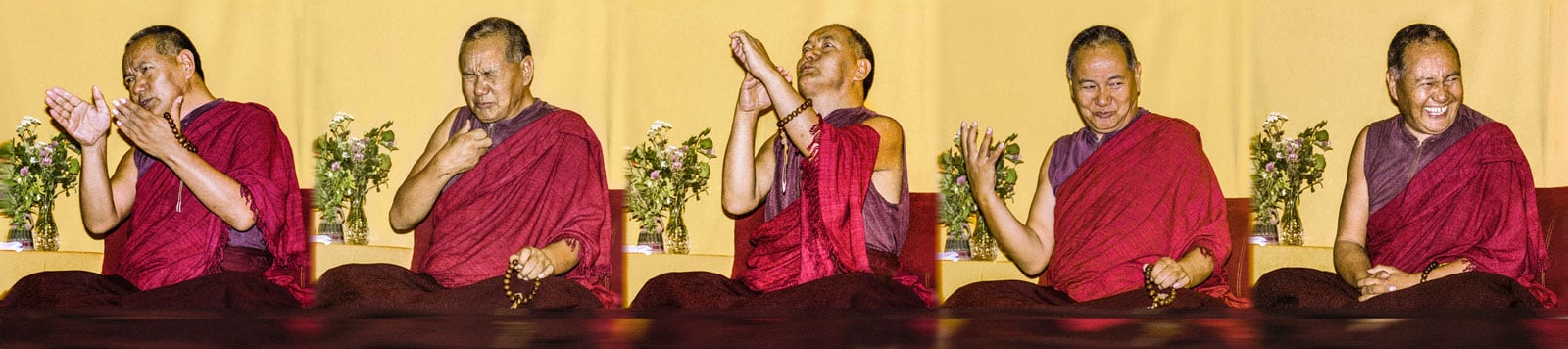
Lama Zopa Rinpoche gave this commentary on the Impermanence and Death section of The Wish-Fulfilling Golden Sun at the Sixth Kopan Course in April 1974. (The entire transcript of Rinpoche's teachings during this course is available here.) The indented sections are from the root text; the sections in italics are topics for analytical meditation in the first person. The rest is Rinpoche’s commentary, edited from the Lama Yeshe Wisdom Archive for the FPMT’s Discovering Buddhism program by Nicholas Ribush.

How Long Is The Life Span?
Life is so fragile, its nature is transitory. It is easy to see how it changes in only one year, a month, a week, a day, an hour, a minute, and second by second. There are sixty-five of the shortest instants in the time it takes to snap my fingers, and even in those short split seconds life is changing.
“Why should I be surprised that life changes so much? That’s natural; let it happen!” To think in this way is very foolish and ignorant because as life is changing so quickly in those very short instants I am becoming older.
Some may say, “That’s natural, I become older; let it happen!” This is another wrong attitude, not caring about becoming old. Others want to deny the impermanent nature of their lives; they do not want to see the true nature of it at all. They try to disguise their appearance in the eyes of others, who also play the same game. This is an absolutely vain attempt, such actions are not of the potential knowledge level of the human mind, and their creation is certainly not the purpose of the human rebirth from the Dharma point of view. No artificial effort can change eighty years into sixteen. Age can never decrease in the view of the truly enlightened mind, which fully realises the samsaric body’s suffering because of its impermanent nature.
These people’s minds have a double illusion: belief in artificial creation (scientific discoveries used to preserve matter and life from ruin and decay) and the wrong conception that a permanent subject-object exists. The first wrong belief causes problems to arise continually. The second wrong idea causes one to become more ignorant, lazy and careless.
There are two levels of impermanence:
1. Gross—changes of matter happening in long periods of time.
2. Subtle—inner changes of mind and invisible changes of matter happening in the shortest part of a second.
Our mind can’t perceive subtle changes of matter; it can see only the gross changes from day to day, hour to hour, such as ruin, death, etc. Gampopa said,
This vessel-like world that existed at an earlier moment does not do so at a later one. That it seems to continue in the same way is because something else similar arises, like the stream of a waterfall.
I should worry about the changes of becoming old. Why should I worry? Because as years, months, days, split seconds are passing and I’m getting older, the perfect chance of attaining enlightenment given by my human rebirth is becoming exhausted and I’m getting closer to death. I have the right equipment, a pilot, a spaceship and enough fuel to make a trip around the universe and visit all the planets. But here I sit, engine running, burning up fuel while my mind is distracted by other things. The longer my mind remains distracted the more I miss the chance of seeing the planets; as the fuel burns, time gets shorter. However, even this analogy does not adequately show the tragedy of wasting this precious human rebirth.
Even if the duration of my life were 100,000 years death would approach like this. With each second that passes, the minutes shorten; with each minute, the hours; with each hour, the days; with each day, the months; with each month, the years. Each passing year shortens my life and the time of my death draws nigh. Although well taken care of, a life of even this great length must end, so why not mine? By comparison my life is extremely short, perhaps lasting forty to fifty, certainly not more than eighty to one hundred, years. With each second, minute, hour, day, month, year, it shortens, nearing death. This human life is really short; this body of mine has not much longer to live.
During meditation time, it is good to remember the fundamental meditations that you should use. These are important topics because they help you to see impermanence, to receive realizations of the impermanence of your life. These are the fundamental things that are helpful, useful, for you to realize how life is impermanent.
As the sun rises, quickly passes across the sky and sets, so quickly—like, this morning we were doing something, now it’s evening and the time has gone so fast—like that, as the sun passes so quickly, as it changes that much, as it’s impermanent, in the same way, our life changes that quickly; from the time we are born until we die, life passes quickly by.
It’s the same with incense or candles burning—just as they are impermanent and quickly finish, so too, life also changes quickly and finishes soon. As they are not permanent and change quickly, so too does the human life.

Since you were born until now, until you die, just as the sun has been rising and setting every day, so has your life been approaching death in the same way. Day appears, finishes; night appears, finishes; they are impermanent, they do not always continue. Day doesn’t always exist as day; it’s not permanent. Just as day changes into night, everything else, all causative phenomena, change just as quickly. As day goes, as night goes, as the sun goes, everything changes in the same way.
All plants are impermanent, so, as they grow, they get older and older. From the time a shoot bursts from its seed, it gets older and older, decays and dies; it’s impermanent.
In summer, everything is beautiful; in winter, everything decays; nothing is permanent, nothing is definite. As the leaves change color in fall, similarly, the whole country changes, the whole Earth changes; nothing is definite—definite, here, means something always retaining the same form, color, aspect, always existing in the same way. Nothing is definite.
It has been like this since you were born, since your mind was conceived in your mother’s womb. From that time, however, you have had a certain karmically determined length of life, the result of your previous karma: forty years, twenty-five—however many years you have from the time your mind was conceived in your mother’s womb until your death, their number has been determined by your karma. Your projected lifespan is karmically determined.
It’s certain that you’re not going to live much over one hundred years if that; you probably won’t get past ninety. But even if you’re going to live a million years, your life starts to finish at the time of your conception. As soon as your mind enters your mother’s womb, your years start running out, the impermanence of your life begins. Even if you’re going to live a hundred thousand years, as soon as it begins, your life starts getting shorter. It changes in the shortest fraction of a second—thousandths, millionths; as even the nanoseconds pass, nothing remains the same; nothing lasts.
Then, as the seconds pass, so do the minutes that are made up by them. As the minutes pass, so do the hours that are made up by them. As the seconds, minutes and hours pass, life changes. As twenty-four hours pass, so does a day; as thirty days pass, so does a month. As the months pass, so do the years. No matter whether your lifespan is a thousand years or a hundred thousand, they’re constantly changing and you’re getting older, decaying—from the time your mind entered your mother’s womb.
From the moment life begins it starts to finish. As each second passes, that much life has finished and you draw closer to death. Similarly, as each minute, hour, day and month passes, that much of your life is over and you are that much closer to death. Eventually, when a hundred thousand years have passed, the person whose life was that long has reached the time of death.
So, even if your life could be that long, it would still constantly be getting shorter, finishing, getting closer to death, therefore, what need to mention our lives, which are that much shorter—six, fifteen, twenty, fifty…whatever it is, according to the individual? Comparing our lives to one of a hundred thousand years’ duration, there’s nothing to compare. Our lives are so short, so short. Even if they’re of average span, say sixty or seventy years, from the moment of conception, they get shorter and shorter, they start to finish. As our lives change, decay, in the shortest part of a second, that much life has finished and we are that much closer to death.
As many years as you have lived so far—twenty-five, twenty-eight, thirty, thirty-two—whatever it is, that much of your life has gone; you are that much closer to death and your time to live is that much less. No matter whether you think you are young or old, whatever your age, that much of your life has finished, gone forever, irretrievable. And what life you have left is certainly shorter than that which has passed; more years of your life have passed than you have left.
To summarize the way to meditate on the impermanence of this life, it’s useful to think like this:
- When you look at a river, think that just as the river flows, life finishes just as quickly.
- As the sun rises and sets, think that life passes just as quickly.
- While you see external things clearly changing—like incense or candles burning down—you don’t see your life finishing in parallel, but if you pay attention to what’s happening around you, you’ll easily be able to understand that your life is finishing without a moment’s delay. Just as the oil in a burning lamp is steadily consumed, so too is your life.
- As the seasons pass, so does your life; as summer, autumn, winter and spring pass quickly by, so does your life, getting shorter and shorter, finishing more and more quickly.

Relating what you see outside of you to yourself is extremely useful; it’s a type of analytical meditation. It is useful because it prevents your mind from becoming deluded; it makes your mind aware of change, of life getting shorter, of the brevity of human life, your life.
We see external things going by quickly but never reflect on our own life. We’re always planning on having a long life; we completely believe that we’ll continue to exist for a long time. We’re totally unaware of the way in which our life is actually evolving: finishing quickly every moment. The same evolutionary changes we see outside of ourselves are happening within; this is the actual evolution, but we don’t recognize it.
Not realizing how quickly and relentlessly life is finishing, then, becomes the greatest hindrance to making our whole life pure, to living in a positive way, to spending our entire life in the Dharma. Because of the wrong conception that we’re not going to die soon and are going to live a long time, we don’t remember death, don’t think of Dharma and don’t make any arrangements for our next life. Since we don’t think about death and how short life is, we have no fear. Because we have no fear of the brevity of life, death and the suffering that follows, we don’t change our life. Even though we might know all about meditation or be great Dharma scholars, if because of our wrong conceptions we remain unaware of the actual evolution of life, if we have no wisdom, we won’t change our lives; we won’t make them pure.
Being worried and afraid at the time of death doesn’t help because at that point there’s nothing we can do. No matter how great our suffering, fear and worry knowing we’re now going to die, there’s nothing we can do. Whatever negative karma we’ve created, whatever the huge amount of garbage in our mind, we have to carry it all. Since we’ve created the cause, we have to suffer each result. Then, no matter how much incredible fear and worry we have, it doesn’t help at all because there’s no time to practice. Our time is up, finished, gone. There’s nothing we can do to solve this problem.
If your house is susceptible to damage by flood, it’s wise to check beforehand how great the danger is. If you find the danger is real, you feel afraid; because of that fear you dam the river or make other arrangements to protect your house, family and property from being washed away or ruined by floodwaters. When you then know you are safe, your life becomes peaceful; you have no worries. In the same way, it is necessary to make arrangements to protect your peace of mind before the flood of death arrives. Before death arrives, research the danger and act accordingly.
If you don’t fear danger, you’ll never make the necessary arrangements to protect yourself. Therefore, you have to meditate on impermanence and death in order to realize the danger, feel afraid and do what’s necessary to protect yourself.
The advantages of remembering death
Thus, these teachings on death and impermanence are very useful. They’re useful for those who don’t practice Dharma because it makes them seek the Dharma out, and also useful for those who do practice Dharma, who meditate. We should always remember death. If we do, our mind will remain aware of the changes constantly happening within us, of how short the human life is, of how life is getting shorter every moment. This has great benefit.
Many great yogis got their start by meditating on the shortness of the human life, impermanence and death; their enlightenment, their realizations and their Dharma practice itself all came from this. Their strength and ability to live an ascetic life in extremely isolated places; to practice the vast and profound subjects no matter how long it took to receive realizations and attain the higher paths, how difficult it was; to generate the incredible energy required to persevere in their practice—all these things came from thinking about the shortness of the human life, impermanence and death; their receiving enlightenment in their lifetime was also due to this remembrance.
It takes a great deal of energy to reach enlightenment; the quicker you want to receive it, the more energy you have to expend. If, for example, you want to cover a long distance quickly by car, you need a good machine, good fuel and the energy to drive. Similarly, it’s not easy to attain enlightenment in your lifetime: you need great energy in order to overcome the difficulties of practicing Dharma and following the path. Where does such energy come from? It comes from remembering the impermanence of life and death. Therefore, this meditation is extremely useful. Even the enlightened being’s continually benefiting sentient beings can be traced back to this meditation.
Remembering impermanence and death is also important if you just want to be reborn in the upper realms or free yourself from samsara.
Remembering impermanence and death is powerful, too, because it helps you put an end to all 84,000 delusions. All the different negative minds—the great root of ignorance, hatred, all the other wrong conceptions, all the obscurations that prevent liberation from samsara and enlightenment—can be terminated by the energy generated through remembering impermanence and death; this is the original cause of the cessation of all these delusions. Therefore, it is very powerful.
If you remember impermanence and death, you can also prevent the arising of temporal negative minds such as greed, ignorance, hatred, pride, jealousy and so forth—minds that cause you discomfort, suffering and confusion—even if they arise strongly. You prevent them from arising because remembering impermanence and death makes you fear death and the shortness of the human life. Therefore, it is very useful in making your mind peaceful, even at present.
Not only is remembering impermanence and death useful at the beginning of the practice—where it persuades, or obliges, you to seek out the Dharma, to begin to practice, to meditate, instead of following your negative mind and acting opposite to the Dharma—it is also beneficial during the practice, once you are on the path, where it very useful in making you continue to practice. Even though you are in the middle of your practice, following the path, by remembering death you keep from losing your realizations and continue on to the higher reaches of the path.
And then, it’s useful at the end of your practice, as I mentioned before.
Finally, at the time of death, this remembrance is greatly useful in that it allows you to die peacefully, with happiness, a relaxed mind, no worries at all. Even though your relatives, your husband or wife, might be crying, the people around you suffering, you yourself can die with great joy, like going on holiday or a picnic. Definitely. The person who has spent his or her life meditating, remembering death every day, continuously making purification, creating merit, trying to stop creating negative karma, creating as little negative karma as possible, has no trouble at the time of death.
Question: Is it really possible to be happy at the time of death?
Rinpoche: Those who have created great, extensive merit are happy at the time of death. This is definitely possible.
For the purest Dharma practitioners, death is like returning home or going on a picnic. The intermediate practitioners’ minds at death are happy, worry-free. The lowest Dharma practitioners, at least those who created much merit during their life, aren’t upset at the time of death; they’re not worried—because they have done much purification and collected much merit, they’re not afraid at the time of death, which ordinary people usually are.
Therefore, since you derive so many benefits from remembering and meditating on death, instead of getting shocked by all this talk about it, forgetting it, stopping yourself from remembering it, this is what you should do; you should always remember and meditate on the impermanence of life and death. Why does this topic shock people? Why do people get shocked when they’re asked their age and the person replies, “Oh, you’re so old!”? Because it’s opposite to the way they feel, opposite to their wrong conceptions, to what they believe.
People always want to look young, not to age, not to change, but no matter how strong their desire, they have no choice. So, they get a shock when they’re told they’re old.
As time passes, the human life finishes. From the moment of conception in your mother’s womb, you’re constantly getting older. No matter how much you don’t want it to happen, you can’t stop change, you can’t stop the natural evolution of the impermanent life. Trying to forget it, not think about it, disguise it, cannot affect the actual evolution.
Artificial change—make-up, plastic surgery and so forth—cannot make you younger, cannot arrest the aging process, cannot prevent decay, cannot stop death. No matter if you spend your whole life trying to look young on the outside, you still age and die. You can’t stop death by forgetting about it, by never thinking about it, by closing your ears and not listening if somebody else is talking about it—nothing can stop death no matter how you try.
Whatever your age, however young-looking you try to remain through external means, the actual evolution is that you’re getting older, decaying; you’re like a piece of rotten fruit painted on the outside to look nice. A painted piece of fruit might look beautiful and fresh, but inside, as time passes, it decays, loses its taste, shrivels up and sours. No matter how much it’s painted on the outside, nothing stops the actual evolution of decay.
Since we have to go through the natural evolution of life without choice, all these external manipulations don’t help. No matter how much we try to disguise what’s happening and pretend that it’s not, we still have to experience the worries of old age and the suffering of death. Trying to forget these things is not the solution. If someone is coming to kill you, how does it help to pretend that it’s not happening? Ignoring the fact doesn’t avert the danger of the person coming to kill you. You have to do something else.
Therefore, instead of getting shocked and trying to escape from the natural way things are, do the opposite and constantly bring impermanence and death to mind. This is much more useful than trying to stop the fear that normally arises from remembering death by ignoring it, and it has all those advantages that I mentioned before.
As the great yogi Milarepa said, “I fled to the mountains through fear of death where I realized the absolute true nature of mind. Now, even if death comes to me, I won’t be afraid.”
This is very tasty; very effective. The great yogi Milarepa—his body was something else. If he showed up in the West today, he’d be arrested; everybody would hate the way he looked. He’d be hidden away out of sight. Because he’d spent a long time naked, doing austere practices, leading an ascetic life in the mountains, his body was blue, scrawny and ugly.
An austere life is one where you forgo possessions and temporal needs no matter how difficult it is, bearing whatever hardships arise in order to practice Dharma. So, remembering death, Milarepa felt afraid and his fear drove him to the mountains, where he realized the absolute true nature, the reality of the mind, and thus overcame his fear of death. This great achievement originally came from his remembering and fearing the shortness of the human life and death. We should learn from his example and practice in the same way—remember death and overcome fear of it before it comes. This is the wise approach, wise work, the skillful method; it is much better than what people normally do, which is avoid fear of death by not thinking about it until it’s time to die.
Another Tibetan yogi, who wrote many texts and was in constant communication with the female buddha Tara [Longdöl Lama Rinpoche], also practiced remembering impermanence and death, created much merit, received many realizations and eventually overcame his fear of death. He said, “When the impermanence of life manifests to me, I won’t be afraid. I can be a monk in the morning and take the body of a deity the same afternoon.” Not only was he unafraid of death but he also had the power to take a pure body when he left his ordinary one.
All these benefits that I’ve mentioned, then, are advantages of remembering impermanence and death, so this practice is very useful. By remembering death, you stop following your negative mind and therefore create less negative karma. The more you remember death, the better the results you experience. It’s very helpful.
The disadvantages of not remembering death
1. If you don’t remember death, you don’t remember Dharma, the only method that can fully eliminate fear of death. How does this work? If you don’t remember death, you’re not afraid of it, and if you’re not afraid of death, you get strongly attached to the comfort of this life and spend most of your time seeking only that—the comfort of this life. You have one idea after another, to do business, to do this, to do that, all to gain only the comfort of this life. You do one thing, then another, then something else, and this is how your entire life goes, working for attachment, the evil thought that’s attached to the comfort of this life. You don’t remember death and because you then spend all your time working for this life, you cannot practice Dharma. Then you finish up with great suffering at the time of death—not only have you used your whole life to create the cause of suffering, you also have no happiness or peace of mind when you die.
2. The next thing is that because you don’t remember death, you’re again controlled by attachment and follow your negative mind, saying, “Oh, I can practice Dharma in a couple of years; there’s no hurry. Maybe I’ll get to it in a year, in a few months’ time.” You put it off. Then when the time comes, you again say, “Maybe next month, next year.” This is a big danger. Even though you remember Dharma, you postpone your practice in this way. This comes from not remembering impermanence and death strongly or frequently enough.
3. Another problem is that you might try to practice Dharma, to meditate, but whatever you do doesn’t become pure. It’s very difficult for your practice to be pure if you don’t remember death. This is another shortcoming.
This wrong conception, this intuitive feeling—thinking all the time, every day, every morning when you get up—“I’m going to live for a long time; I’m not going to die; I’m not going to die today”—is the worst hindrance to making your Dharma practice pure. Whatever you’re doing—walking, sitting, whatever—the intuitive feeling “I’m not going to die today” is always in your mind.
Of course, anybody can say, “Eventually I’m going to die; after a long time.” This is not difficult to think, but it’s not enough. Even people who don’t meditate think this. But the problem for the meditator and non-meditator alike, especially the meditator, especially for those of us who are trying to practice Dharma, is that the thought, the wrong conception, “I’m not going to die today,” not remembering death, is that even though we try to practice Dharma, our practice becomes impure.
How does the thought, “I’m not going to die today” prevent our practice from becoming pure? Because when we think this, we have no fear of death, and because we do not fear death, we always follow, fall under the control of, attachment; attachment to the comfort of this life. This is the way it works; this is how not remembering death prevents whatever practice we try to do from becoming pure. Because of the continual feeling “I’m not going to die today” we have no fear of death, are controlled by attachment to the comfort of this life and therefore work only for this life. In this way, everything we do becomes the cause of suffering.
Because you aren’t afraid of death, even though you try to do something positive, try to meditate, your motivation is not pure; you don’t have the strong thought that what you are doing is only for the benefit of future lives and complete disregard for this life; you don’t have the feeling that the comfort of this life is like used toilet paper, something only to be cast aside. You don’t have strong motivation like this.
Even if you do have some idea of future lives, however, your desire to benefit this life is much stronger, so even when you try to practice Dharma, the motivation behind it is to gain the comfort of this life. Therefore, what you do doesn’t become pure Dharma. If you don’t have the strong motivation of wanting to achieve the supreme happiness of enlightenment, the cessation of samsara or the happiness of future lives and complete detachment from the comfort of this life—throwing the happiness of this life away like garbage—if you have the intuitive thought “I’m not going to die today” constantly arising, your practice becomes impure because the pure motivation to do the practice only for those higher goals is prevented from arising.
Question: If you discover that practicing Dharma solves your temporal problems, can’t that be a good kind of motivation for continuing your practice? You’re suffering before you hear about Dharma, and you start to practice. Then, after you’ve been practicing for a while you find that you’re suffering less and that your temporal problems are going away. Is that a motivation that’s concerned with this life?
Rinpoche: Do you mean thinking that through your pure Dharma practice you can release your temporal problems? Having this idea, then practicing Dharma?
Question: I mean you discover through experience that Dharma practice makes you happy and your temporal needs are met. Can that motivation still lead to pure practice?
Rinpoche: The Dharma practice that we are talking about here—following the remedies that are the opponents to the negative mind, practicing the antidotes to the delusions—even though you know from theory that it will make your present life happy or from experience that it does make your present life happy, as long as you are practicing the remedy to the delusions, it is always pure Dharma and therefore, there’s no danger. If you have the experience that renouncing this life also solves your daily problems, also brings much happiness into this life, and also know that you can receive the most supreme happiness of enlightenment, cessation of suffering and better future lives, and then with this knowledge practice Dharma, practice renouncing the evil thought of attachment to the comfort of this life, the remedy to the negative mind, what you do always becomes pure Dharma and is never an interruption to your path to enlightenment. Since you are never attached to the comfort of this life, even though you know the benefits of your practice for this and future lives, your practice becomes pure Dharma.
The purpose of my talking about the disadvantages and advantages is because they’re important to know and remember. Otherwise, you’ll have no interest in, won’t see the value of, meditating on death and impermanence; and if you don’t see the value, you’ll have no energy for the meditation. Then, if you don’t do the meditation, you won’t gain all the perfections that come from remembering and meditating on impermanence and death. Therefore, it’s very useful to think of the shortcomings and the benefits—what happens if you don’t remember these things and what happens if you do. This then gives energy to meditate on impermanence and death instead of getting shocked by the subject. You are interested in and willing to experience these meditations.
[A meditation on how life is finishing quickly, led by Lama Zopa Rinpoche]
First think how quickly a life of 100,000 years’ duration finishes, by seconds, months and years. Every second, month and year, a life of 100,000 years’ duration gets shorter and shorter. 100,000 years is the collection of a certain number of seconds, a certain number of fractions of a second, which start running out from the moment of conception in the mothers’ womb. As soon as life begins, as each split second passes, the whole collection of split seconds starts to finish; the entire collection of split seconds that together number 100,000 years diminishes split second by split second, and each moment, the life of 100,000 years gets shorter. In this way, by subtracting each split second from the whole, the total number gets less and that quickly, life finishes. Life finishes so quickly.
Similarly, think, “Since I was conceived in my mother’s womb, since my mind entered the fertilized egg, my karmically determined lifespan—sixty, seventy or however many years it is—has been decreasing. My projected lifespan has a finite number of hours, minutes and seconds, and within that time, there’s a finite number of split seconds. As each split second passes, each second gets shorter and finishes; as each second passes, each minute gets shorter and finishes; as each minute passes, each hour gets shorter and finishes; as each hour passes, each day gets shorter and finishes; as each day passes, each week gets shorter and finishes; as each week passes, each month gets shorter and finishes; as each month passes, each year gets shorter and finishes; and as each year passes, I have one year less to live.
“If I’m going to live to seventy, as each year passes—each year, which is made up of split seconds, seconds, minutes, hours, days, weeks and months—my life is finishing. As many split seconds as there are in my karmically projected lifespan, as each one passes, my life is getting closer to its end, continuously finishing. From the time of my conception, from the time my mind entered my mother’s womb, my life has been getting shorter and shorter, without a fraction of a second’s pause; from that moment, my seventy years have been running out. My life is like a pile of rice, from which grains are removed one by one—as each grain is removed, the pile gets closer to depletion. In just this way, as each moment passes, my life is finishing and I’m getting older and closer to death.
“As each second that makes up my seventy years passes, I’m getting closer to death. Day and night, whatever I’m doing—eating, drinking, sleeping, talking, meditating—moment by moment, all the time, I’m getting closer to death. From the time of my conception up until now, a certain number of the total seconds allocated to my life has passed; a certain number of days, months and years have passed. Since that time, I have been running towards death without even a split second’s pause.
“If I’m going to live seventy years, within that time I have a certain number of breaths; there’s a fixed number, it’s not infinite. So, each time I breathe, my life is finishing. As the total number of breaths that makes up my life decreases, I’m getting closer to death. In one day, I have a certain number of breaths, several thousand, so as each one finishes, I’m getting closer to death…just like an animal being led to slaughter.
“As a goat is led from its pen to where it will be butchered, each step it takes brings it closer to being killed, closer to death. The goat, being led by a rope tied round its neck, doesn’t know that with each step, it’s getting closer to death, and I’m just like that pitiful, ignorant animal; with each breath, with the passing of each split second, I, too, remain unaware that I’m getting closer to death.
“My life is getting closer to death just as a stone thrown into the air continuously gets closer to hitting the ground without a moment’s delay. Just like that my life is constantly getting closer to death. No matter how much I say that I’m alive, the fact is that every moment I’m getting closer to not being alive, to being dead.”
[A meditation on the circumstances of death, led by Lama Zopa Rinpoche]
Now I have received a perfect human rebirth, but does it last for long time? Will this human rebirth exist forever? No, it will not always exist; it will end after some time. Some time soon, the body that I now have will become empty, finish. There will soon be a time when this body will be seen only in old photographs. Such a time will soon be here.
Just as I now refer to others, “So and so is dead; he died at such and such a time,” soon others will be talking in the same way about me. In a short time, the vision of this life will stop. Just as day finishes and turns into night, so too will the vision of this life soon stop, no matter how long I think I’m going to live. All of a sudden I’ll have the thought, “Now I’m dying,” and there’ll be nothing to do but worry. I’ll be crying; all my family and friends surrounding me will be crying; the whole atmosphere will be one of upset and there’ll be nothing in my mind except worry and suffering. Because of this suffering, I won’t be able to remember Buddha, Dharma and Sangha; all I’ll experience will be great fear because of the illusory vision created by my delusions and the imbalance of my body’s elements. Even now, when something suddenly happens, when there’s some sudden danger, I never remember to take refuge; my mind is completely dark—and this even now, before death. So what will happen at the time of death, when the sufferings are greater and my mind is even more uncontrolled? How will I remember to take refuge in the enlightened being then?
Now, all my family and friends are laughing, smiling and enjoying my company; soon the time will come when they’ll be weeping at the news of my death.
Now, I keep my body nicely covered with clothes; soon the time will come when it will be dead, like stone, feeling nothing.
Now, my body can’t bear being touched by even a tiny stick of burning incense; soon it will be burnt in a fire.
This body, which has always been well preserved, will soon be ash.
This body, which is always going everywhere, unable to stay still in one place, will soon be nailed into a box and buried under ground.
This body, which cannot bear to be bitten by even a little flea, will soon be full of worms eating it.
This body, which is always talking about everything, will soon be dead, unable to talk about anything.
This body, which at present has the ability to express all its desires, will soon be unable to see properly or even explain my will.
This body, which I have always tried to keep attractive, will soon become a frightening corpse. Even people who are presently attached to my body will soon be terrified, afraid to even look at it let alone touch it.
This body, which has always enjoyed the best of food and drink, will soon be unable to swallow anything at all, even drops of medicine put into my mouth. At that time I’ll be completely unable to move my body or open my mouth; all I’ll be able to do will be with great difficulty to open an eye. Even if my relatives or friends try to encourage me, all I’ll be able to do will be to open an eye. Soon after that I won’t even be able to hear anything they say.
Soon this body will be called a corpse. Soon nobody will want to touch me. All they’ll want to do will be to drag me away by the farthest corner of my clothes that they can reach.
Soon, this body that I always dressed so well will be completely naked, lying on a slab.
It’s uncertain when all these things will happen, but it won’t be long. It could be tonight; this month; this year. Whenever it is going to happen, I am constantly getting closer to that time, approaching it day by day.
So, this is the way to start meditating on death. First do the meditation on how life is finishing quickly and then the meditation on the circumstances of death. Don’t just think about the circumstances of death intellectually; meditate as above. Meditate on the changes that your body will undergo in the future, on what is definitely going to happen, but visualize as if it is happening right now, as if you’re in that situation right now. This is very useful; it’s a special technique for realizing impermanence and death. Meditate on what would be happening to your body if you were dying right now—how your body changes; how it looks.
If you do this meditation properly, if you generate a strong feeling that you are dying right now, you’ll notice your heartbeat and breathing quicken. This is a sign that you have gained a level of experience of the meditation on impermanence and death. You need to keep practicing this meditation until such signs appear.
At present, it’s merely words and there’s not much feeling. But as you meditate continuously on impermanence and death, you will feel it deeper and deeper. At present, your mind is not well trained, but as you train it through continuous meditation, your feelings will get stronger and stronger and it will feel more and more true, real. Then you will no longer want to engage in meaningless actions; you won’t want to do any actions that have only to do with the present body. You will spontaneously work for enlightenment and won’t want to spend even a short time working for this life’s body. This feeling will get stronger and stronger through meditating on impermanence, the shortness of life and getting closer to death. You won’t even want to spend the short time it takes to shave your beard; things like that.
Yogis who realize impermanence don’t even want to waste time removing a splinter. One yogi, the meditator Geshe Kharag Gomchung, retreated in a cave in an isolated place and realized impermanence. There was a thorn bush growing at the entrance to his cave, and each time he went in and out, the thorns would catch his clothing. Each time he went out he’d think about cutting it back, but then he’d think that there was certainty that he’d return, so he wouldn’t bother. Then, when he went back in, again he’d get caught and think he ought to cut it back, but then he’d think that there was no certainty that he’d ever come out again, so again he wouldn’t bother. In that way, he spent his life meditating in solitude without taking the time to prune the bush. This shows that he had realized impermanence. It’s important that you try as much as possible to do so yourself.
Why am I talking about death? Perhaps you think, “My country is full of danger; people are always dying, this and that. I’ve heard it all before. What’s the point of hearing it again?”
But this is different. Actually, if we looked the right way at all the examples of impermanence around us, it would be easy to understand by ourselves, but we don’t. No matter how many outer examples of impermanence we see, we don’t realize impermanence on our own.
Take fear of death, for example. Even animals are afraid of death—when they’re threatened, when they fall—but that’s useless. Also, we often feel afraid of death—when we’re in an accident, when we get sick and so forth—but these feelings don’t last. After a day or two, when the danger’s passed, we no longer feel afraid and what happened becomes useless because we didn’t use it to practice Dharma.
Therefore, it’s not enough to bring up a feeling of fear of death for just a couple of minutes; that’s not the point of meditating on impermanence. It’s necessary to make the heavy feeling, the fear of death, last for more than a few minutes, more than an hour, because you can’t complete the practice of Dharma in an hour. You can see how lazy you are, therefore, that’s not enough. You have to make the feeling last until you know you can be reborn according to your choice, or at least until you can be fully confident of having achieved the lowest purpose of this meditation, which is not suffering at the time of death. Anyway, it’s necessary to make this feeling last in order to receive the higher, more difficult realizations; that’s the purpose of meditating on impermanence and death—to make the feeling last.
As I said before, even ordinary people who know nothing about Dharma sometimes think, “Oh, I will die in a while, after a long time.” That’s nothing. If you have the realization, if you really fear death, if you have had the experience of impermanence through meditation, you can never fall asleep while meditating, for example. Sometimes you might meditate on the actual topic for a couple of minutes and then your mind will go off on a picnic, but if you have understood and realized impermanence, your mind will be so strong that this sort of thing will never happen; your mind will never be easily distracted. Things like falling asleep during meditation, getting easily distracted and finding it difficult to focus on the subject show that you need energy, that you need to work on a better understanding of impermanence and death. If you haven’t experienced impermanence through meditation, if you don’t have this realization, then any little problem will disturb your meditation.
Meditators who have real, true, deep understanding and experience of impermanence and death are never shocked when they hear “renounce this life.” Such words only please their minds. Those who realize impermanence and death are only too happy to practice that which is most powerful and beneficial to stop delusions, no matter how difficult it might be. Anyway, for such people it’s not difficult. Why are we not capable of this? It’s because we haven’t realized the impermanence of life and death.
Another thing is that meditating for just a month at a Kopan course doesn’t do much to stop your future problems. Of course, there are benefits, great benefits—I’m not saying there aren’t benefits—but in order to stop future problems you need to keep the meditation going. Also, since meditation is meant to stop your problems, you need to know how to do it, so practicing for just a day or two is not enough to learn; hearing someone explain something once and then just working on that is also not enough.
Is death definite?
My death is inevitable because no being has ever existed in the realms of samsara without continuously suffering death and rebirth.
Is the time of my death definite?
Death has many causes and so its time is uncertain:
1. When, according to past karma, life’s end is due;
2. When factors sustaining life are unavailable, e.g., death by starvation; or
3. Through ignorance, e.g., suicide, or carelessness.At this moment, if I really check up within myself, I can find neither evidence nor guarantee that my life will continue for any definite period.
Death is definite
Here are some suggestions on how to meditate on this topic. Think from the depths of your mind, “After some time, this whole world will become completely empty; also, I will cease to exist on this Earth.” Feel the complete emptiness of all these things and conclude, “Therefore, death is definite.”
Think, “There is no cooperative cause, or condition, that can stop death; there is no external condition that can stop death. As it has not been possible to prevent death from the time the world began until now, death is definite. Also, the lifespan cannot be made longer and spontaneously decreases, therefore, death is certain to occur.” Bring to mind your own life when thinking these thoughts.
“Also, my death will occur before I’ve had much time to spend practicing Dharma. Nothing external can prevent it and when the time comes for me to die, even the best hospitals and the latest medicines cannot help. No matter where I go, I can’t escape it.
“If I think back to my parents, my parents’ parents, their parents, and on and on back through my ancestors, there are so many, an infinite number, and now, not one of them exists. All those previous generations have gone; not one of them remains.” Think of your parents, your grandparents, your great-grandparents who have died; all of them gone. “Therefore, it is certain that I will also die. Just as they have ceased to exist, so will I. Soon it will be my turn to die. Therefore, my death is definite.”
Time of death is uncertain
Generally speaking, the lifespan of the beings in this world is not definite. It’s not fixed at a hundred years or a thousand years as it is in some other realms. In this world, the lifespan varies, and especially in these degenerate times it is shorter and even more indefinite; much shorter and more indefinite than in previous times. Therefore, the time of death is uncertain, not definite.
For example,
- People come to the East from the West but there’s no certainty that they’ll return; before it’s time to return, they die. The time of death is uncertain in this way.
- Even though they might have returned to the West, they die before getting home.
- Many people go to sleep but die before they awaken.
- Many people start a meal but die before they’ve finished even a plate of food.
- Many people go trekking but die before they can return
- Many people go out by car but die before getting back home.
- Many people are born but die before reaching adulthood.
- Many people are conceived but die before they even get out of their mother’s womb.
- Many people go out to play sports but die even before the game’s over.
- Many people buy new clothes but die before they’ve had time to wear them.
- Many people start to read a book but die before they finish.
- Many people plan a project but die before they can complete it.
- Many people go to war but die before they get back home.
- Many people go to work but die before they can collect their salary.
- Many people start to talk but die before completing what they wanted to say.
- Many people breathe out but die before they can breathe in.
These are just a few examples of how the actual time of death is uncertain, indefinite; a few examples for you to use in meditation.
So, just as you see these kinds of thing happening around you, it’s necessary for you to put those examples on yourself, to meditate that what is happening to others can happen to you. It’s important to think, “One day I will also die somehow, before I’ve had time to complete what I’m doing.” Just as you see others dying before they’ve had time to finish what they’re doing, you have to see the same thing happening to you. This is a very effective way to meditate. It is certain that you are going to die either during the day or during the night, in the morning or the afternoon, without having finished something. You breathe out but die before you can breathe back in. It’s certain to happen to you, that you’ll die somehow or other, according to your karma. Either at home or while you’re out.
You also have to think how temporal needs can become the cause of death; how there are more life-endangering cooperative causes than life-supporting ones. Therefore, the time of death is uncertain.
Even life-supporting things can endanger your life; food, for example. People dying while eating meat or fish, when a bone gets stuck in their throat. Others die when a house collapses on them or the roof falls in. Some get killed by others in arguments over money or in drunken brawls. Others overdose on drugs. Even things that are supposed to support life can finish up destroying it. Therefore, the actual time of death is indefinite.
And this body is extremely fragile, like a water bubble. Even a slight movement can cause injury; therefore, it’s so easy to endanger this life. For this reason, too, the time of death is indefinite.
The time of death is uncertain because it occurs
- When life’s end is due according to previous karma;
- When factors sustaining life are unavailable; and
- Through ignorance.
Check in your own mind whether or not you can perceive when you will die. Also check if it’s sure to happen only after a long time, after ten years; see if you can be sure of living that long or not. Also check to see if you can be sure of still being alive tomorrow, as you tend to think; as you tend to think that you’ll live for a long time, see if it’s definite that you’ll live until tomorrow. What reasons do you have for thinking that you’ll still be alive then? Similarly, check up if you can be sure of being alive tonight; if you’ll live long enough to go to bed. What proof do you have that you’ll live that long? If you can’t find any proof that you’ll definitely exist that long, then you can’t be sure of being alive tonight, that you’ll live long enough to go to bed.
Perhaps you might reason, “I have this intuitive feeling that I’ll exist. I don’t see anything to indicate that I’ll die at such and such a time; I just have this instinctive feeling.” You talk a lot about your instincts, but this instinctive feeling that you’re going to continue to exist will carry on until you die. This is the worst hindrance to Dharma practice. But this is the reason you give, however, this feeling continues up to the point of death. Even if you were going to die in a minute from now you’d still have that feeling. That instinctive feeling is the greatest hindrance to Dharma practice.
Many people worry, thinking, “What’s the method to stop distractions? I can’t concentrate; I can’t do this, I can’t do that.” Why do they have these problems? It’s because they are distracted by the instinctive thought that feels, “I will not die now; I will exist. I won’t die now; I won’t die today.” This instinctive feeling that we always have causes the hindrances that prevent our concentration from lasting. This should be destroyed; this disturbing conception should be stopped by meditation on impermanence and death.
Imagine a person walking through a tiger-infested forest. He’s constantly aware of the danger of being attacked by a tiger, so he’s always on the alert, looking around; he doesn’t dare spend even a few minutes gazing at something without maintaining a lookout for tigers. Why does he spontaneously keep a lookout for tigers? It’s the same with somebody who realizes that the time of death is indefinite, uncertain; who always feels that it’s not sure that death won’t come today, in an hour, in a minute; who always thinks the opposite of what we do. We always think, “Not die; not die; not die now,” but the person who has realized through meditation the indefinite time of death is the complete opposite. The meditator who has had the experience thinks, “I will definitely die in an hour, at this time, tonight,” which is completely opposite to our usual idea. Because the person thinks, “I will die now, in a minute, in an hour,” he or she has incredibly great energy to make any action perfect, pure. So, if you meditate with this thought, you won’t have any hindrances to meditation; your mind won’t get easily distracted. Your concentration will last much longer because this thought and the fear that comes with it does not allow you to fall under the control of hindrances; it protects you from hindrances.
When Guru Shakyamuni Buddha passed away, he took off his robes and lay down, and said to his disciples, “This is the tathagata’s last holy body, so you must look at it.” A tathagata is an arya being who has gone beyond all suffering and illusory mind, so when he said “tathagata,” he meant himself. Then he gave his last teaching: “All causative phenomena are impermanent. This is the last teaching of the tathagata.” Then he passed away.
This was his last teaching; this was his bequest to us sentient beings. This was the most important thing he had to leave us—a teaching on impermanence. Then he passed away. When he asked his disciples to look at the last holy body of the tathagata, many of them fainted and some arhats even passed away themselves; they couldn’t bear his passing.
Later on—because the teachings were in danger of getting lost—five hundred arhats who had memorized Guru Shakyamuni Buddha’s teachings, got together on three different occasions and recited the teachings by heart, while other arhat pandits wrote them down for the benefit of future sentient beings.
So the very last thing he left, his very last teaching—like a will that ordinary people leave, a will that talks about money or whatever it is that the dying person’s most hung up on, the thing most precious thing to the dying person—the most beneficial thing that Guru Shakyamuni Buddha could leave, the most important thing for us to realize, to understand, was impermanence. Therefore, he ended his life with a teaching on impermanence; his entire teaching ended with this. This is what he told us: “You sentient beings should practice Dharma; if you don’t, there’s impermanence and death.” In saying that, he meant suffering. This one word, impermanence, shows the entire range of samsaric suffering: “You sentient beings should practice Dharma because you are living in suffering, living in impermanence, under the control of death.”
When you’re meditating on death, another useful technique is to remember and count up all your relatives and friends who have died. Earlier, we meditated mainly on the generations of ancestors who had passed away; here I’m talking about those you met in this life.
Many of my own relatives and friends of this life have passed away—lay people, monks, lamas and many other friends. I never knew my grandfather, even as a small child; I remember only my grandmother—gray hair, rosary, always sitting by the kitchen fire—but she died while I was in Tibet or India. During the time I was away she was sick for seven years and later went blind, close to the time she died; at that point she couldn’t do anything. My uncle looked after her for many years—giving her food, taking her out to the bathroom, bringing her back in; he offered service to his mother for a long time, and in between taking care of her, he did prostrations.
Before this, however, my uncle himself had become sick. He checked with many doctors in Solu Khumbu and Tibet as well, and took all kinds of medicine, but nothing helped. He was in so much pain he couldn’t even eat. He, too, was sick for seven years. Then he asked the advice of a lama whose cave was close to Lawudo; that lama was quite a good meditator. I vaguely remember him because when I was little I always thought he was a good monk. He liked me, too; I got a good feeling from him, different from others. He’d always play with me and had a good vibration, from keeping a pure mind or something. My uncle checked with this meditator; asked for an observation. The lama observed that the cause of my uncle’s sickness was karmic obscuration, which means the result of negative karma—something that cannot be cured by medicine, only by purification. So then my uncle asked for a meditation on prostrations and refuge—things like that—so the lama gave him some meditations to do.
My uncle was poor, but just above this meditator’s cave lived the family of a married lama, and they helped my uncle by taking care of his temporal needs. They also helped him build a little room for prostrations and so forth, where he could also take care of his mother. He made prostrations for about seven years, something like seven times 100,000, and as he continued to make them, gradually his illness got cured and eventually went away altogether. He became completely well. Since that time he hasn’t been sick, at least not with any heavy disease. During that time, while he was taking care of his mother, she died at that place.
Then there’s my father. I never saw my father in my life. About the time I was due to come out of my mother’s womb he’d already left home—gone to his next rebirth. He’d already renounced the home. What I do remember is that when I was very, very small, all of us children would sleep together at night under our father’s long-sleeved coat—his chuba, as it’s called in Tibetan. But it wasn’t made of simple cloth; it was made of animal hide with fur inside. So we all slept under our dead father’s coat, and sometimes we’d say, “This belonged to Dad.”
My mother had several other children, but many of them died before I was born. One of them had two heads; that one didn’t survive long and died as a baby. There were stories about that baby. Mother didn’t know how to check up, and the baby died. Another sister born before me also died. She had some kind of little tail, like an animal’s. So now there are just three or four of us left. Soon all these will also be gone and only their names will remain, with people saying, “Such and such a person did this,” where nobody can see their physical body any longer.
Then there’s the first Western pen friend I had, when I was in India. Our schoolteacher was a [Buddhist] nun; I think she must have been one of the first Western nuns. She’d been a nun for many years. Originally she was Christian, then later she traveled around Ceylon, where she took precepts from a Theravadin guru, and then she went to India, where she lived and worked. Around this time, the Tibetan uprising of 1959 occurred and many Tibetans escaped to India; this nun was amongst those sent by the relief committee of the Indian government to look after the Tibetan refugees. Where she was, the refugees were mainly monks from Lhasa.
After that, she had much contact with monks; even her cook was a monk. She gradually became familiar with Tibetans and got more and more interested. Later on, she went to the place where more than a thousand monks lived for several years, continuing their study of Dharma philosophy and tantra. One of the ways in which she helped the monks was by finding them pen friends; people in the West with whom they could correspond. The pen friend she found me was a Jewish lady living in London. Sometimes she would send me photos of herself, some when she was young and some as she was at the time, which was very old. I used to get confused because I was quite young and didn’t know which one was her—I didn’t realize that they were pictures of the same person; I thought they were two different people.
People recognized her as having a good personality and being wise. I think she also wrote books, although I didn’t read any of them. She wrote me letters for seven years; each week, so many letters. My room was full of the garbage of her letters. I replied only occasionally; maybe only three or four times altogether. She was more than eighty-seven, but at that time there wasn’t much I could do to help her. She really wanted to understand Dharma, but I couldn’t communicate much in English myself, and there weren’t any other Tibetans at that place who could write well in English either. We studied a lot of ABCD, but it wasn’t enough. And if you asked the Indians for help, that would really get complicated! They’d always write things that you didn’t want. So, I had a lot of trouble writing to her. Later on I tried, whether it was correct or not, and despite the mistakes, perhaps she understood, perhaps she didn’t.
Then, her flood of letters stopped for a couple of months and I wondered what had happened. I think she thought that if she told me that she was going into hospital for an operation, I’d worry; that’s why she didn’t write. When she got out of hospital she tried to write but her handwriting was no good; she didn’t have the energy to form the letters properly. She couldn’t even finish the letter she was writing and had some girl help her complete it. That was the last one I got, where she said she’d just been released from hospital.
After that, I had a dream that I was near my house and someone handed me a white letter. The next day, I received a letter exactly like that from her friend, who was the pen friend of another incarnate lama, explaining that she’d died. Then the more than one thousand monks who lived there made pujas for her; also His Holiness’s gurus and other high lamas prayed for her to find a better rebirth. Later on I checked how she died, in which direction she’d been facing—someone explained all these things to me. Around that time I’d sent her a gift but I’m not sure she received it. She was cremated and her ashes were scattered outside in her garden. She gave the paintings I had sent her from India—Guru Shakyamuni Buddha and perhaps others—to a local Tibetan center before her death. Anyway, this is just a little story of impermanence.
So, just as this happens to other people, the same thing will happen to us. A couple of years ago, our first Western student, the nun [Zina], was planning to come to Kathmandu and Dharamsala to receive teachings from our gurus; she made many plans to do all these precious things. However, just before it was time for her to come down [from the mountains where she was in retreat], she suddenly got sick and couldn’t get up. Three or four days later, completely unexpectedly, she was dead. While she was ill for those few days, she lay down in bed, but just before she died, she sat up, holding her rosary in her hand. Her daughter was there, looking her in the face and crying, “Please, mother, don’t die.” The day she died her daughter cried a lot, but a couple of days later she was back to normal, playing in the yard.
Even though Zina was sick, she had a little time to prepare for death. She was fully expecting to do all the things she planned, but all of a sudden her life finished, before she’d had time to do them. Still, she was very lucky she could die a nun—luckier than people who die in America in their beautiful, expensive apartments surrounded by all their relatives and possessions. She died in a very simple, tiny room, having spent most of the previous year in retreat. Also, she had the constant wish to help other people, especially Westerners, but always worried that she was incapable of doing so. She wasn’t even able to sign the last letter she sent us.
Why should I be afraid of death?
Kar.ma.pa d’ü.sum ky’en.pa (Karmapa Realising Past, Present and Future) said,
Why should I be afraid of death? Because when the Lord of Death comes it is difficult for the mind to be happy.
I am greatly ignorant in being unafraid of death. This lack of fear results from not understanding the suffering of the death process itself or the suffering of my future lives. After death my ignorant mind will continuously suffer in the cycle of the twelve dependent links. In one month, one day, even in an hour, I create more negative than virtuous karma and have been doing so since beginningless time, in all my previous lives. Unless I break my chain of bondage to the cycle of the twelve dependent links, I shall eventually be reborn in one of the three lower realms.
For these reasons I should start practising Dharma as soon as possible, without being lazy.
Why should I be Afraid of Death?
Kar.ma.pa d’ü.sum ky’en.pa was a highly realized lama who lived in Tibet a long time ago [the First Karmapa, 1110-1193].
The so-called “Lord of Death” in the quotation is actually created by our own karma—a being who interrupts our life.
Dying without having time to practice Dharma
When you meditate on this, it’s useful to think as follows:
“If I live to seventy, I spend half my time, the nighttimes, sleeping. Most of the remaining daytime is spent in distraction or creating negative karma, the cause of suffering. And even if I have created a little merit, I have destroyed most of it by not dedicating it and generating the negative minds of heresy, anger and so forth. Therefore, it is more definite that when this life ends, I’ll be reborn in the three lower realms.”
Thinking like this is very effective, because the way it works it is factual evolution; it is true. In this way, you know yourself; you recognize your own life.
Guru Shakyamuni said:
It is unsure whether tomorrow or the next life will come first. Therefore [since tomorrow is very indefinite], it is more worthwhile and wise to be prepared for the future life than for tomorrow.
Think about what Guru Shakyamuni Buddha said. It’s very logical. Even after an hour, you’re more likely to dead than alive. Why is it more certain that you’ll be dead? Since death is definite, it’s certain that you will not exist permanently; therefore, death is more certain than continued existence, even at this time. Think like this; it is very, very useful.
If you check up with your own mind, you’ll see that it’s not only true because Guru Shakyamuni Buddha said so but because it’s the factual evolution. It’s true. So because death is more definite than continued existence, even at this time, it is therefore more profitable for you to do something that benefits your future lives than to do something for this body alone. You can never be sure when you’ll have to leave this body, when you’ll no longer have it. Thinking like this is especially useful when you get angry, for example; at such times it’s more helpful to think about death than shunyata, which is something that you don’t really understand. Of course, generally speaking, thinking about emptiness is profound, but when you are experiencing an immediate problem, thinking about death is more profound. When you have to solve a problem, it’s quicker and more profound to think about death than about shunyata or various tantric things.
When you’re having a mental problem with somebody—extreme greed, attachment to possessions or a person, anger, pride or any other negative mind—in order to stop creating negative karma and make your mind peaceful, to release confusion, try to remember what Guru Shakyamuni Buddha said and think, “Guru Shakyamuni Buddha said that death is more likely than continued existence, so if I’m going to die right now”—and here think from the depths of your mind that you are going to die—“If my breath is going to stop right away, what’s the use of being angry? Why be angry, proud or attached?” There’s no use whatsoever. You can’t take the person to whom you’re attached into your future life, to another realm. It’s completely useless, nonsensical. All you’re doing is creating the cause of suffering. Therefore, think like this. It’s very useful. Whenever attachment to other people arises, think, “It’s more definite that I’ll leave this body than remain in it. There’s no guarantee that I won’t leave my body right now, that I can remain in it.” Think in the depths of your mind that you are about to leave your body.
If you do this properly, all of a sudden, the uncomfortable feeling, the negative mind that you feel coming up strongly, growing strongly—pride, anger, whatever it is—will loosen, subside, or relax. You’ll see no purpose in getting angry; you’ll discover by yourself that it’s meaningless, nonsensical. In this way you won’t cause problems for others and your mind will relax; you’ll stop creating negative karma and confusion. This is really practical; this is using meditation in the actual critical time. This is real, practical meditation. Meditation is a force to stop problems, not something that you can only practice very quietly somewhere on a mountain. Meditations like these on death are meant to solve problems; if you don’t use them for their intended purpose, what’s the point? Anyway, there’s not much time to go into detail on this, but it’s an important point, so I just wanted to introduce it to you.
Shantideva, in his Bodhicaryavatara, said:
It is not right to enjoy samsaric pleasures thinking, “I am not going to die today,” putting off the practice of Dharma and not confessing negative karmas.
This quotation is also very, very useful to remember. First, ask yourself how you could possibly allow yourself to create any more negative karma on top of what you’ve already created over your beginningless lifetimes. There’s no reason at all to make extra donations to this already huge collection. Then second, there’s also no reason to try to relax by postponing your practice of Dharma. Why can’t you relax by giving up the practice of Dharma for even a day? Because even this day—and this is how you must think—death is more certain than continued existence.
You have an incredible collection of negative karma in your consciousness, built up since beginningless time. Knowing this, how can you relax? You have an infinite amount of negative karma in your mind, so how can you postpone your practice of Dharma? As long as this cause of suffering remains, suffering is certain to arise. Since death is more definite than continued existence, how can you give up the practice of Dharma? Since you have so much negative karma in your mind, how can you relax, even for a day? Because the cause is there, suffering arises continuously; you have a huge collection of negative karma in your mind; death is more certain than continued existence—so because of all these reasons, how can you relax by giving up Dharma practice? This is a very tasty teaching. It’s useful to remember; it means many things. When you feel too lazy to meditate, to practice Dharma, it’s very useful to remember these powerful, blessed words.
Do people or material possessions help to ease or prevent death?
At the hour of death even universes containing numberless jewels that could bring all wishes cannot prevent death from occurring. Neither people—relatives, friends, or others—nor any amount of personal strength or fame can prevent death. Instead of helping, these things only contribute to greater suffering.
How do my attachments cause great suffering at death?
At the time of death I realise that I am separating from all my possessions and from my loved ones, and tremendously strong attachment and fear arise. My worry is far greater than usual worry, such as that arising from the separation of a couple or from parents. My physical body now creates much suffering and, although I have cared more for it than for any other being’s body, it now becomes my enemy.
At the hour of death, the king and the beggar are exactly equal in that no amount of relatives or possessions can affect or prevent death. But who is the richer at the time of death? If the beggar has created more merit, then although he looks materially poor he is really the rich man. From the Dharma point of view, the mind that has prepared itself for the journey into the next life has the real riches.
If material possessions and relatives and friends are so meaningless and ineffectual at the time of death and cause suffering, becoming enemies, why do I attach so much importance to them and spend so much time caring for them?
For countless lives I have been attached to my physical body, providing it with all life’s comforts, yet still this care has not ended, and my body continues to cause me problems. Has this care really any end? Wouldn’t it be better to spend my life working for something that can be finished?
As you read the words above, meditate on their meaning. Why is your body described as an enemy? Because as you feel that you are going to separate from it, you get extremely anxious; you don’t want to leave it. Instead of helping you solve your problem at that time, strong attachment to your body only causes you to remain longer in samsara, to always be trapped in the circle of the bondage of suffering, rebirth and death.
And the same trouble and worry you have with your body—attachment, fear of leaving it, not wanting to do so—you have with your possessions and relatives; you feel very upset at having to leave them.
Padmasambhava said:
The vision of this life is like last night’s dream. All meaningless actions are like ripples on a lake.
The dream you had last night was so short; from beginning to end, it was over so quickly. In a dream you might feel as if you’ve been on a long journey or spent many years doing something, but actually, a dream’s just a few minutes in duration. Whatever good things happen in a dream, it’s all over so quickly. This is one reason why Padmasambhava likens life to a dream—they both finish so quickly. Life is over so soon it’s like a dream.
Another reason is that no matter what you enjoy in a dream, when you awaken, it’s all gone. You might dream that you were successful in business; you made billions of dollars and you feel so happy, but when you wake up, not a single dollar remains; you bring nothing out of your dream. Everything you do in a dream is of no use. In exactly the same way, no matter what you do in this life, how much money you make, how many possessions you accumulate, how successful your business, how happy you are, it’s all like last night’s dream—not a single atom of it can be carried into your next life. Just as what you do in a dream is meaningless, so too are all the things you do for just this life, everything you receive through great effort.
“All meaningless actions are like ripples on the lake.” Ripples on a lake—one comes, one goes, another comes, another goes; it’s always like that. Things done for only this life are like that; such actions are endless. No matter how much you work, it can never finish. This quotation from the great yogi Padmasambhava is also very powerful.
By caring only for my physical body I am like a person who will die tomorrow anyway, but goes to the hospital today for much expensive treatment. Any temporal happiness is meaningless and only results in suffering, never helping to end the cycle of death and rebirth. At the time of death numberless relatives, every possession—even numberless universes full of numberless jewels—and my body, which I have cared for more than any other, must all be left. All are of as little use as a single hair, for at death neither can be taken with the mind: in effect, there is no difference between all the world’s possessions and one tiny hair.
This also very helpful to think about when you are meditating on death; very useful. If you reflect on the fact that you are more certain to die now than to keep on living and that neither your body nor any of your possessions can be carried with you, that at the time of death these things are useless as a single hair, they can’t help you at all, you will see how meaningless, how trivial they really are. When you see that all your possessions and a single body hair are equal in value, you will come to see your possessions—which you think are so terribly important, for whose sake you endanger your life, which you would die trying to protect—as no longer important.
As I am not sure to exist even from second to second, why should I be attached to my body or any possession, even at this moment?
When you practice this meditation regularly, when certain problems arise in relation to your body—perhaps you are fighting or doing something else to take care of it—you’ll think, “It’s more definite that I’ll leave this body than remain in it, so why should I be attached to it? How can I be sure that I’m definitely going to exist?” In this way you’ll discover that what you’re doing—creating confusion and problems for others—is nonsensical.
When meditating on the above topics, see which parts are more powerful for you, more effective for your mind, and focus on those, but in general, it’s good to remember all of them. If you find certain parts more difficult, focus on the parts that are more effective for you and then amplify them according to your own wisdom and experience in order to see things more clearly.
Question: If we have a friend or relative who’s dying, what should we do with the body and how long should we leave it?
Rinpoche: Generally it should be kept two or three days. Tibetans often check astrologically if the body should be taken out of the house in the morning or the afternoon. The astrologer checks the state of the person’s mind at the time, what attachments there are, the external cooperative cause of death, what kinds of spirits might have cut off the person’s life and what time the body should be removed. All these things can be determined astrologically.
However, unless the person has a little control and is able to listen, it’s extremely difficult to talk to a dying person. Otherwise, there are many methods of helping. A lot of it depends upon whether the person knows something about Dharma or not; has faith in the enlightened being or not. If the person has no idea of Dharma, the enlightened being, no faith, it’s difficult to say anything useful, especially at the time of death. If it’s difficult to communicate these things during life, it’s even more difficult at the time of death, when the mind is even more uncontrolled.
Nevertheless, generally it’s good if, as the person stops breathing, you can recite some prayers or mantras very loudly. For example, you can recite the Avalokiteshvara or Guru Shakyamuni Buddha mantras or the prayer, “Lama tönba chom den de….” It’s difficult for a dying person to hear, so first blow in the person’s ear or call the person’s name and then recite the mantra very loudly. Before the person stops breathing—and the details of this come in discussion of the actual death process below—the twenty-five gross objects dissolve. After that, the gross mind absorbs and it’s almost impossible to communicate with the dying person from outside. So before that happens, it’s good to say the person’s guru’s name loudly or these other things like prayers and mantras. This is one thing you can do.
Another thing is that during the process of the dissolutions, visions and so forth, the person has a lot of fear and suffering, and unless he or she is a little fortunate, having created much merit during his or her lifetime, it’s difficult for the dying person to hear any of the words. If the person has created much merit and is able to hear at least a little, it’s a great help in reducing the terrible suffering that the person is experiencing.
Also, if the dying person has created much good karma during his [or her] lifetime, has really taken care to observe karma and done much purification, if someone reminds him of his guru’s name, even if his mind is uncontrolled, because of the purification made and the friend’s help, this fortunate person can remember to pray to his guru or manifestation of the Buddha. Because the dying person is in shock and very afraid, normally he can’t remember to do anything, but if someone says, “Do this,” he can remember, and his suffering becomes less.
Thus, by remembering their guru or other manifestations of the Buddha and praying accordingly, those who have created more merit, who are a little more fortunate, who have a little control, can protect themselves from being reborn in the lower suffering realms.
Even when something fearful happens in dreams, you don’t remember to take refuge, to pray, to rely on the enlightened being, the perfect guide, so you can see how difficult it will be for you to remember at the time of death.
When people died in Tibet, what others who knew a little bit of Dharma would try to do was to recite some mantras to the best of their ability. If the dying person is surrounded by people who don’t know anything and just stand around weeping, creating an environment of upset, his suffering is only made worse and it’s difficult to help that person. Even little things, like reciting mantras loudly, reminding the person of his guru’s name, telling him to pray and so forth, can help…as much as the dying person’s fortune allows.
Reading things [like the Bardo Thödrol, the Tibetan Book of the Dead] after the person has died, can be difficult. If the person couldn’t understand such texts in life, how can he while he’s dying? Of course, it has some power because it’s the teaching of the enlightened being, but the degree to which it can help depends mainly on the fortune of the dying person.
Sometimes in Tibet they would also put blessed nectar pills into the dying person’s mouth. Anyway, the most practical thing you can do is to recite mantras and blow. Just hearing the holy name of an enlightened being can help a lot.
Another thing that can help is to offer the dead person’s possessions to holy beings, asking them to pray, or using the person’s possessions for virtuous work and dedicating the merit to the person’s welfare. Even if the person has been reborn in the hell or preta realms, this can definitely help. Since holy beings’ minds have power, their praying can also be very effective.
Something else that was done in Tibet when somebody died was to get a lama from the monastery to transfer the person’s consciousness, but again, the effectiveness of this depends on how much good karma the dead person has created. But doing pujas sponsored by the sale of the dead person’s possessions can definitely help.
What you can do yourself is, instead of crying, meditate; do purification with Guru Shakyamuni Buddha, purifying all sentient beings, including the dead person, as we did earlier in this course [for the recently deceased father of one of the students]. This is very good; this is real, practical puja.
A year or two ago, a monk from the monastery below the Lawudo Gompa [Thamo Gompa] passed away. The head lama of the monastery had instructed this monk to stay in retreat and never come out; I think he was retreating on Avalokiteshvara, reciting mantras and so forth. He was a very fortunate person. Before he died he was a little sick, but just before his death, he recovered. Then he didn’t want to stay in his room; he wanted to go out. The abbot of that monastery was a very quiet, simple and good monk who took good care of his morality, and this monk asked the abbot to read him the Tibetan Book of the Dead just before he died. Asking to have it read before death is very wise, as is asking for any other method, because if you can become familiar with these things beforehand, there is a chance that you’ll be able to try them at the actual time of death. The reason the monk asked for it to be read before death was that during the evolution of death, it’s extremely difficult to remember the text, and if you don’t have enough control yourself, you have to depend on somebody else’s reading it to you. So, he asked for it before he died, and he died very peacefully; he had a good death.
There was also a nun at that monastery who died well. Most people had no idea that she would die that well, but at death time she had no sickness or any other problem. She just lay down very peacefully on her right side in the position that Guru Shakyamuni Buddha adopted when he passed into parinirvana and asked her nun helper to remind her of her gurus as she died. Then she spent several days of her death process in meditation. She had a very peaceful death. I knew what had happened because some of the other nuns came up and asked me to pray for her and I asked for details of how she led her daily life. It seems she always made much purification, never missed saying her daily prayers and took many lamrim teachings. She did not study much philosophy, she was not a learned scholar, but she simply led a very good daily life.
There are also many other people who died good deaths like this in both India and Tibet, even in modern times. The head lama of that monastery [which is in Nepal] was another of these. He was an ascetic lama, which means he had renounced this life and was living in the pure practice of Dharma. He always wore very old, simple clothes; he himself was very old. I don’t know much about him because I met him only later in his life. He had heard that we were building a monastery up the mountain, but we didn’t get a chance to go see him at that time. Apparently he would get very sick and vomit pots of blood but on hearing some good Dharma news would get better. Then he’d get sick again, vomiting blood, and so on. So, he invited us [Lama Yeshe and Lama Zopa Rinpoche] to come down to see him, and we went.
At first I thought he was a nun. He looked very simple, sitting there with a piece of cloth covering his head. But the vibrations were very good. He was very pleased to hear that we were building the [Lawudo] monastery as a Dharma teaching center, and his advice to me was not to build it small. He said, “Don’t have a small mind; don’t just worry about expenses and build it small. Have a big, strong mind and make the monastery as big as possible. This will be very beneficial for the teachings.” Then he gave me some books—lamrim and tantric teachings—to take to America; he already had them ready to give. He said, “Either you or someone else who goes to America should take them. It doesn’t matter where, the main thing is that they get there.” He made observations, prayed over the texts and gave them to us. Then he said he has only a year to live, and some other things, as well.
I asked him to pray for the success of the monastery we were building and he said, “If the mind is noble, everything will be successful.” By “noble” he meant pure, like with bodhicitta motivation. This might have been a reference to what Lama Tsongkhapa said: “If the mind is pure, noble, everything, even the place, becomes noble. If the mind is evil, everything, even enjoyments, becomes evil.” This teaching of Lama Tsongkhapa is really true.
Anyway, a year later, as he’d predicted, he passed away. Before that, he gave his final advice to all the monks as to what they should do, like collecting together all the money offered by people and using it to do pujas on special days; things like that.
During his time in Tibet, this lama took care of all the monks. When people offered him money to do prayers and pujas, he would spend it all on his monks; he was the kind of person who always spent whatever he got, saying it was better not to keep it otherwise it would become the cause of fighting and problems.
At the time of his death, he was very well. During his last night, he talked together with everybody and when dawn came, he asked for tea, good tea, closed his door, sent everybody out and passed away sitting up in the meditation posture. He reincarnated in that area and his tulku has been recognized by His Holiness the Dalai Lama and many other high lamas.
Earlier, this lama was the manager of a beautiful monastery in Tibet that was founded by an emanation of Tara, a female aspect of the Buddha. It was way up high on a huge rocky mountain; if you stood at the foot of the mountain you could see a path leading to the monastery on the point of a rocky outcrop. His job was to bring things in from the outside, pay the bills, keep the accounts and make offerings and so forth. Despite working very hard, somehow he failed in his job as manager, got very upset, and left to take teachings from his gurus elsewhere. Then he went into retreat for many years.
Slowly, slowly, as his realizations developed, people began to recognize him as a lama. At first he was a very simple, ordinary monk, but gradually his name became well known. Later on, he built two monasteries, one for monks, the other for nuns. When the Chinese occupied Tibet, he fled to Nepal and settled in Thamo, just below Lawudo. At first he lived in a tent, but then a benefactor offered him some land and within six days he’d built a monastery. Because it was built so quickly, it was pretty rough; the walls had no shape. But it had a very good feeling; very relaxed, very quiet.
However, there are many methods you can employ at death. The wisest, most clever thing to do is to, before death, make yourself capable of protecting yourself from the dangers that arise at the time of death. When you die, be your own guide, become capable of helping yourself, like that lama, like that nun; guide yourself without having to depend on others. Be your own guide; protect yourself from suffering at the time of death. This is the cleverest thing to do, the best thing to do. Train yourself in the right meditations during your lifetime; make yourself ready, capable. If you are born to carry heavy things but your body is weak, you have to rely on porters to carry them for you, but if your body is strong, you can carry the things without having to rely on and pay other people. So, just like this, make yourself capable of guiding yourself at the time of death.
The main thing is to meditate continuously on the graduated path to enlightenment; that’s very helpful. Also continuously purify your previously created negative karma and avoid creating more, especially with holy objects. Then, on the basis of observing karma, there are many tantric techniques, special methods, very practical techniques in which you can train yourself before death in order to be able to transfer your consciousness by yourself, to be reborn in a pure land through your own guidance, your own Dharma practice.
However, although many such special, powerful techniques exist, if you don’t have any idea or experience of the fundamental meditations, those techniques don’t become that practical. Such practices have to be done with a deep understanding of the sufferings of samsara and strong bodhicitta motivation; great love and compassion. Those techniques are not easy; they have to be done on the basis of the fundamental meditations, which are very, very important.
There are several special, practical methods of transferring your consciousness at the time of death, where many gods and goddesses from the pure lands greet you like a king, with prostrations, sweet music, incense and many other offerings. You can be reborn into a pure land like this, but again, to make such practices work, for them to be useful, beneficial, at the time, you have to have a strong understanding of the fundamentals, especially impermanence and death, the nature of suffering and, of course, bodhicitta as well; you need to have understood and practiced the graduated path to enlightenment.
In short, only pure Dharma practice can make the higher techniques practical, bring quick rebirth in a pure land. Without the fundamentals, you’ll never make it, just as a car without wheels can’t move even a few inches.
One illustration of how important it is to practice the graduated path to enlightenment, how much it helps, especially the pure practice of renouncing this life, is the well known story from Tibet about the old monk who was having trouble transferring his consciousness at the time of death. During his life, he practiced the methods for transferring the consciousness to the pure land at the time of death, but as he was dying, he found that the techniques weren’t working. The reason was that he didn’t have a deep enough understanding of impermanence—he hadn’t thought enough about impermanence and death or lived in pure Dharma practice, detachment from the eight worldly dharmas—and couldn’t leave, renounce, the butter tea in the wooden bowl on his table. Even though he tried to practice the technique for transferring his consciousness, he couldn’t because he was attached to the butter tea.
However, the guru from whom he’d learned these techniques was able to see through his psychic power that the old monk was having trouble transferring his consciousness to the pure land of Tushita, the pure land of the Buddha Maitreya and Lama Tsongkhapa. So the guru sent the monk a message, “There’s better butter tea in Tushita,” and as soon as he got the message he was able to transfer his consciousness.
This is an important point and why I emphasize the necessity of pure Dharma practice so often. Attachment to material things is one of the eight worldly dharmas, and at that moment, the monk could not cut his attachment, renounce the butter tea. This shows how making advanced techniques practical, beneficial at the crucial time, totally depends on the fundamentals.
However, if you don’t train your mind continuously during your lifetime and then suddenly try to practice something at the time of death, it’s not going to work. The cleverest, most skillful thing is to train principally in the fundamentals; practice meditation in order to lose the negative mind. This is the most important thing. If you train properly during your lifetime, when the time comes to put the techniques into practice, it will be easy and they will work.
Here’s another example of what not to do. There was a family man who believed for a long time that he was ready to go to the pure land of Padmasambhava. He even announced this to his family: “You people are so pitiful. I’m ready way ahead of time!” At the time of his death, the people around him were crying and upset—not for him but for themselves, because they believed, “He has no worries, he can go to the pure land, but we’re terrible, we’re not ready; we can’t go.” But then the man said, “Now I think I’d rather pray to stay here and enjoy myself with you rather than go to the pure land.” Because he had not lived in the pure practice of Dharma, when the time came, he was unable to renounce.
The people I mentioned who had peaceful deaths were able to die in that way through the power of the enlightened being’s Dharma. Otherwise, whether you’re on the moon, underneath the earth, anywhere in the solar system, afraid of death, no matter where you are, nothing else can help. Therefore, before the danger comes, meditate on the graduated path to enlightenment; make this meditation the foundation of your life’s work and adorn it with the practice of the higher teachings. This is what’s necessary to do.
What we ordinary human beings usually try to do is to copy those who are very wealthy or attractive. If someone has excellent possessions, we want the same; if they have beautiful clothes, we want to wear what they wear; if they wear their hair a certain way, we want to do the same. There’s so much confusion in our mind; we keep ourselves busy trying to imitate the rich and good looking. But none of this helps; all it does is create more confusion, especially at that most dangerous time of life, death.
There are so many good examples—holy beings and yogis. Why don’t we try to copy them? We’re also human; we’re all scared of death. So it’s necessary, wise and skillful to try to find a method to help at that time. What’s the method? It’s keeping the practice of the graduated path to enlightenment as our life’s fundamental work, our daily work, and on top of that, practicing the higher tantric techniques as well. We can study; we can learn; we can practice. And many of these things are not only for monks, nuns and lamas; even lay people can practice and achieve these higher methods.
Many ordinary laypeople in Tibet were able to enjoy a peaceful death; many found themselves in a pure land in their next life. Also in India, I remember how the mother of one of our benefactors died. She was a very simple person but recited the mantra of her special deity all the time and had a very noble personality. She also spent much time circumambulating the monastery where more than a thousand monks lived. One day she came downstairs as usual, no problem, thanked her sons for helping her, and said goodbye. She sat on a chair, asked for some cold water, and before it could be brought to her, left; very peacefully, she left home.
In Tibet, too, many people passed away in meditation. One lady, knowing she was going to die, cleaned and tidied her room, set out many offerings, did puja, asked the other people to leave, closed her door, and passed away in meditation to the pure realm. But this is not something that’s restricted to Tibetans; others can also die like this, too. It’s most worthwhile.
A brief explanation of death as shown by a fully understanding mind
At the time of death, the elements are absorbed one after the other and the many changes appear gradually as feelings and visions. The final death comes when the subtle mind splits from the body, and this also is accompanied by physical signs.
At death, the person who has created much non-meritorious karma suffers from seeing evil omens that are the result of his past evil action. A very frightening physical situation occurs because of fearsome visions coming at that time. Dying with an indifferent mind, neither meritorious nor non-meritorious, one experiences neither pleasure nor suffering.
When the creator of evil dies the heat leaves the body starting from the head. When the creator of merit dies the heat first leaves from the feet. In each case the final loss of heat is from the heart.
At the time of death the mind is separating from the body, and the evil creator has the vision of going from light into dark.
Here follows an explanation of the process of a natural death, i.e., a death which is not sudden or traumatic:
1.
a. The skandha of form is absorbed.
External sign: the physical body becomes thinner and loses power.b. The great mirror wisdom is absorbed. This wisdom clearly sees many objects at the same time, as a mirror reflects many objects together.
c. The earth element is absorbed.
External sign: the physical body becomes very thin, the hands and legs are very loose, and we feel very uncontrolled and as if being buried under a great weight of earth.d. The eye organ is absorbed.
External sign: it is impossible to control or move the eyes.e. The inner subtle form is absorbed.
i. External sign: the colour of the physical body fades and the body loses its strength completely.
ii. The inner sign is a trembling silver-blue mirage, like water in the heat.2.
a. The skandha of feeling is absorbed.
External sign: the physical body doesn’t experience pain, pleasure or indifference.b. The wisdom of equality is absorbed. This wisdom sees all feelings of happiness, suffering and indifference together, as having the same nature.
External sign: we no longer remember these feelings, i.e., the feelings perceived with the sense of mind as distinct from those perceived by the physical body.c. The water element is absorbed.
External sign: all liquids of the body—urine, blood, saliva, sperm, sweat, etc.—dry up.d. The ear organ is absorbed.
External sign: hearing ceases.e. The inner sound is absorbed.
i. External sign: the buzzing in the ears ceases.
ii. The inner sign is a vision of smoke.3.
a. The skandha of cognition (perception) is absorbed.
External sign: there is no longer any recognition of our relatives and friends.b. The wisdom of discriminating awareness is absorbed.
This is the wisdom that discriminates and remembers who our relatives and friends are.
External sign: not remembering their names.c. The fire element is absorbed.
External sign: the heat of the physical body disappears, and the capacity to digest food ceases.d. The nose organ is absorbed.
External sign: breathing in becomes difficult and weaker, and breathing out becomes stronger and longer.e. The inner sense of smell is absorbed.
i. External sign: the nose no longer detects smells.
ii. The inner sign is a vision of sparks of fire, trembling like starlight.4.
a. The skandha of volitional formations (compounded phenomena) is absorbed.
External sign: the physical body can no longer move.b. The all-accomplishing wisdom is absorbed. This is the wisdom of attainment, remembering outer work and success and their necessity.
External sign: losing the idea of the necessity and purpose of outer work.c. The air element is absorbed.
External sign: breathing ceases.d.
i. The taste organ is absorbed.
External sign: the tongue contracts and thickens and its root turns blue.
ii. The tactile organ is absorbed.
External sign: neither soft nor rough sensations can be perceived.e. The inner taste sense is absorbed.
i. External sign: we can no longer detect the six different tastes.
ii. The inner sign is a vision of a dim red-blue light, like the last flickering of a candle.5.
Finally, the skandha of consciousness is absorbed.
This is the eighty gross superstitions and their foundations, motion (Skt., prana; Tib., lung). “Superstitions” means the gross illusive mind, the dualistic, wrong-conception mind. At this point we have the following visions:a. White vision
A vision of a very clear sky, like that in autumn, full of the brightness of the moon.
It is caused by the prana going up through the left and right nadis, opening up the head chakra, and coming down through the central nadi. It occurs when, as the central nadi opens, the white sperm or seed, received from the father, comes down to the heart chakra, visualised in the form of the letter HAM upside down. This is called “vision and emptiness.”b. Red vision
A vision of a copper-red reflection in the sky.
It is caused by the prana going up the central nadi to the heart, opening up the navel and fifth chakras. It occurs when the red blood—the nature of which is fire-heat received from the mother, comes up to the heart chakra, visualised in the form of the letter AH upside down.c. Dark vision
A vision of empty darkness, like a dark and empty space.
At this point the sperm and the blood are absorbed into a tiny seed: the bottom half is red, the top, white. It occurs when these two come to the heart. After this vision we fall unconscious—into complete darkness. Then the subtle mind arises and momentarily all gross superstitions absorb. Then appears thed. Clear light vision
This is a vision of complete emptiness, very clear, like the sky of an autumn dawn. This is the clear light, the vision of the final death. At this time, the time of the actual death, the gross mind, that which is holding the gross objects, ceases, but only momentarily. Due to karma, the seed of it is always there. The subtle mind having this vision is enclosed within the seed formed by the united white and red hemispheres. The seed then opens and the subtle mind goes out, leaving the body to take the intermediate form. Then, the white sperm goes down and comes out of the sex organ, while the blood leaves from the nostril. This is the final sign—the consciousness, or spirit, (nam-she), has left the body. Now the mind has completely separated from the body. It is possible that ordinary people stay in this stage for some time, but don’t then recognise it. Highly realised yogis can stay in this stage, meditating in the void for months, and are able to recognise all the visions of the death evolution.
I don’t need to talk much about the changes occurring throughout the evolution of death; they’re summarized above. As you study this topic more, your understanding will increase. There’s not time to go through it now.
As you can see, different visions come and go: mirage, smoke, sparks, flame. Then the white vision, like an autumn moon rising or snow on the ground; then red; then dark, like the complete darkness of a dark room, like you are suddenly falling into darkness. These visions occur as the white seed descends, the red seed goes up and so forth.
After the dark vision comes the clear light vision, emptiness. But this is not shunyata; not that emptiness. If it were, it would be an effortless realization, achieved without meditation. It is not shunyata but an emptiness like that of the sky at dawn, devoid of the white, red and dark visions.
All I’m trying to do here is to briefly introduce you to these ideas; generally it’s not permitted to give the details of these methods openly. However, at this point in the death process, the yogis—the meditators who have spent their lifetime in meditation and followed, or practiced, Vajrayana, tantric methods, who have observed karma well and kept their precepts purely—use the methods they have been practicing all their life. This is the moment they have been waiting for. Then they can remain in meditation [in the clear light] for seven days, twenty days—the duration varies; it depends upon the meditator.
During that time, there is no smell of decay; they smell the same as when they were alive. Also, they look very magnificent, totally different from an ordinary person dying. Ordinary people, those who didn’t practice Dharma during their life, who didn’t observe karma well, who created many negative karmas, appear very afraid when they die. Their eyes get wide, they cry because they have many fearful visions, they thrash their limbs about, move their hands as if they’re trying to grab hold of something, become incontinent of urine and feces—many awful things happen like this.
Some lamas have also passed away in meditation since coming to India. Ordinary Indian people never believed that such things as passing away while sitting in meditation were possible because they never heard about it or saw it happen. Their usual conception was that the moment a person died, he or she should be taken out and burnt, otherwise the body would start to smell. Many Tibetan monks in India had to go to hospital and if they died there, it would be difficult to get permission to leave them alone for a while because the doctors would never listen. They would want the body taken out immediately. Their conception was that as soon as the breathing stops, the person’s dead; that’s the last step in the death process. So Indians who saw high lamas in meditation after death were very surprised. Far from there being a bad smell in the room, there was a fantastic sweet smell due to the power of their realizations.
These visions, including the clear light vision, also occur between sleeping and dreaming and dreaming and awakening, but they pass very quickly. The great meditators, those who practice tantra, first practice here. Once they can control their dreams, they know for sure that they’ll be able to employ the profound methods during their actual death. Thus, you can see from your own inability to do this during sleep how impossible it will be for you to be conscious enough to practice these methods during death, to be conscious enough to recognize the visions as they evolve during the death process.
All these visions down to the clear light vision are ordinary occurrences that all beings experience, unless their death is sudden, as in an accident, murder and so forth, where death comes instantly; even ordinary people experience the gradual absorption of the eighty gross superstitions after the breathing stops, before the white, red and dark visions occur. The dark vision occurs when the very subtle mind is enclosed in the seed at the heart. This seed, like a tiny bean, is composed of two joined hemispheres, like a couple of lids put together. The moment of death comes when this seed opens and the very subtle mind leaves the body. The sign that this has happened is that a trickle of red blood comes out the person’s nose and a white fluid exudes from the sex organ. It usually takes up to three days for all this to happen, although with certain diseases, these fluids don’t come out. But when the great meditators have completed their meditation, the red and white fluids come out.
The intermediate state (bardo)
Until the cognition becomes unclear and powerless, the mind retains its habitual attachment to the “I.” Because of this attachment, as the cognition weakens the wrong conception arises that “I” am becoming non-existent, causing fear of losing the “I.” These thoughts create attachment to and craving for the body, which in turn leads to birth in the intermediate state.
After the clear light vision, before actually entering the bardo, we experience the other three visions and the formation of the skandhas in the reverse order.
The evolution from death to the intermediate state is like passing from sleep to a dream. The eighty gross superstitions of the mind arise and the being takes the intermediate body. (During this time we can see the world, relatives and past dead body, but karmically do not remember any of it, so there is no desire to get back into it.)
The bardo body is formed by previous karma and delusion. The principal cause of the intermediate state mind is the subtle mind and its co-operative cause is the prana, which comes with the subtle mind. The principal cause of the intermediate state body is the prana, and its co-operative cause is the subtle mind.
The form of the bardo body is that of the next rebirth. Karmically it has no resistance to matter, is indestructible, and the being has many psychic powers, such as the ability to fly or do anything else it thinks of.
The length of existence in the bardo body is seven days, after which time that intermediate being dies, taking rebirth in the same realm for a further seven days until death occurs or a physical body is found. The longest bardo existence is forty-nine days.
To be born in the formless world, we do not pass through the bardo.
The consciousness leaves the physical body according to the being’s karmically-determined realm of rebirth:Hell: from the anus.
Preta: from the mouth.
Animal: from the sex organ.
Human: from the eyes.
Gods of the senses: from the navel.
Evil spirits and demons: from the nose.
Spirits enjoying one particular sense: from the ears.
World of form: from the forehead chakra.
Formless world: from the highest head chakra.
Pure land: from the highest head chakra.
Then the being enters the intermediate stage. The consciousness leaves the body as shown just above, according to where the person is to be reborn, like through the crown of the head, the anus and so forth.
The heat leaves the body in two different ways, either from the head down to the heart if the person has been cultivating non-virtue and from the feet up to the heart if the person has created much merit. Also, different people have different visions as they enter the intermediate state according to the future rebirth they will take.
The principal cause of the intermediate state being’s mind is the person’s very subtle mind, which also serves as the cooperative cause of the intermediate state being’s body. The principal cause of the intermediate state being’s body is the wind that supports the very subtle mind; this wind also serves as the cooperative cause of the intermediate state being’s mind.
As the person enters the intermediate state, the visions that occurred during the death process re-occur but in the reverse order: dark, red and white. Then the eighty superstitions arise.
The intermediate state body is indestructible, like a vajra; like diamond. It has no resistance; nothing can resist it. It also has certain karmically derived psychic powers. It can instantly arrive wherever it thinks of being. But it also undergoes much suffering, for example, feeling as if it’s buried under ground and being pressed down by huge mountains. It also has illusory visions, but not realizing that these are projected by its own mind, it gets very frightened. It feels as if it’s being blown about uncontrollably from place to place by a strong red wind or a fierce storm, or caught in a noisy fire, or drowning in an ocean with huge, wrathful waves. It might see karmically created yamas—monsters with terrifying bodies and fearful heads like those of animals: lions, sheep, scorpions and so forth—chasing it, shouting, trying to beat and destroy it. It has many frightening experiences like this. There is no time to relax in the intermediate state; there is much fear and suffering.
If the intermediate state being could recognize its previous life’s body it would be able to re-enter it, but it can’t. Once the consciousness leaves, it completely forgets. The life of each intermediate state body is seven days. Sometimes it will find rebirth before the first seven days are up, in which case it dies and goes through the evolutionary death process again, very quickly, and finds itself in its next life’s body. If this doesn’t happen after seven days, the intermediate state body dies and it takes another similar one. This process can happen up to a maximum of seven times, forty-nine days. The intermediate state cannot last longer than that. Therefore, Tibetans do pujas for the deceased every seven days after death for seven weeks, the last one being on the forty-ninth day.
Describing the death process another way, we can say that when we die, it’s like we’ve fallen asleep; dreaming is like being in the intermediate state; and waking from a dream is like being reborn in the lower realms, all of a sudden waking from a dream to find ourselves born in an incredibly terrifying place. The whole ground is red-hot burning iron and on that foundation many different things, like burning houses without doors or windows, just solid walls made of red-hot iron, in which we suffer without escape; or red-hot double houses [where the only escape from one is into the other].
Such houses have not been built for us by anybody—they’re all karmic creations; created by our own karma; we have to suffer in them for eons. Even if we manage to escape from one house due to one particular karma’s having finished, we automatically find ourselves in another karmically created red-hot iron house.
Also, in the hell realms, the karmically created bodies of the suffering sentient beings are huge, as if they’ve been specially made for suffering. The bodies are big and the skin is extremely thin, not like the thick skin on our heels, for example. It’s like the new skin that first grows to cover a wound; it’s paper-thin. And besides all that, no matter how long we suffer, we don’t die easily. In the human realm it’s easy to die—from an injection, the prick of a thorn, from many small things. In the hell realms it’s not like that. No matter how great or long the suffering, because it’s karmically created, the sentient beings there don’t die.
I heard that once, somewhere in the West, a man was put in a coffin and taken to the cemetery, but before they could bury him they heard noises coming from inside the coffin. When they opened it they found he was alive. They checked but they couldn’t determine exactly how it had happened. He’d been certified dead—his breathing had stopped and so forth—but he was still alive.
Question: Is the whole evolution of the bardo karmically determined?
Rinpoche: Yes, as I explained.
Question: What happens to the person who dies quickly, like in car accident, and does not have time to go through the normal process?
Rinpoche: Then consciousness leaves right away. It depends on the individual case, like how badly the person was injured and so forth. It’s possible for the consciousness to leave right away.
Question: Is there more suffering for the person if the consciousness has to leave quickly?
Rinpoche: You can’t be sure, but it’s almost certain that the person will be reborn in the suffering realms. But it depends on the individual. If the person who dies has control, it’s almost impossible for that person to be reborn in the lower realms, even if it’s a sudden death.
Question: What is the best way to sleep if you want to train your mind?
Rinpoche: There are many things you can do when you go to bed. One thing is to go through the evolution of the death process. Then, when you get to the clear light vision, meditate as you do when practicing the Guru Shakyamuni Buddha meditation: the clear light vision, Guru Shakyamuni Buddha’s holy mind and your mind, all three are one. Try to fall asleep with this concentration. Practicing this also prepares your mind for practicing higher tantric methods later on. It’s also good because it reminds you of death. And of course, it allows you to train your mind so that when you’re in the actual evolution of death you’ll be familiar with the process. If you do this practice well enough, you might even be able to meditate in your dreams with continuous concentration.
When you lie down to sleep, lie on your right side, like Guru Shakyamuni Buddha did when he passed into parinirvana. Your right hand cradles your head and your ring finger occludes your right nostril. Your left arm rests along your left side and your legs are fully extended. Sleeping in this way has many benefits. Think, “When Guru Shakyamuni Buddha passed away like this he was showing the nature of impermanence and suffering. By remembering this I will follow his teachings.” Occluding your right nostril stops the wind on which the delusion of attachment rides.
It’s also good if you can visualize yourself in the form of Guru Shakyamuni Buddha. First sit in meditation, visualizing him in front of you, purifying you; then he absorbs into you and you become oneness in the form; then you lie down. Then go through the evolution of the death process and so forth as above. When you wake up, remember the meditation you did when you went to bed, your mind oneness with Guru Shakyamuni Buddha’s holy mind and yourself in the form of Guru Shakyamuni Buddha, and then you get up. This very useful and again is a good preparation for your later practice of higher tantric methods.
Conclusion
So many hospitals and chemical methods are provided to prevent death, yet patients and doctors still die without control. But, since the scientific idea is of lifelessness after death, is it not better to choose death, rather than this complicated life with its many difficulties, much work in trying to solve life’s problems and its worries about death—a life without satisfaction or answers to these problems? According to this view, these problems do not exist after death, and such beliefs render the development of external methods meaningless.
Ideas limited by technical knowledge limit the power of the mind to understanding the factual, true nature of the mind’s evolution. If scientific minds are really scientific—fully understanding and completely believable—then why are scientists unable to explain clearly and logically the reasons for the Earth’s evolution? Why should there be living things on the Earth? What caused the degeneration of the mind?
With their great knowledge of physics, medicine and psychology, scientists look at all phenomena in terms of their outer material aspects rather than their inner nature. With this limited knowledge they can see no way for the development of inner perfect happiness without being materialistic or greedy. Greed replaced knowledge, and this limited knowledge is the quality or function of ignorance.
Are there any scientists or psychologists who can prove their “scientific” ideas about death? Can they see the evolution of the mind or fully see every existence? Research these questions—meditational practices are the best research: the best, quickest and most logical method of gaining full knowledge of science on every level.
Without the experience to prove their scientific understanding of death and life’s beginnings, how can they prove that there are no future or past lives? This scientific knowledge is exactly like the small mind that sees only today, forgetting yesterday, and not perceiving tomorrow.
I can’t criticise without having knowledge of science, but anyway, this matter is true for the true mind and wrong for the wrong mind.