
Benefits of Building a Monastery
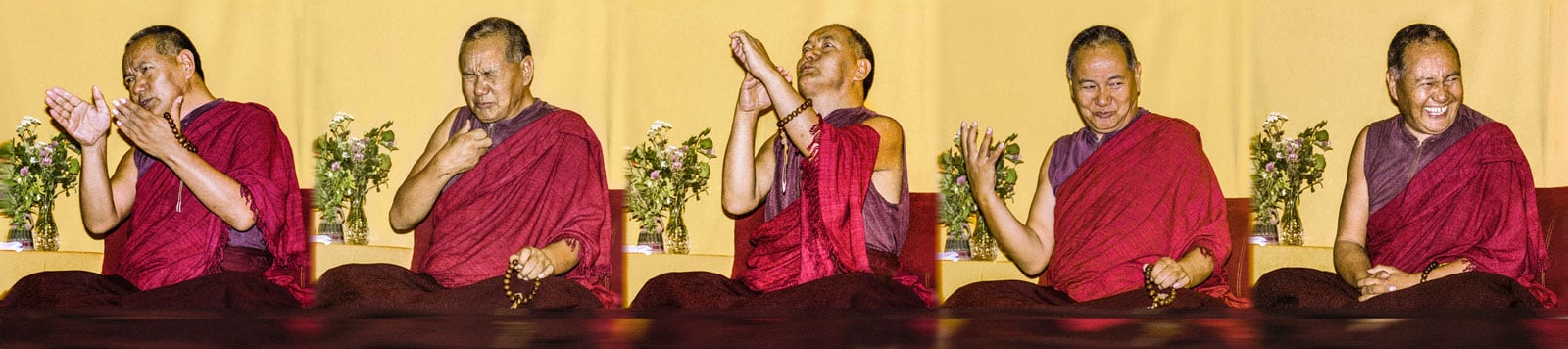
This talk was given by Lama Zopa Rinpoche at Nalanda Monastery, France on 27 March, 2001. Transcribed by Su Foo, checked and lightly edited by Ven Thubten Labdron.
The monks at Nalanda Monastery also produced a video of Rinpoche's visit. The video includes this teaching about the benefits of building monasteries, as well as precious footage of Rinpoche speaking with the monks in informal settings, and a demonstration and commentary on how to make offerings to pretas. You can watch the video on our YouTube channel.

All the happiness and peace of sentient beings depends only on the teachings of the Buddha because the cause of their suffering is not outside, it is within: the negative emotional thoughts, the delusions, the karma motivated by that and the negative imprints left on the mental continuum by the delusions.
The antidote, like medicine to cure sickness, is only the teaching of Buddha, which, as is mentioned in the texts, includes the teachings and the realizations—these two things. The fundamental teaching and realizations are the three higher trainings. The third higher training is great insight, which cuts the delusions. That depends on the second higher training of concentration, such as shamatha, which controls the rising of delusions, and all that depends on the first higher training, morality, the very basic one, mainly abstaining from negative karmas of the body and speech—harming yourself and other sentient beings.
So you see the higher training of morality is the foundation. Without this foundation you can’t really have any realizations of the path to enlightenment. Without moral discipline you engage in creating a lot of obstacles, obscuring the mind. That’s how it becomes difficult to achieve realizations, liberation from samsara and full enlightenment.
It’s said here in the teaching, all the peace and happiness of sentient beings depends only on the teaching of Buddha existing, and that depends only on the Sangha. This word “only,” “only the Sangha,” denotes those who are correctly abiding in the teachings; the essence of Buddha’s teaching is the Vinaya.
It is not defined by whether there is the teaching of Buddha in that country, it is not defined by tantra, by how many people learn and practice tantra teachings; it is defined by people living in the Vinaya, having the lineage of the ordinations.

Lama Tsongkhapa’s heart disciple, Khedrub Rinpoche, mentioned that all the happiness and peace of sentient beings comes from the teaching of Buddha. The Sangha is like the great treasure of water, for example a dam, from where water goes to all the cities, where millions and millions of people can get it, so from Sangha the teachings of Buddha spread.
In India, the great aryan country, when the great yogi Gambala analyzed what can benefit the teaching of Buddha, he saw there is nothing better than constructing monasteries. Because he had the freedom, he purposely took the birth of a wealthy king and built the Vikramashila, a temple in India. I think there were two great universities, one is Nalanda and one is Vikramashila.
Many great holy beings built and established great and small monasteries. Lama Tsongkhapa and Lama Tsongkhapa’s disciples, and disciples of disciples, built Sera, Ganden and Drepung, within each of which there are two colleges, then also Tashi Lhunpo Monastery, then the two tantra colleges. From disciple to disciple they built like this. These are the main monasteries, but there are many branches, Kumbum Monastery, the disciples built, then also there is Tashi Choeling, in Amdo.

Due to Lama Tsongkhapa’s kindness the disciples built these monasteries where Lama Tsongkhapa introduced an incredible, unique way of studying the entire teachings of the Buddha, the sutras condensed into five major philosophical texts then, after that, tantra. The Vinaya, Madhyamaka, then logic, Pramanavartika, then Abhisamayalamakara and Abhidharmakosha—this very extensive study of sutra which helps very much to develop understanding, then extensive study of tantra.
Due to that kindness, up till now, many monasteries were established from these main monasteries—many, many branches. That’s one example, through Lama Tsongkhapa’s kindness, but of course there are many other traditions as well. Until now the teachings of Buddha still exist in that way, through the beautiful work of these monasteries.
It is said in one sutra: “Establish hope (having texts of all Buddha’s teachings), then continue food offering to the Sangha, providing rooms and bedding—all the needs of the Sangha.” This is said in the sutra by Buddha. It is said that providing these things is a great way to collect merit. The great Mongolian Lama, Zahi Pandita said, “Among causal phenomena, the virtue of establishing monasteries is the greatest. There is no greater than that.” Lama Atisha told the same to Dromtonpa.
In the sutra, Mindfulness, Buddha’s teaching, it is mentioned that making statues, temples and places for Sangha, with bedding and other needs, makes one’s life go from happiness to happiness. All the future lives will be always in happiness, going from virtue to virtue, always positive; not just being born human and having ordinary pleasures, not just that—virtue to virtue means having a virtuous life. Even for 1000 ten million eons the virtue collected by having provided these things will never get lost; so you see, it is unbelievable merit.
As Buddha advised King Sangyal regarding the benefits of building monasteries. “Any human being building Buddha’s temple, even while still in samsara, in future lives will always have incredible wealth, like radiating palaces, like the king of devas.” That includes power and so forth. “In all the lives you will have happiness, will get good rebirth, and will create good karma in the next lives. While experiencing the result for ten millions of eons, all the time you will enjoy your life, with joyful mind, with no sorrow, and in the end will achieve the state of peace, the cessation of suffering and its causes.”
Then also in the sutra it says, showing the ripening aspect result of the karma, “Anybody who builds a temple, without doubt in the future lives will become king. You will do the work for many transmigratory beings, many sentient beings.” Then, “You are harmonious with all sentient beings,” everybody is harmonious with you, they like you. If everybody is harmonious with you, you can benefit them, bring them to enlightenment.
Also the great Indian yogi, Nagden Pawo said, “To establish a temple for the mighty aryan beings (Sangha) of Shakyamuni Buddha, soothing somebody with the words, ‘please help to build,’ ‘please donate,’ ‘please give a hand with the work’…”—any group of people who help to build a monastery, even during sleep, while standing up, eating, whatever they do, the merit of building the temple continuously increases, immeasurably.
Another Indian pandit, whose name I am not sure of, mentioned, “Even the insects that get killed under the feet, under the rocks or whatever, during the building of a temple, because the temple is the hall of the Buddha, will never get reborn in lower realms, they will be reborn in higher realms, such as the devas. Why? Because they died for the work of a temple of Buddha.” This is mainly due to the power of Buddha having ceased all the gross and subtle defilements and having completed all the realizations, due to Buddha’s inconceivable qualities. It is said that even the negative karma of anyone who is touched by the smoke from food being cooked for the workers gets purified. Again, it is the power of Buddha.
So it is extremely worthwhile to build a monastery. Here it is not just a temple but a place for sentient beings, especially monks, to do practices to purify the mind, collect merit and actualize the path. As well, it is providing for the needs of the monks, rooms and so forth. Helping physically or in whatever way one can offers unbelievable merit and purification.
Lung.shi, the Vinaya, explains how to define the existence of the holy Dharma: “As long as the activities of the Vinaya are done precisely, the teaching of the holy Dharma is existing.” If the activities of the Vinaya are not practiced, such as the so.jong gaya, it is not Buddhadharma, the holy Dharma has degenerated. It happened before but now it’s not happening.
Emphasizing the importance, Lama Tsongkhapa explained: “All the Buddha’s teachings come into the Tripitaka, the Three Baskets; the essence it reveals is of three types and the very beginning, the foundation is morality. That is the Vinaya.” It says, “The holy Dharma taught well, as explained in many of the Vinaya teachings, the learned one understands well the higher and lower stages of the teaching of Buddha”—I think the levels of the ordination vows—“So why not enjoy that?”
Another great Tibetan Lama from Amdo, Kalmen Gyatso, said, “The means to benefit the general teaching of Buddha and the sentient beings depends on the existence of the pure field, Sangha. Therefore, if one benefits monastic discipline with skilful means, the traditional practice of Vinaya will last a long time.”
Thank you very much.