
Understanding Anger
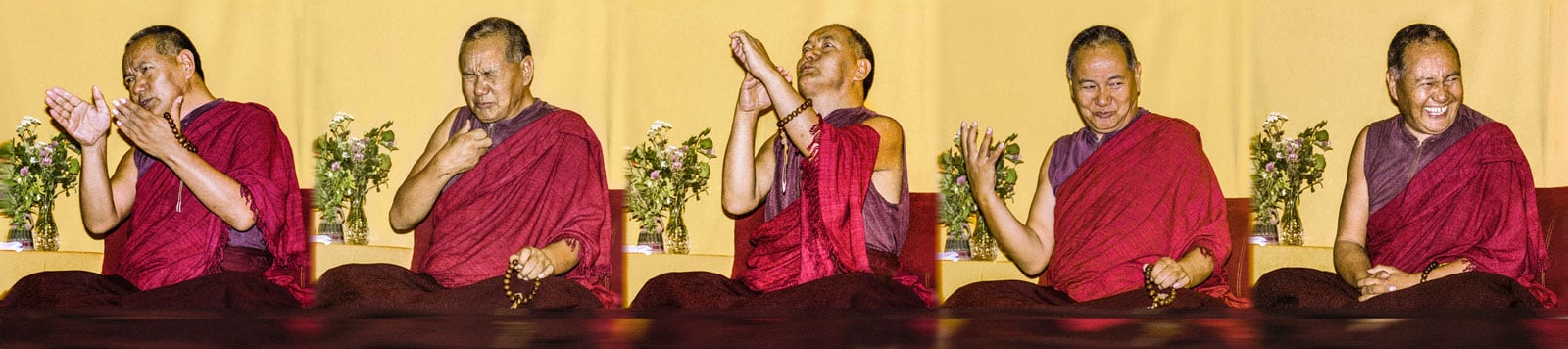
During a teaching at Vajrapani Institute in Boulder Creek California on May 23, 1997, Lama Zopa Rinpoche explained various ways to deal with anger—one's own anger and the anger of others directed at oneself. This teaching appears in the July-August 1997 issue of Mandala, the newsmagazine of the FPMT.

Emptiness is a remedy for the foundation of all delusions—ignorance—so all the other delusions will disappear. The minute one meditates on emptiness, anger for example, will stop. Anger arises when you believe in the false I, false object—all this which does not exist. So when one meditates on emptiness of the self and other objects, there is no foundation for anger. This is the most powerful antidote. But if it arises again, it is because there is no continuation of the meditation; the meditation, the mindfulness, has stopped. The problem is to remember the technique. Once you remember the technique, it always works. When you don't remember the technique, it is delayed and the delusion, anger and so forth, has already arisen and taken you over.
One thing I tell people is always to think about karma. His Holiness always says Buddhists don't believe in God. This basic Buddhist philosophy helps you remember there is no separate mind outside of yours that creates your life, creates you karma. Whatever happens in one's own life comes from one's own mind. These aggregates, all the views of the senses, all of the feelings, happiness, sadness and so forth—your whole world comes from your consciousness. The imprints of past good karma and negative karma left on the consciousness manifest, become actualized. The imprints to have a human body, senses, views, aggregates, all the feelings—everything is realized at this time, and all of it comes from consciousness, from karma.
If your meditation on emptiness is not effective, this teaching of karma is very powerful for us ordinary beings. The minute one meditates on karma, there is no room in the mind for anger because there is nothing to blame. Thinking of karma is practicing the basic Buddhist philosophy that there is no creator other than your mind. It is not only a philosophy but a very powerful technique. Anger is based on believing in a creator: somebody created this problem; this happened because of this person. In daily life, when a problem arises, instead of practicing the philosophy of no creator, we act as if there is a creator, that the problem was created by somebody else. Even if we don't use the word God, we still believe someone else created the problem. The minute you think of karma and realize there is no creator, there is no basis for the anger.
We need to think: In the past I gave such a harm to sentient beings, therefore I deserve to receive this harm from another sentient being. When you get angry what you are actually saying is that you can harm others, but you feel that you should not receive harm from others. This is very illogical. So in this practice you say, 'I deserve this harm.'
Another practice is to use this situation to develop compassion: I received this harm because of my karma. Who started all this? It's not because of the other person, it's because of your own actions. You treated other sentient beings this way in the past, that is why you receive harm now; your karma persuaded the person to harm you now. Now this person has a human birth and they harm you because of something you inspired in the past. By harming you now they are creating more negative karma to lose their human rebirth and to be reborn in lower realms. Didn't I make that person get lost in the lower realms?
In this way you are using that problem to generate bodhicitta. This means one is able to develop the whole Mahayana path to enlightenment, including the six paramitas, whether sutra path or tantra path. One can cease all mistakes of the mind and achieve full enlightenment. Due to the kindness of that person you are able to generate compassion, free sentient beings from all the sufferings, to bring enlightenment, to cause perfect happiness for all sentient beings.
One can also think in this way: by practicing compassion on that person, one is able to generate compassion towards all sentient beings. This person, who is so kind, so precious, is helping you stop harming all sentient beings, and on top of that, to receive help from you. By not receiving harm from you, peace and happiness come; also, by receiving help from you, numberless sentient get peace and happiness. All this peace and happiness that you are able to offer all sentient beings comes from this person.
Similarly, one can practice patience in this way and is able to cease anger. In the Kadampas' advice, there are six techniques for practicing patience; I don't need to go over all that now. They are good to memorize, to write down in a notebook, in order to use.
Another thing that is very good is what Pabongka Rinpoche explains in Liberation in the Palm of Your Hand: generally speaking one doesn't get angry at the stick that the person used to beat you. The stick itself is used by the person, so therefore there is no point in getting angry at the stick. Similarly, the person's body, speech and mind are completely used by the anger, by the delusion. The person's body, speech and mind become like a slave, completely used as a tool of the anger. The person themself has no freedom at all—no freedom at all. So therefore, since the person has no freedom at all, they should become an object of our compassion. Not only that, one must take responsibility to pacify that person's anger. By whatever means you can find, help the person's mind, pacify the anger; even if there is nothing you can do, pray to Buddha, Dharma and Sangha to pacify the person's mind.
What His Holiness teaches is to meditate on how that person is kind, how that person is precious like Dharma, precious like Buddha, precious like Guru; kind like Buddha, like Guru. The conclusion is that if no one has anger towards us, we can never develop patience. If everybody loves us then we can never generate the precious quality of patience, the path of patience. So therefore there is an incredible need in our life for someone to have anger towards us. It is so precious, so important that someone has anger towards us. It's not precious for that person, but for us it's very precious. For that person it's torturous, it's like living in the lower realms. But for us, that person having anger towards us is so precious. We have a great need for this, a great need.
It's important that someone loves you, but it is even more important that someone has anger towards you. You see, if someone loves you it does not help you benefit numberless sentient beings or actualize the entire path to enlightenment. So why is this person the most precious thing to me. Because they are angry with you. To you, this person's anger is like a wish-granting jewel.
Also, your anger destroys merit, destroys your happiness, not only in day to day life but in long term happiness. As the Bodhicaryavatara mentions, one moment of anger delays realizations for one thousand eons. Anger is a great obstacle, especially for bodhicitta realizations. Therefore, because this person is angry towards me, I am able to develop patience and overcome my own anger and complete the entire path to enlightenment. One can complete the two types of merit, cease all the obscurations, achieve enlightenment, and free all sentient beings and lead them to enlightenment.