
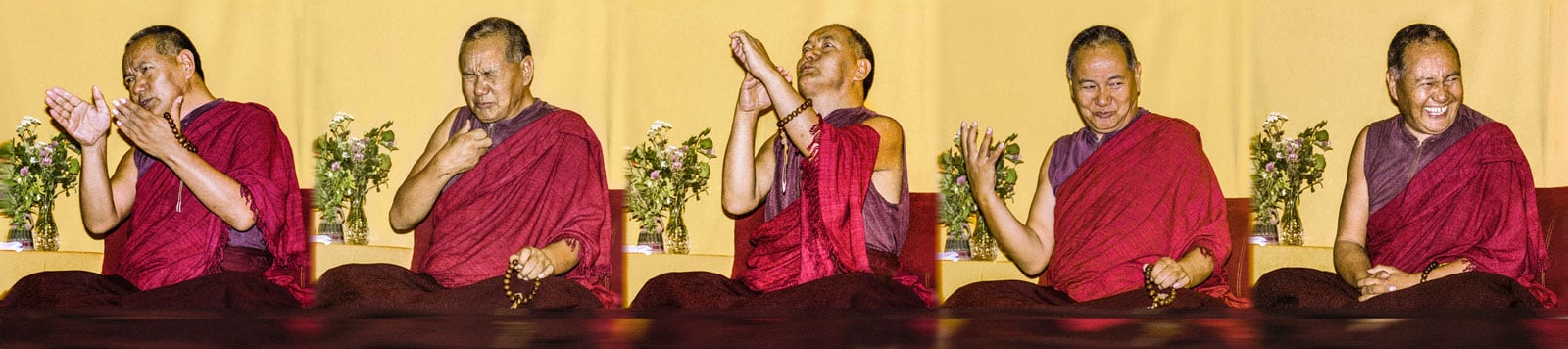
Powa: Transference of Consciousness at the Time of Death
A lightly edited transcript of teachings given in March 1981 at Tushita Meditation Centre, Dharamsala, India. Originally published as a transcript by Wisdom Publications. You can also listen to more teachings on this topic here.
Visit the FPMT Catalogue to find Amitabha Phowa, a meditation practice for transferring the consciousness to Amitabha's pure realm, This practice was composed by Lama Yeshe in February 1981 at Tushita Meditation Centre, Dharamsala.

First Discourse: 2nd March
Tonight we shall have a short introduction to the transference of consciousness, known in Tibetan as powa. For the practice at this time we shall use Amitabha Buddha as our Refuge object. In fact, powa meditation can be performed with many different meditational deities, such as Vajrayogini, Yamantaka and so forth, and all such meditations derive not from Tibetan lamas but from the teachings of Shakyamuni Buddha himself. To be precise, powa instructions derive from the Guhyasamaja tantra, which contains a description of this technical method even though it does not spell out the instructions in the exact form in which they are practiced. Although this subject matter belongs to the highest level of tantra, many skillful Tibetan lamas have extracted it from this context and have presented it in terms of the deities of the lower levels of tantra. I myself received these instructions in terms of Vajrayogini, but I feel that it will be good for Westerners, and myself as well, to have them explained here in terms of Amitabha Buddha. My reasoning is that Amitabha Buddha is less complex than other deities. Even more important than this is the fact that most Westerners easily relate to and understand Avalokiteshvara, and many of our students have received his initiation. As you have great devotion to this Lord of Compassion and as there is a close connection, or agreement, between him and Amitabha, I thought it would be beneficial to take advantage of these close connections and present a practice that might prove useful to many interested Westerners.
Although different powa instructions are given in terms of different deities, the actual technical methods explained in all of them are the same. There is really not much difference between the actual method of powa as explained in terms of Vajrayogini and the method to be explained here in terms of Amitabha. What is essential, however, is that we practice with the right attitude. This is extremely important. For example, some people may have heard that with powa instructions it makes no difference if you commit heavy negativities, such as killing your parents and so forth; you will still be able to achieve a fortunate rebirth. But this is a mistaken attitude; it does not work this way. Without depending on the creation of virtuous karma and establishing the proper connection with Amitabha Buddha, it is very difficult to achieve his pure land. It is not some place you can fly to by jet. So we must create the appropriate karma. This matter of karma is actually quite simple. We do have devotion to Avalokiteshvara; we do have confidence in the essence of Avalokiteshvara and Amitabha Buddha, and to some extent we have a fairly good intellectual notion of what Amitabha's pure land is. What we need, however, is devotion. We need to maintain the correct attitude towards these practices.
We know that our present situation—where we are now—is dependent on karmic causation, and in our everyday life we are constantly dealing with cause and effect. At the moment we have enough good fortune not to have been born in one of the three lower realms. We have certain powers and abilities of mind, a certain strength of intellect and a certain freedom of movement. Everything we are able to engage in comes from the mind; this is karma as well. However, even though we now have the human freedom to move about as we like, to avoid unpleasant situations, and to pursue our desires and so forth, no matter where we go we end up with miserable disappointment. It does not matter where we go; unexpectedly we end up with problems. All of us experience this. We are always experiencing dissatisfaction and confusion, not to mention sickness, old age, death and other worries. Thus, although we may have a great wish to benefit others greatly as did Shakyamuni Buddha, Padmasambhava, Je Tsongkhapa, Milarepa and many other great teachers, our present circumstances makes this difficult, if not impossible. Life in this desire realm is so difficult that even our altruistic wishes remain unfulfilled. Therefore it is extremely worthwhile to gain rebirth in Amitabha's pure land.
Furthermore, by checking up on our own experience we discover how slow we are. For instance, think of the time we have wasted today. We have spent a great deal of our day in sleep and other fruitless activities. The circumstances of our life-style are overwhelming; it is not easy to transcend the nonsense of our existence. This is also due to our karma. The paradise of Amitabha's pure land, however, does not contain such difficulties and hindrances. Even the name of mundane suffering does not exist there. There is no illness, dying or suffering of birth. Everyone reborn into this pure realm just appears there instantly and receives teachings directly from Amitabha Buddha himself. Merely by being in this pure realm one possesses the five telepathic powers. All of these conducive conditions have come about because of the prayers Amitabha Buddha sent forth during the five hundred great aeons he traveled the bodhisattva path. Therefore, anyone who is born in Amitabha's actual pure land possesses extrasensory powers and experiences no confusion of mind whatsoever. Furthermore, unlike the experience of being in other higher realms, beings born into Amitabha's pure land never fall down to a lower state.
Therefore, concerning the right attitude we mentioned earlier, we should be interested in discovering the quickest method to benefit all mother sentient beings: you should be motivated to be born in Amitabha's pure land solely because you feel that this is the quickest way of accomplishing this aim. In such a realm we can become enlightened in but one lifetime and therefore benefit all beings. Thus you should adopt the great enlightened attitude of bodhicitta. With this attitude our meditation will be worthwhile. Otherwise, if we are interested only in enhancing our reputation or building our ego, our attitude is incorrect.
Although we should have such a strong bodhicitta attitude, we should also be relaxed. This is very important. True bodhicitta itself is a relaxed attitude. This is practical; if we are uptight and someone comes to us with a problem, we will become so nervous that we cannot offer help. But with a properly relaxed bodhicitta attitude, we have the space to handle any problem we may encounter. This is an essential point.
So all of us should approach these powa instructions with the proper attitude. Yet it is important to realize that anyone who has achieved enlightenment in this lifetime already has no need whatsoever for these instructions on the transference of consciousness. These teachings are not necessary for everyone. For someone who has achieved enlightenment in this lifetime with this body, these present teachings are useless. powa teachings are only for those people who feel that it is impossible for them to gain enlightenment in this lifetime. They are for someone who thinks, "I have received teachings on the three principal paths; I have meditated on them; I have received Vajrayana instructions and tried to practice the generation stage, but I have discovered that it is not possible for me to attain enlightenment in this lifetime. I can see that according to my circumstances this would be impossible. Therefore, I cannot stand to wait and have to go through the suffering of confusion again; instead I must go to Amitabha's pure land." (Therefore I cannot believe that so many people have come to attend these teachings; does that mean that none of you think that you can achieve enlightenment in this lifetime?)
Also, you should recall the line in the guru puja: Lam-na ma-zin chi-way du-je-na, which means, "Should we not have completed the points of the path at the time of death." This means that if you have practiced the bodhisattva path but still have not attained the destination (enlightenment), then you should practice powa. So it is only if you cannot achieve your destination in this lifetime that the practice of powa becomes necessary. In other words, if you feel that it is utterly impossible for you to attain enlightenment without going through the experience of yet another lifetime—and you can be almost certain about this—then you need to follow these powa practices. This matter completely depends upon one's individual experience. Philosophically, however, it is said that these practices are for those who will not attain enlightenment in this lifetime and definitely need another life to reach their goal. Such people need to practice powa. We all know that the samsaric realms are full of obstacles to the completion of our practices. This is the logic to explain why one would want to transfer one's consciousness to a pure land.
Yet for the Western mind these powa instructions can present a problem. We Tibetans generally have no difficulty believing that it is possible to be reborn from a lotus, without depending on a father and mother. Can the Western mind accept this? Do you believe that it is possible to be reborn in a pure land with either a human or a psychic body without a father or a mother? According to the powa instructions this is what happens—one is reborn instantly from a lotus flower. With Amitabha's activity as a co-operative cause, your consciousness is thrown like a seed into a lotus and it is from such a situation that you are born immediately in his pure land. Furthermore, once we are reborn in such a land we have no need to work for a living, prepare food or engage in any other mundane tasks. Everything that we might desire or need comes to us intuitively and instantly.
I think it is very helpful to visualize these excellent qualities of Amitabha's pure land; it is very helpful for eliminating the lower, baser concepts we have about our environment. We do in fact have such low conceptions. We always feel that our environment is complicated. It does not matter where we go; every environment we meet is complicated. For example, when I go to America, everything seems to be polluted; when I go to Italy, everything seems to be dirty; when I go to Spain, neurotic energy seems to be coming in my ears; when I go to England, the English uptight mind seems to come at me; and when I go to France, their samsaric technology seems to come after me. Thus we do need to develop a pure vision. You know from the practice of tantra that it is important to visualize yourself as a buddha and your surroundings as a mandala; this is the pure land visualization. Thus it is very good to bring to mind these excellent qualities of a pure land.
The importance of this can be explained by example. When I come to the Tushita Retreat Center in Dharamsala, I automatically feel relaxed. Whenever I return from a tour to the West, I always stop at Tushita, where I feel so comfortable. In my small, quiet room there I experience release from the problems people bombard me with. For me it is such a conducive environment. This example demonstrates the possibility that Amitabha's pure land, created by his prayers over five hundred great aeons, is a place where the mind can experience total and unceasing awakening. It is a place where the mind never falls asleep from this awakening, where there is no hatred, no aggression and so forth. This is definitely possible.
As I said before, those who have no possibility of attaining enlightenment in this lifetime and definitely need another one should follow these powa instructions. What about ourselves? In this case there is no certainty: maybe we shall become enlightened in this lifetime, maybe not. This depends on many co-operative circumstances. Thus it is very hard to say with complete assurance that one either will or will not become enlightened in this very lifetime. So the best thing to do in either case is to make preparations now. It is never too late to make such preparations. I heard that some monks at Sera, when they heard that the Chinese were coming in 1959, decided that it was no longer worthwhile to stay around, so they practiced powa and left. In fact, many monks and geshes have been successful in this practice.
It is very good to be able to have this ability and gaining it is totally a matter of the human will. Bodhicitta, for example, is a very powerful mind, both subjectively and objectively. In the same way, when one has the proper will and the necessary technical skill, it is definitely possible to transfer one's consciousness to a pure land. Therefore, it is good to master these technical methods, even if we do not feel we actually need them. At the moment we may be healthy and think that death won't come for a long time, but we cannot be sure about this; we are never certain what will actually happen to us. Therefore, it is wise to master these techniques now, so that even if death comes sooner than we expect, we shall be prepared. If we do not prepare ourselves beforehand, then it will be impossible to practice the transference of consciousness when death actually comes. There's a Tibetan proverb that says that without training, a horse won't run correctly. Similarly, if we are to perform powa successfully at the time of death, we must train ourselves beforehand. Furthermore, even if we don't need to practice powa ourselves, we can use it to help others to transfer their consciousness.
Furthermore, if we possess such a technique, we can live our lives without fear: we shall know that even if a disastrous situation arises, there is something we can do. If we find ourselves in a bad situation, we have the confidence of knowing that we can go to a better place whenever we want. This allows us to be relaxed instead of uptight.
It should also be understood that practicing powa and achieving the pure land is not easy. Why? Because we are tied to the desire realm by the iron chain of our grasping. As long as we don't break this chain of attachment it will be impossible for us to achieve Amitabha's pure land. Therefore, the necessary preparation for this practice is developing the mind that is unattached to possessions, friends and so forth. This is the real preparation for this practice. The true obstacle that prevents us from reaching Amitabha's pure land is our grasping attitude. That is why in Tibet, when a monk knew he was going to die, he would completely dispose of all his material possessions, indicating precisely how they should be distributed. Therefore, at the time of death there would be nothing left for him to hold on to. In the West there is the system of making one's will.
The point is that to be able to go to Amitabha's pure land, you cannot be hung up with objects of temporal pleasure. This is our usual problem, so of course it also interferes with achieving Amitabha's pure land. In this regard there is the story of the dying monk who had great difficulty transferring his consciousness to the pure land of Tushita because he was so attached to the butter in his butter tea. His guru realized that his hangup was his attachment to the butter tea so he told him, "There's better butter tea in Tushita." This put the monk's mind at ease and he was then able to transfer his consciousness easily.
Now let us turn from philosophical considerations to practical ones. To accomplish powa we need a certain amount of concentration. We also have a special need for preparing our central channel (sushumna). We have to be able to visualize this channel clearly, seeing it smaller on its lower end than it is on its upper. This channel begins four finger widths below the navel and goes straight up until it ends at the crown of our head, eight finger widths behind our hairline. It is of a clear crystal-like nature, not in any way heavy or solid. It is very smooth and soft. It is necessary to visualize this well, but that does not mean we should squeeze our mind.
According to tantra there are gross, subtle and very subtle levels of the mind. While practicing the powa visualizations in preparation for death we utilize the gross levels of mind; however, when the time comes for us actually to transfer our consciousness, it is the very subtle level of mind that is activated. At the time of our conception, when the germ cells of our mother and father came together, they contained certain delicate, clear, essential drops of energy. That subtle, essential energy, present at the time of conception, still exists at our heart center sitting within the central channel. This very subtle drop of energy at our heart is known in Tibetan as tigle (Skt: bindu) and it is within this tigle that our very subtle mind is located. When the time comes to transfer our consciousness it is this very subtle energy together with our very subtle mind that is propelled up our central channel, out of the crown of our head and into Amitabha's pure land.
Tonight's practice will be to visualize the central channel, which should be seen as closer to our back, a little bit in front of our spine, closed at the bottom for the time being and open at the crown of our head. Then see the fundamental energy of the tigle, or seed-syllable, as sitting like a small pea within this channel at the level of the heart. After focussing your attention on this seed syllable, if you can you should try to bring it up to the throat level and then to the crown. From this vantage point look down the central channel and try to see its interior as clearly as possible. Then have the seed syllable descend until it reaches the throat center, the heart center and then all the way down to the navel. This way of exploring the central channel is an excellent preparation for the actual practice of powa.
Before doing the meditation thus described it is helpful to visualize Amitabha Buddha seated in space in front of you at the level of your forehead. He is ruby red in color and his entire body is made out of transparent, radiant light. In the actual powa practices he will be visualized above the crown of your head, but now at the preliminary stage it is permissible to see him in front of yourself facing you. You should begin your practice by taking refuge in Amitabha and then visualize that radiant light energy comes from him down into your central channel and completely purifies you of all hindrances to the practice. This light especially purifies your indecisive mind and the grasping attitude with which you are attached to objects of the desire realm. Such purification is very useful and should be done extensively. By means of such purification visualization you slowly transform your gross physical body into one of radiant light. Once you have accomplished this transformation in your meditation it is much easier to visualize the central channel within your body. Meditating on the body as being transparent makes it easier to visualize the central channel and the blissful seed-syllable at your heart. This seed-syllable, or tigle, should be seen as white in color, clear as crystal and with a slight reddish tint. This seed-syllable is a small radiant point of light, like a tiny star vibrating with a white radiance and having a reddish glow. Focus your concentration on this seed-syllable and then move it to the various centers as described above. As you move the seed-syllable up and down the central channel you should pause for a while in each of the centers. For example, when you reach the throat center you should stop there and send forth radiant light. Visualize that this light removes whatever blockages might be obstructing the throat center, thereby allowing energy to flow smoothly through the many minor channels that make up the throat chakra. This same type of purification visualization should be done at the other chakras as well.
In order to strengthen your visualization of the central channel and the seed-syllable, you can do this visualization in conjunction with holding the vase breath. This technique will be discussed and practiced in more detail later. In brief, it entails bringing a long, slow breath down into the abdomen and then tightening the lower muscles of the pelvic floor (those involved in retaining urine, feces, etc.), and then, while holding this breath, focusing your attention on the seed-syllable at your heart. At the point where it is just becoming difficult to hold your breath any longer, you can breath out a long, slow exhalation through either your nostrils or your mouth. Holding the vase breath in this way helps your mind experience bliss and enhances your concentration. Breathing in deeply and tightening your lower muscles slightly causes the upper and lower energies to meet, and this meeting in turn produces a blissful feeling. If and when this experience arises you should let go of it; you need to learn to give up grasping at pleasure and not pay emotional attention to it. This is the true training of the mind and something we all need.
Concerning the visualization of the central channel, you should choose a dimension that is comfortable for you. At this point in the practice, whether you visualize it as narrow as a pencil or as wide as your arm does not matter, but you should see it as wider at the top than the bottom. This practice of powa is not easy; it is not something completely unrelated to your individual karma. On the contrary, it has a lot to do with your karma. Therefore you should do the practice in a way that is most comfortable for you as an individual.
In addition to the technical methods mentioned so far, there are other things you can do to enhance your practice. For instance, when you go to sleep tonight, feel that you are going to Amitabha's pure land. When you lie in your bed, think that your head is resting in Amitabha Buddha's lap. When you wake up in the morning you should feel that you are being roused from sleep by the sound of Amitabha's wisdom bell telling you it is time to arise. Then visualize that Amitabha himself sinks into you, and when you come to the next meditation session feel that you are again on your way to Amitabha's pure land. This way of thinking and practicing is very good—much better than our ordinary confused and nonsensical way of thinking and acting.
So that is enough for this lecture. As always, we should finish with an attitude of dedication, dedicating all our energy to rebirth in the pure land of Amitabha's buddha field in order to benefit all mother sentient beings most quickly. Thank you.
Next chapter: Second Discourse: 3rd March »