
Bodhicitta: The Perfection of Dharma
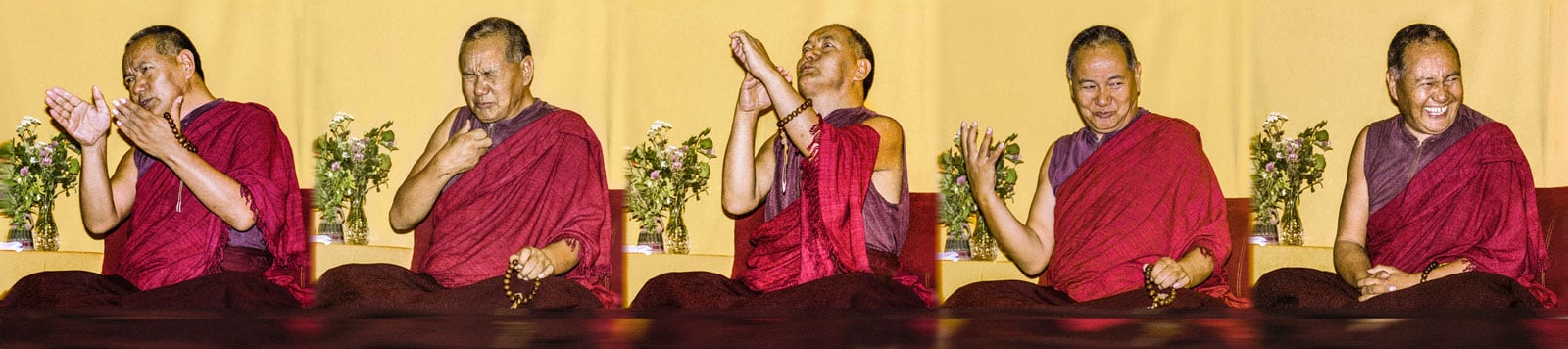
Lama Yeshe gave this teaching on bodhicitta and the bodhisattva vows on December 10, 1983, during the Sixteenth Kopan Meditation Course held at Kopan Monastery, Nepal. This was the last public teaching by Lama Yeshe before he tragically passed away in March 1984, so it has a special significance. Edited by Uldis Balodis. The first part of this teaching, Bodhicitta: The Perfection of Dharma, was published in a special commemorative issue of Wisdom magazine in 1984, shortly after Lama Yeshe's death.
The immeasurably kind Lama Yeshe gave three teachings at this meditation course, available as an ebook, The Enlightened Experience: Collected Teachings, Vol. 3 and now published in the book Knowledge-Wisdom: The Peaceful Path the Liberation.

Bodhicitta: The Perfection of Dharma
I think it is absolutely essential for us to have loving kindness toward others. There is no doubt about this. Loving kindness is the essence of bodhicitta, the attitude of the bodhisattva. It is the most comfortable path, the most comfortable meditation. There can be no philosophical, scientific or psychological disagreement with this. With bodhicitta, there's no East-West conflict. This path is the most comfortable, most perfect, one hundred percent uncomplicated one, free of any danger of leading people to extremes. Without bodhicitta, nothing works. And most of all, your meditation doesn't work, and realizations don't come.
Why is bodhicitta necessary for success in meditation? Because of selfish grasping. If you have a good meditation but don't have bodhicitta, you will grasp at any little experience of bliss: "Me, me; I want more, I want more." Then the good experience disappears completely. Grasping is the greatest distraction to experiencing single-pointed intensive awareness in meditation. And with it, we are always dedicated to our own happiness: "Me, me I'm miserable, I want to be happy. Therefore I'll meditate." It doesn't work that way. For some reason good meditation and its results—peacefulness, satisfaction and bliss—just don't come.
Also, without bodhicitta it is very difficult to collect merits. You create them and immediately destroy them; by afternoon, the morning's merits have gone. It's like cleaning a room and an hour later making it dirty again. You make your mind clean, then right away you mess it up—not a very profitable business. If you want to succeed in the business of collecting merits, you must have bodhicitta. With bodhicitta you become so precious—like gold, like diamonds; you become the most perfect object in the world, beyond compare with any material things.
From the Western, materialistic point of view, we'd think it was great if a rich person said, "I want to make charity. I'm going to offer $100 to everybody in the entire world." Even if that person gave with great sincerity, his or her merit would be nothing compared with just the thought, "I wish to actualize bodhicitta for the sake of sentient beings, and I'll practice the six paramitas as much as I can." That's why I always say, actualization of bodhicitta is the most perfect path you can take.
Remember the story of the Kadampa geshe who saw a man circumambulating a stupa? He said, "What are you doing?" and the man answered, "Circumambulating." So the geshe said, "Wouldn't it be better if you practiced Dharma?" Next time the geshe saw the man he was prostrating, and when he again asked what he was doing, the man replied, "One hundred thousand prostrations." "Wouldn't it be better if you practiced Dharma?" asked the geshe. Anyway, the story goes on, but the point is that just doing religious-looking actions like circumambulation and prostration isn't necessarily practicing Dharma. What we have to do is transform our attachment and self-cherishing, and if we haven't changed our mind in this way, none of the other practices work; doing them is just a joke.
Even if you try to practice tantric meditations, unless you've changed within, you won't succeed. Dharma means a complete change of attitude—that's what really brings you inner happiness, that is the true Dharma, not the words you say. Bodhicitta is not the culture of ego, not the culture of attachment, not the culture of samsara. It is an unbelievable transformation, the most comfortable path, the most substantial path—definite, not wishy-washy. Sometimes your meditation is not solid; you just space out. Bodhicitta meditation means you really want to change your mind and actions and transform your whole life.
We are all involved in human relationships with each other. Why do we sometimes say, "I love you," and sometimes "I hate you"? Where does this up-and-down mind come from? From the self-cherishing thought—a complete lack of bodhicitta. What we are saying is, "I hate you because I'm not getting any satisfaction from you. You hurt me; you don't give me pleasure. That's the whole thing: I—my ego, my attachment—am not getting satisfaction from you, therefore I hate you." What a joke! All the difficulties in interpersonal relationships come from not having bodhicitta, from not having changed our minds.
So, you see, just meditating is not enough. If that Kadampa geshe saw you sitting in meditation he'd say, "What are you doing? Wouldn't it be better if you practiced Dharma?" Circumambulating isn't Dharma, prostrating isn't Dharma, meditating isn't Dharma. My goodness, what is Dharma, then? This is what happened to the man in the story. He couldn't think of anything else to do. Well, the best Dharma practice, the most perfect, most substantial, is without doubt the practice of bodhicitta.
You can prove scientifically that bodhicitta is the best practice to do. Our self-cherishing thought is the root of all human problems. It makes our lives difficult and miserable. The solution to self-cherishing, its antidote, is the mind that is its complete opposite—bodhicitta. The self-cherishing mind is worried about only me, me—the self-existent I. Bodhicitta substitutes others for self.
It creates space in your mind. Then even if your dearest friend forgets to give you a Christmas present, you don't mind. "Ah, well. This year she didn't give me my chocolate. It doesn't matter." Anyway, your human relationships are not for chocolate, not for sensory pleasures. Something much deeper can come from our being together, working together.
If you want to be really, really happy, it isn't enough just to space out in meditation. Many people who have spent years alone in meditation have finished up the worse for it. Coming back into society, they have freaked out. They haven't been able to take contact with other people again, because the peaceful environment they created was an artificial condition, still a relative phenomenon without solidity. With bodhicitta, no matter where you go, you will never freak out. The more you are involved with people the more pleasure you get. People become the resource of your pleasure. You are living for people. Even though some still try to take advantage of you, you understand: "Well, in the past I took advantage of them many times too." So it doesn't bother you.
Thus bodhicitta is the most perfect way to practice Dharma, especially in our twentieth-century Western society. It is very, very worthwhile. With the foundation of bodhicitta you will definitely grow.
If you take a proper look deep into your heart you will see that one of the main causes of your dissatisfaction is the fact that you are not helping others as best you can. When you realize this you'll be able to say to yourself, "I must develop myself so that I can help others satisfactorily. By improving myself I can definitely help." Thus you have more strength and energy to meditate, to keep pure morality and do other good things. You have energy, "Because I want to help others." That is why Lama Tsongkhapa said that bodhicitta is the foundation of all enlightened realizations.
Also, bodhicitta energy is alchemical. It transforms all your ordinary actions of body, speech and mind—your entire life—into positivity and benefit for others, like iron transmuted into gold. I think this is definitely true. You can see, it's not difficult. For example look at other people's faces. Some people, no matter what problems and suffering they are enduring, when they go out they always try to appear happy and show a positive aspect to others. Have you noticed this or not? But other people always go about miserable, and angry. What do you think about that? I honestly think that it indicates a fundamental difference in the way these two kinds of people think. Human beings are actually very simple. Some are a disaster within and it shows on their faces and makes those whom they meet feel sick. Others, even though they are suffering intensely, always put on a brave face because they are considerate of the way others feel.
I believe this is very important. What's the use of putting out a miserable vibration? Just because you feel miserable, why make others unhappy too? It doesn't help. You should try to control your emotions, speak evenly and so forth. Sometimes when people are suffering they close off from others, but you can still feel their miserable vibration. This doesn't help others with even momentary happiness; forget about leading them to enlightenment. To help the people around you, you have to maintain a happy, peaceful vibration. This is very practical, very worthwhile. Sometimes we talk too much about enlightenment and things like that. We have a long way to go to such realizations. Forget about enlightenment, I don't care about buddhahood—just be practical. If you can't help others, at least don't give them any harm, stay neutral.
Anyway, what I'm supposed to be telling you here is that bodhicitta is like atomic energy to transform your mind. This is absolutely, scientifically true, and not something that you have to believe with blind religious faith. Everybody nowadays is afraid of nuclear war, but if we all had bodhicitta, wouldn't we all be completely secure? Of course we would. With bodhicitta you control all desire to defeat or kill others. And, as Lama Je Tsongkhapa said, when you have bodhicitta all the good things in life are magnetically attracted to you and pour down upon you like rain. At present all we attract is misfortune because all we have is the self-cherishing thought. But with bodhicitta we'll attract good friends, good food, good everything.
As His Holiness the Dalai Lama said recently, if you're going to be selfish, do it on a grand scale; wide selfishness is better than narrow! What did His Holiness mean? He was saying that, in a way, bodhicitta is like a huge selfish attitude because when you dedicate yourself to others with loving kindness you get a lot more pleasure than you would otherwise. With our present, usual selfish attitude we experience very little pleasure, and what we have is easily lost. With "great selfishness" you help others and you help yourself; with small it's always "me, me, me" and it is easy to lose everything.
Remember, Atisha had over 150 teachers? He respected them all, but when he heard the name of one—Lama Dharmakirti—he would come out in goosebumps. He explained this by saying, "I received many teachings from many, many great gurus, but for me, Lama Dharmakirti, who gave me the bodhicitta ordination and teachings on the method and wisdom of bodhicitta and the six paramitas, was the most helpful for my life." This is very true. Sometimes techniques of deity meditation are extremely difficult, but bodhicitta meditation is so simple, so incredibly profound and real. That's why Atisha would shake when he heard the name of his main teacher of bodhicitta.
The main point, then, is that when you contact Buddhadharma you should conquer the mad elephant of your self-cherishing mind. If the Dharma you hear helps you diminish your self-cherishing even a little, it has been worthwhile. But if the teachings you have taken have had no effect on your selfishness, then from the Mahayana point of view, even if you can talk intellectually on the entire lamrim, they have not been much use at all.
Do you recall the story of Shantideva and how people used to put him down? They used to call him Bhusuku, which means one who knows how to do only three things: eating, sleeping and excreting. This was a very bad thing to call someone, especially a monk. But that's all that people could see him doing. However, he had bodhicitta, so whatever he did, even ordinary things, was of greatest benefit to others. Lying down, peacefully, he would meditate with great concern for the welfare of all living beings, and many times, out of compassion, he would cry for them.
Westerners need that kind of practice. Fundamentally we are lazy. Well, maybe not lazy, but when we finish work we are tired and don't have much energy left. So, when you come home from work, lie down comfortably and meditate on bodhicitta. This is most worthwhile. Much better than rushing in speedily, throwing down a coffee and dropping onto your meditation cushion to try to meditate. It doesn't work that way; your nervous system needs time and space. You can't be rushing through traffic one minute and sitting quietly meditating the next. Everything takes time and space. It is much better to have a quiet, blissful cup of coffee, and don't pressure yourself either; that too is very bad. Don't punish yourself when you are too tired to meditate: "I should be meditating; I am very bad." You destroy yourself like this. Be wise. Treat yourself, your mind, sympathetically, with loving kindness. If you are gentle with yourself you will become gentle with others so don't push. Pushing doesn't work for me, that's why I tell others not to force themselves. We are dealing with the mind, not rocks and concrete; it is something organic.
The Western environment offers lots of suffering conditions that act as causes for our actualizing bodhicitta, so life there can be very worthwhile. For example, it is much better to subdue an adversary with bodhicitta than with a knife or gun. When attacked, you can practice loving kindness. We could also do this in the monasteries of Tibet, where there were often horrible monks. Don't think that Tibet was full of only holy people—we had unbelievably wild monks there that nobody in authority could subdue! If you would try to control them wrathfully they would only get more aggressive. But arya bodhisattva monks, people who had completely given themselves up for others, would treat them with loving kindness, and the wild monks would calm down completely. They would feel, "This man loves me; he has great compassion. He has given up everything for others and has nothing to lose." In that way aggressive people would be subdued, without authority but with bodhicitta. There are many stories about this kind of thing, but I'm not going to tell them now. Perhaps you think they're funny, but it's true—you can conquer your enemies, both internal and external, with loving kindness and bodhicitta. It is most worthwhile and there's no contradiction. Bodhicitta is the totally comfortable path to liberation and enlightenment.
In his text Lama Chöpa, [v. 94] the Panchen Lama says, "Self-cherishing is the cause of all misery and dissatisfaction, and holding all mother sentient beings dearer than oneself is the foundation of all realizations and knowledge. Therefore bless me to change self-cherishing into concern for all others." This is not some deep philosophical theory but a very simple statement. You know from your own life experiences without needing a Tibetan text's explanations that your self-cherishing thought is the cause of all your confusion and frustration. This evolution of suffering is found not only in Tibetan culture but in yours as well.
The Panchen Lama goes on to say that we should look at what the Buddha did. He gave up his self-attachment and attained all the sublime realizations. But look at us—we are obsessed with "me, me, me" and have realized nothing but unending misery. This is very clear, isn't it? Therefore you should know clean-clear how this works. Get rid of the false concept of self-cherishing and you'll be free of all misery and dissatisfaction. Concern yourself for the welfare of all others and wish for them to attain the highest realizations such as bodhicitta and you'll find all happiness and satisfaction.
You people are young, intelligent and not satisfied with what you have in your own countries. That's why you are seeking further afield. And now you have found that most worthwhile of all things, bodhicitta.
But it is not an easy thing. Easy things bore you quickly. It is quite difficult, but there's no way you'll get bored practicing it. People need to be most intelligent to actualize bodhicitta, some, though, have no room for it. "Forget about yourself and have a little concern for others?" they'll ask. "That's not my culture." It is very difficult to change holding yourself dear into holding others dear instead—the most difficult task you can undertake. But it is the most worthwhile and brings the greatest satisfaction.
After practicing some meditations, such as impermanence and death, for a month you'll say, "I'm tired of that meditation." But you'll never get tired of meditating on bodhicitta. It is so deep; a universal meditation. You'll never get tired of bodhicitta.
You have heard of many deities that you can meditate on, many deities to be initiated into—Chenrezig and the rest. What are they all for? I'll tell you—for gaining bodhicitta. As a matter of fact, all tantric meditations are for the development of strong bodhicitta. That is the purpose of your consciousness manifesting as a being with one thousand arms so that you can lend a hand to a thousand suffering beings. If you don't like to manifest yourself this way you can relate the meditation to your own culture and see yourself as Jesus. Avalokiteshvara and Jesus are the same: completely selfless and completely devoted to serving others.
Remember what happened the first time that Avalokiteshvara took the bodhisattva ordination? He vowed to guide all universal living beings to enlightenment from behind, like a shepherd. "I do not want to realize enlightenment until first I have led all mother sentient beings there first. That will be my satisfaction." He worked for years and years, leading thousands of beings to enlightenment, but when he checked to see what was happening he found there were still countless more. So again he worked for years and years and again when he checked there were still so many left, and this cycle was repeated until finally he was fed up and thought to himself, "For eons and eons I have struggled to lead all sentient beings to enlightenment but there are still so many left. I think it is impossible to fulfill my vow." And because of the intensity of his emotion his head split into eleven pieces. Then Amitabha Buddha came and offered to help, and blessed him to be successful.
So I'm sure some of you people can be like Chenrezig. The main thing is to have strong motivation. Even if it comes strongly only once, it is extremely powerful. It is very rare to have this kind of thought. A mere flash is so worthwhile; to have it for a minute or for a day.
Next chapter: The Bodhisattva Vows »